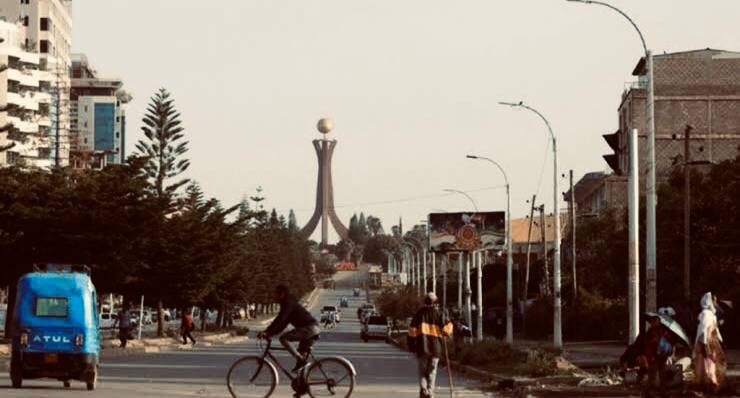
Mekelle is beginning to reconnect. A resident told the BBC on October 4 that mobile phone services appeared to have resumed in parts of the city, as pro-government forces took control of the Tigray capital after TPLF forces withdrew The immediate question is how much of the network has actually returned. But there is another question that may be more important: what happens to a city when communication becomes unreliable while fighting is taking place?
The answer is not simply that people lose the ability to make phone calls. A communications disruption can also make a city harder to see, harder to understand and harder to verify from the outside The latest disruption began as fighting intensified across Tigray. On September 25, Reuters reported that calls to numbers on Ethio Telecom were not connecting, while limited connectivity remained available to some Safaricom customers.
NetBlocks independently confirmed an internet disruption in the region. AFP also reported residents gathering at a telecommunications retailer in Mekelle to purchase and activate SIM cards These reports suggest that Mekelle did not experience one uniform state of disconnection Connectivity depended on both network and location. Some residents could still communicate through Safaricom in certain areas, while others had little or no reliable service.
That distinction is easy to overlook. Public discussion often treats connectivity as binary: a place is either online or offline. In practice, a city can be connected in pockets and still experience the consequences of a wider communications failure a signal available on one street does not necessarily help someone several kilometres away. One functioning network does not replace another if people do not have access to the necessary SIM card, handset or service.
For residents, the consequences can be immediate. Telecommunications are tied to banking mobile transactions, businesses and contact between families. When those networks become unreliable, ordinary activities become more difficult. People may be unable to check on relatives access money, coordinate work or receive information about what is happening nearby. But during conflict, the more consequential problem may be what happens to information itself On October 3, the Associated Press reported that severe disruptions to internet and cellphone networks had made it difficult to gather and verify information from Tigray.
Major developments were therefore taking place in an environment where independent confirmation was already
difficult. This creates a different kind of information problem from simply having too little news Information may still circulate, but the ability to test it becomes weaker A report from one resident can become more difficult to compare with accounts from others A journalist may receive a claim but be unable to make a second call. A family may hear that
something has happened but be unable to establish whether relatives are safe. Humanitarian organisations may have greater difficulty communicating with staff or assessing conditions.
Even when information reaches the outside world, the process of determining whether it is accurate can become slower and more uncertain In that sense, communications infrastructure is also part of the infrastructure of verification This does not mean that every communications disruption produces complete informational darkness. The continued availability of Safaricom in some locations illustrates the opposite.
Safaricom had established an independent 4G network in Tigray before the latest fighting, and some residents were able to use it when Ethio Telecom services became unavailable The resulting situation was therefore a patchwork rather than a total blackout. Some people remained connected. Others actively searched for ways to reconnect, including purchasing new SIM cards. That patchwork matters because it can create very different experiences of the same conflict within the same city.
It also complicates how the disruption should be understood. The question is not simply whether Mekelle had internet or mobile service. The more useful question is who could communicate, through which network, from which location and with what degree of reliability There is a historical reason to take that distinction seriously During the 2020–22 Tigray war, the region experienced a prolonged communications blackout that left millions of people isolated from the outside world and restricted access to information and essential services.
The latest disruption therefore carries a memory that goes beyond the immediate fighting. For people who experienced the earlier blackout, a sudden loss of communications can signal more than a temporary technical problem At the same time, the current episode should not automatically be treated as a return to the conditions of 2020–22. The continued operation of some Safaricom services and the reported restoration of mobile services in parts of Mekelle point to a more fragmented situation. That is why the latest restoration needs to be understood carefully.
The return of a signal is important, but it is not the same as the restoration of reliable communication The BBC report indicates that services appeared to have resumed in parts of Mekelle. It does not establish stable, citywide coverage.
The distinction matters because connectivity is not only about having a way to send a message Reliable connectivity allows people to maintain relationships, conduct economic activity and establish what is happening around them. In a conflict zone, it also allows information to be checked against other information.
Mekelle’s experience therefore illustrates something broader about modern conflict. A city does not have to become completely disconnected to become difficult to see. Partial connectivity can leave some people communicating while others remain isolated, producing an uneven information environment at precisely the moment when reliable information is most important For now, Mekelle appears to be moving from disruption toward reconnection. Whether that becomes genuine restoration will depend not simply on whether a signal has returned, but on whether communication becomes dependable enough for ordinary life and independent verification to resume.