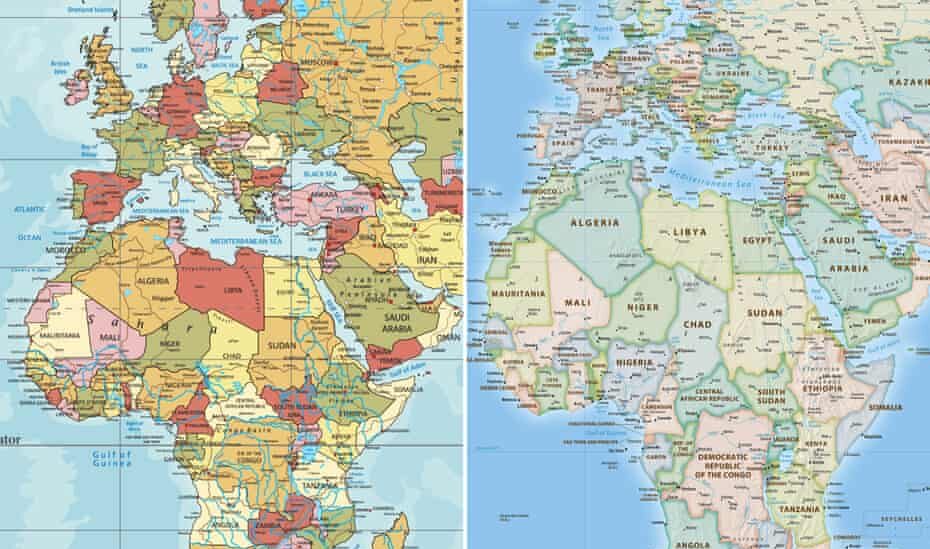
The African Union (AU) has joined growing demands for the abandonment of the Mercator projection, a centuries-old map design that distorts the true scale of the world’s continents. The Mercator map, developed in 1569 for navigation, stretches landmasses closer to the poles while shrinking those near the equator. As a result, Africa, the second largest continent both in population and land area, has long appeared significantly smaller than it actually is.
The issue is not merely cartographic but also psychological and political. On most widely used world maps, Africa looks comparable in size to countries such as the United States or China, while in reality it can contain both nations along with several others. This distortion has contributed to centuries of misperception about Africa’s scale, wealth, and global importance. Critics argue that the continued use of the Mercator projection in classrooms, textbooks, and digital platforms sustains a Eurocentric worldview that underrepresents the Global South.
By joining the call for change, the AU is emphasizing the importance of accurate representation in shaping global consciousness. Maps are not neutral since they frame how societies perceive power, resources, and geography. The AU’s stance highlights the connection between visual imagery and geopolitical influence, suggesting that correcting Africa’s image on the map is part of restoring balance in international narratives.
Several alternatives exist, including the Gall-Peters projection, which presents landmasses in proportion to their true area and offers a more accurate view of Africa’s vastness. Adopting such maps in schools and institutions could gradually correct misconceptions and instill a greater appreciation of the continent’s real scale and potential.
The AU’s intervention reflects a broader movement to reclaim African identity in global knowledge systems. Beyond cartography, it touches on how history is taught, how economics is framed, and how power relations are perceived. Replacing the Mercator projection will not by itself dismantle global inequalities, but it would mark a symbolic step toward affirming Africa’s rightful place in the world.