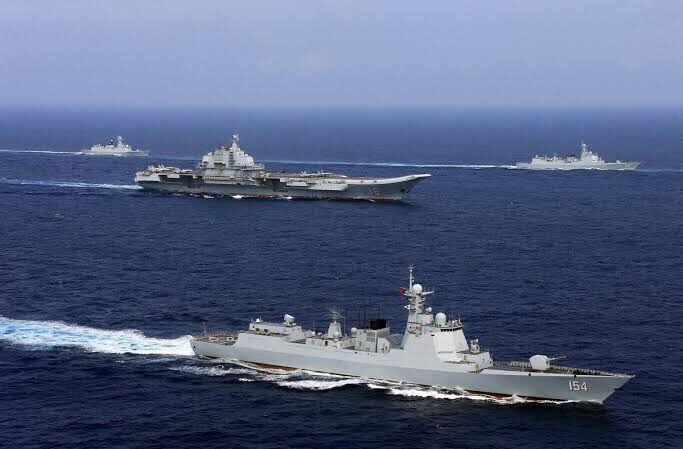
Next week, BRICS-Plus navies are set to run joint drills off South Africa an exercise framed as “maritime safety,” but unfolding in a world where hard power is back in fashion and for the Horn of Africa, the most interesting detail may be this: multiple reports say Addis Ababa is expected to be part of it.
On paper, that might sound minor, But Ethiopia is landlocked, and it has no coastline to patrol But in Red Sea politics, symbols matter,And participation if confirmed like a message: Ethiopia’s maritime ambition is not rhetorical.
It is being placed, deliberately, inside a wider coalition’s security language Let’s start with what we know. South Africa says it will host a China-led multinational naval exercise “Will for Peace 2026” from January 9 to 16 in South African waters.
The official framing is technical: joint maritime safety operations, interoperability drills, and “maritime protection serials,” with a theme focused on protecting shipping and maritime economic activity But the context is not technical.
This is a moment when major powers are testing the edges of the international system in real time whether it’s China’s military pressure campaign around Taiwan, or the US seizure of Venezuela’s leader So when BRICS-Plus moves from summits and communiqués into naval formations, it signals something bigger than training at sea.
What the exercise signals
The most direct signal is that BRICS-Plus is increasingly comfortable borrowing the vocabulary and the theatre of power projection.
Even within South Africa, the exercise has triggered domestic political criticism precisely because it looks like something more than routine cooperation.
And while official statements do not list every participant publicly, multiple outlets report the presence of China and expect Russia and Iran, alongside the host South Africa.
Some reporting goes further naming a broader BRICS-Plus including navies from a long list that includes Ethiopia, alongside countries like Egypt, Saudi Arabia, the UAE, and Indonesia Other reporting treats Ethiopia’s participation as “likely,” rather than confirmed.
That gap matters because it determines whether Ethiopia is being referenced loosely, or whether it is actually being integrated into a security tableau it has been trying to enter for years: the Red Sea arena Historically, the Ethiopian highland state’s relationship to the Red Sea ran through coastal gateways and trading systems for the better part of two millennia.
Ethiopia became only became landlocked after Eritrea’s independence just 30 years ago a shift that is historically recent, and politically consequential And that is why Ethiopian leaders often frame sea access not as expansion, but as restoration: a correction to a modern political outcome, not a permanent geographic destiny.
You can debate how that history should translate into today’s borders but the underlying point is clear: the Red Sea is not “someone else’s problem” in Ethiopia’s national story.
Now place that inside the present.
The Red Sea corridor is saturated with external presence global navies from far and wide, Gulf port deals, foreign military bases, and maritime security arrangements.
So Ethiopia’s strategic argument is straightforward: in a corridor crowded with foreign flags, it is hard to accept a permanent Ethiopian exclusion from maritime security conversations that shape its own trade lifelines.
That is the lens through which a BRICS-Plus naval exercise becomes relevant. It’s not only about ships It’s about recognition-by-inclusion If Ethiopia’s participation is confirmed, it will still be easy for outsiders to dismiss it as symbolic Ethiopia cannot suddenly become a naval power without a coastline.
But symbols are often the early infrastructure of policy A decade ago, BRICS expansion itself was treated as optics Now it is producing new formats new alignments, new exercises, new arenas where membership translates into status.
So Ethiopia joining even at the margins would read as a signal that Addis Ababa is trying to anchor its sea-access agenda inside a “multipolar” security framing: not just a national desire, but a regional stability argument that partners might endorse.
So here is what makes this exercise worth watching:
If Ethiopia is indeed brought into this exercise, even symbolically, it suggests something subtle but significant: that Ethiopia’s Red Sea ambition is being converted from a national grievance into a coalition-recognized strategic claim And then comes the sharper question:
When the drills end and the ships disperse, does Ethiopia’s inclusion translate into anything concrete, or does it remain a moment of optics in a world that is rapidly reorganizing itself around power? Because if this era is moving toward a harder global order, the Horn and the Red Sea will not be spectators They will be the arena.