

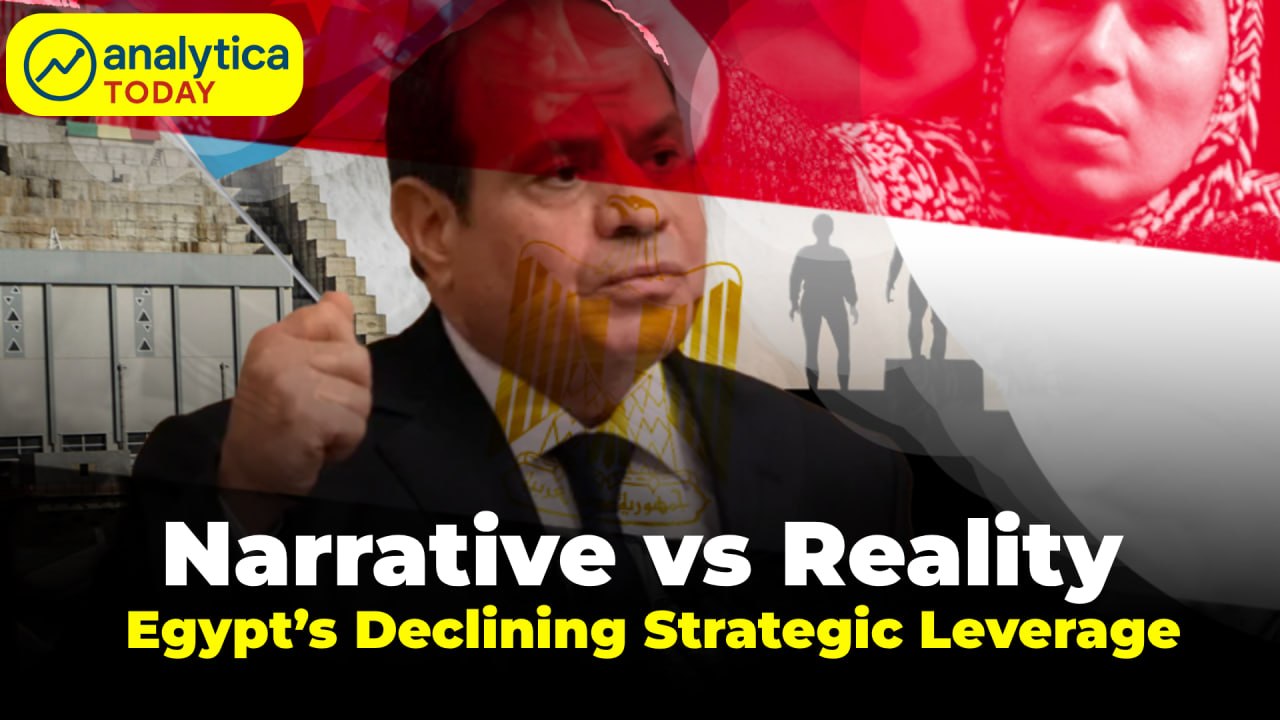
For decades, Egypt has positioned itself as a cornerstone of regional leadership, from the Nile River to the Red Sea corridor. But beneath the rhetoric of influence and historical prestige, a different reality is emerging: one where ambition increasingly outpaces capacity.
Cairo’s claim to regional leadership has long rested on a mix of geography, military size, and diplomatic legacy. Yet in today’s fragmented and competitive geopolitical environment, those foundations are under strain. The question is no longer whether Egypt seeks to lead but whether it still can.
Historically, Egypt’s regional role was anchored in strategic geography and political centrality. Control over the Suez Canal, proximity to the Middle East and Africa, and a large standing military gave Cairo disproportionate weight in regional affairs. Figures like Gamal Abdel Nasser shaped an era where Egypt was not just influential, but ideologically central to Arab and African politics. That legacy continues to inform Cairo’s self-perception. However, legacy is not power. It is a reference point—and increasingly, a constraint.
The regional system Egypt once dominated has transformed. Power is now more diffuse, contested by emerging and assertive actors such as Turkey, United Arab Emirates, Saudi Arabia, and Iran. These states combine financial leverage, expeditionary military capabilities, and flexible diplomacy. They intervene directly in conflicts, broker deals, and shape outcomes. Egypt, by contrast, often operates through cautious positioning rather than decisive engagement. This has created a widening gap between its leadership narrative and its operational footprint. Nowhere is this gap more visible than in the Horn of Africa. Cairo’s strategic focus on the Grand Ethiopian Renaissance Dam has defined its regional engagement with Ethiopia. Framing the issue as existential, Egypt has pursued diplomatic pressure, alliance-building, and internationalization of the dispute. Yet the outcomes have been limited. Addis Ababa has maintained its trajectory, recalibrating its diplomacy while consolidating its position on the ground. Egypt’s inability to translate concern into decisive leverage underscores a broader limitation: influence without enforcement capacity.
In parallel, Cairo’s involvement in Sudan has exposed further constraints. Alignment with specific actors in a fluid conflict has not yielded strategic clarity or control, instead entangling Egypt in a volatile and unpredictable theater.
Egypt maintains one of the largest militaries in the region. But size does not automatically translate into effective power projection. Operational reach, logistical sustainment, and political risk tolerance define modern military influence. In these areas, Egypt shows caution. Its engagements tend to prioritize regime security and border stability over expansive regional intervention. This contrasts with actors willing to deploy force, fund proxies, or absorb higher strategic risk. The result is a perception gap: Egypt appears powerful, but acts selectively.
Economic fragility further constrains Cairo’s ambitions. Structural pressures, debt, currency instability, and reliance on external financing limit the state’s ability to sustain long-term regional initiatives.
Dependence on Gulf financial support, particularly from Saudi Arabia and the United Arab Emirates, introduces another layer of strategic limitation. Leadership becomes conditional when autonomy is reduced. In this context, Egypt’s regional posture is shaped as much by economic necessity as by geopolitical ambition. The central issue is not that Egypt lacks influence. It retains diplomatic weight, military capacity, and geographic advantage. The issue is alignment between what Egypt claims, what it can execute, and how the region perceives both.
Leadership in today’s environment requires agility, resource mobilization, and the ability to shape outcomes across multiple theatres simultaneously. Egypt’s current model, rooted in historical prestige and cautious engagement, struggles to meet these demands.
Egypt’s leadership narrative is not collapsing but it is being tested. In a region defined by competition and rapid realignment, symbolic power is no longer sufficient. Influence must be demonstrated, sustained, and adaptable.
For Cairo, the challenge is clear: recalibrate its strategy to match contemporary realities, or risk watching its leadership claim become a relic of a different geopolitical era.