A new front in the diplomatic battle for stability in the Horn of Africa has opened in the highlands of Tigray. United States Ambassador to Ethiopia Ervin Massinga arrived in Mekelle on July 15 for a high-stakes visit, marking a significant attempt to salvage the faltering Pretoria Agreement, a peace deal now described by one party as “effectively dead”. The ambassador’s arrival comes less than three weeks after a planned trip was postponed amid escalating internal tensions and deep political fractures within the region, tensions that have already prompted Washington to impose visa restrictions on what it calls “hardline members” of the Tigray People’s Liberation Front (TPLF).
The visit unfolds against a backdrop of renewed strain between Mekelle and Addis Ababa, with the TPLF accusing the federal government of failing to implement key provisions of the AU-mediated peace accord and allegedly preparing for renewed conflict. The political divide has further widened over Ethiopia’s National Dialogue process, which the leadership in Tigray has outright rejected, arguing it fails to address the region’s security concerns and unresolved political grievances. As the clock ticks on the Pretoria Agreement’s viability, Ambassador Massinga’s one-day mission seeks to engage humanitarian partners and hold talks on the agreement’s implementation, a task that grows more complex by the hour.
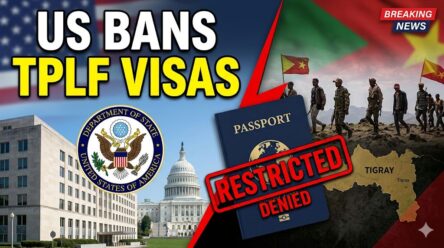
The diplomatic intervention by the United States signals a critical juncture in the post-war trajectory of northern Ethiopia. Ambassador Massinga’s visit to Mekelle is not a routine diplomatic stop it is a direct response to a rapidly deteriorating situation that Washington views as a direct risk to regional stability. The visit was preceded by a stark warning from the U.S. Department of State, which on 18 June announced visa restrictions targeting “hardline members” of the TPLF and their immediate family members. The State Department explicitly cited escalating tensions that threaten to “reignite conflict in northern Ethiopia” a scenario that would have devastating consequences for a region still recovering from a war that claimed hundreds of thousands of lives.
The core of the crisis lies in the contested implementation of the Pretoria Agreement signed in November 2022 to end the two-year civil war. The federal government’s failure to implement key provisions including the restoration of Tigray’s territorial integrity, the return of displaced populations and the establishment of a functioning interim administration has led the TPLF to declare the agreement “effectively dead”. The situation was further complicated by the TPLF’s formal reconstitution of the pre-war Tigray State Council and the election of Debretsion Gebremichael as regional president, a move viewed by Washington as a destabilizing factor that threatens the peace process.
This political fragmentation has crippled the effectiveness of the Interim Regional Administration and created a power vacuum. The U.S. Embassy’s previous statement urging leaders to engage in dialogue and warning that “those who are actively undermining peace processes must urgently cooperate” highlights the international community’s concern that the Pretoria Agreement is being hollowed out, with its core provisions deferred and its framework increasingly weaponized for political gain. Ambassador Massinga’s mission is to apply direct pressure, but the deep-seated grievances and lack of political will in both Mekelle and Addis Ababa represent formidable obstacles to a genuine resolution.
The political impasse is not limited to the implementation of the Pretoria Agreement it has also spilled over into the Ethiopian National Dialogue process, further complicating efforts for a unified national consensus. The TPLF-reinstated regional government has firmly rejected participation in the National Dialogue Commission, which officially kicked off its consultations today. The regional administration dismissed the forum as “isolated and unacceptable,” accusing the federal government of shifting “from implementing the Pretoria Agreement to another round of blockades, drone attacks and the continuation of genocide”. This accusation underscores the deep-seated mistrust between the two sides.
The rejection is a significant blow to the Commission’s efforts to foster an inclusive national conversation. The TPLF argues that the process does not adequately address the region’s security concerns and unresolved grievances, including the presence of non-ENDF forces in contested areas like Western Tigray and the dire humanitarian situation for nearly one million internally displaced people. By refusing to participate, the TPLF is signaling that it does not view the federal government as a legitimate partner for dialogue, insisting instead that a genuine resolution must begin with the full implementation of the Pretoria Agreement.
This stance effectively creates a dual crisis one of political legitimacy and another of humanitarian urgency. The international community, led by the U.S is caught in a difficult position. It must balance its commitment to the Pretoria Agreement and its desire to prevent a return to conflict with the reality that its key tools diplomatic engagement and targeted sanctions have so far failed to bridge the divide. Ambassador Massinga’s visit is a final attempt to pull the two sides back from the brink but with the TPLF accusing the federal government of preparing for renewed war and Addis Ababa pushing forward with a dialogue process that Tigray rejects the window for a peaceful resolution is closing.
The clock is now measured in months, if not weeks before the fragile peace in northern Ethiopia potentially unravels. The United States’ renewed diplomatic push, embodied by Ambassador Massinga’s visit to Mekelle, makes clear that the outcome of this crisis will be judged by the actions of leaders who must choose between political negotiation and a return to devastating conflict.
The unity and future of the Ethiopian state hinge on whether the parties can distinguish between political rivalry and a path toward sustainable peace, rooted in the justice and implementation that the Pretoria Agreement promised but has yet to deliver.