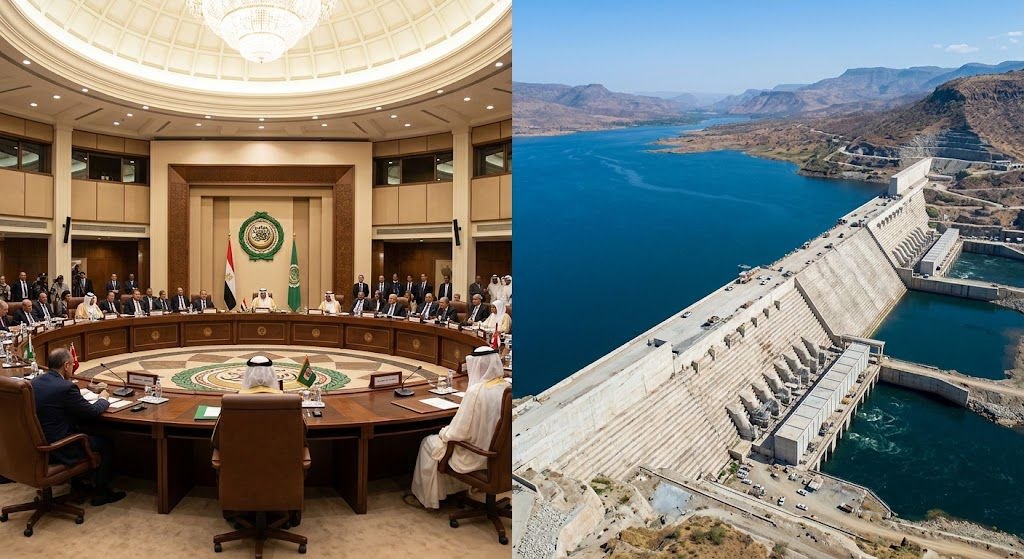
In the endless Middle East news cycles, there has been extensive coverage of Gaza, Israel, Hamas, Lebanon, Syria, Qatar, Turkey, Saudi Arabia, the United Arab Emirates, and the Houthis, but surprisingly little about Egypt. In some ways, it is curious: Egypt remains the most populous Arab nation, boasts the region’s largest military, and has historically served as the political beating heart of the Arab League. In other ways, Egypt’s practical invisibility in recent years makes sense. Power in the Middle East has shifted decisively eastward moving away from Cairo, Damascus, and Baghdad toward financial heavyweights in Riyadh, Abu Dhabi, and Doha. Farther south, in the Horn of Africa, an even more fundamental realignment is taking place as Ethiopia consolidates its status as the region’s dominant power.
For decades, Cairo commanded the Arab political consensus. When Egypt spoke, it wielded the institutional weight of the Arab League to turn national disputes into collective Pan-Arab causes. That dynamic has largely eroded. Today, Gulf monarchies drive regional diplomacy, backing their ambitions with massive financial capital that Cairo desperately requires to stabilize its own faltering economy. As a result, Cairo’s leverage within the Arab League has waned. Rather than setting the agenda, President Abdel Fattah al-Sisi’s government often finds itself reacting to moves made by former junior partners. In regional hotspots from Gaza to Sudan, Gulf states now act as the primary power brokers, leaving Egypt to maneuver in their wake—forced to balance domestic stability against the economic demands of its wealthy regional allies.
Nowhere is Egypt’s strategic retreat more evident than in the Horn of Africa. Historically, Cairo treated the Nile River Basin as its exclusive sphere of influence, leveraging diplomatic clout to limit upstream developments. However, the rise of Ethiopia has upended this long-standing geopolitical balance Through the construction and operation of the Grand Ethiopian Renaissance Dam (GERD), Addis Ababa has reshaped the hydro-politics of East Africa. Despite Cairo’s efforts to frame the dam as an existential security threat and rally Arab League support against it, Ethiopia successfully pushed forward, declaring that upstream development cannot be vetoed by legacy agreements. By establishing energy dominance, demographic weight, and central economic authority in East Africa, Ethiopia has effectively established itself as the indispensable regional hegemon.
Cairo’s attempts to counter Ethiopia’s growing dominance ranging from military pacts with neighboring Horn nations to diplomatic rhetoric have frequently failed to yield structural concessions. Instead, these maneuvers highlight how limited Egypt’s unilateral options have become against a self-reliant Addis Ababa.
Does this decline in visible influence mean Egyptian diplomacy is inherently clumsy? Not necessarily. Sisi’s administration is operating within severe structural constraints. Economic Vulnerability: Deep financial crises have made Egypt dependent on multi-billion-dollar investments and bailouts from Gulf partners, limiting Cairo’s ability to cross those nations on core foreign policy files. Border Volatility: Egypt is surrounded by active crises ranging from the war in Gaza on its northeastern border to state collapse in Sudan to its south and instability in Libya to its west. Resource Constraints: Maintaining security while managing domestic economic pressure leaves little room for expansive foreign interventions.
Viewed through this lens, Egypt’s low-profile diplomacy looks less like clumsiness and more like an attempt at survival. Cairo is forced into ungainly diplomatic postures because it must satisfy competing demands: maintaining a historic security role, keeping Gulf funding flowing, and preventing surrounding fires from spilling over its borders. Egypt may no longer hold the gavel in the Arab League or dictate terms in the Horn of Africa, but its quiet maneuvering reflects a pragmatic response to a changing neighborhood where power has migrated elsewhere.
Egypt’s Shrinking Footprint in the Arab World and Horn of Africa