

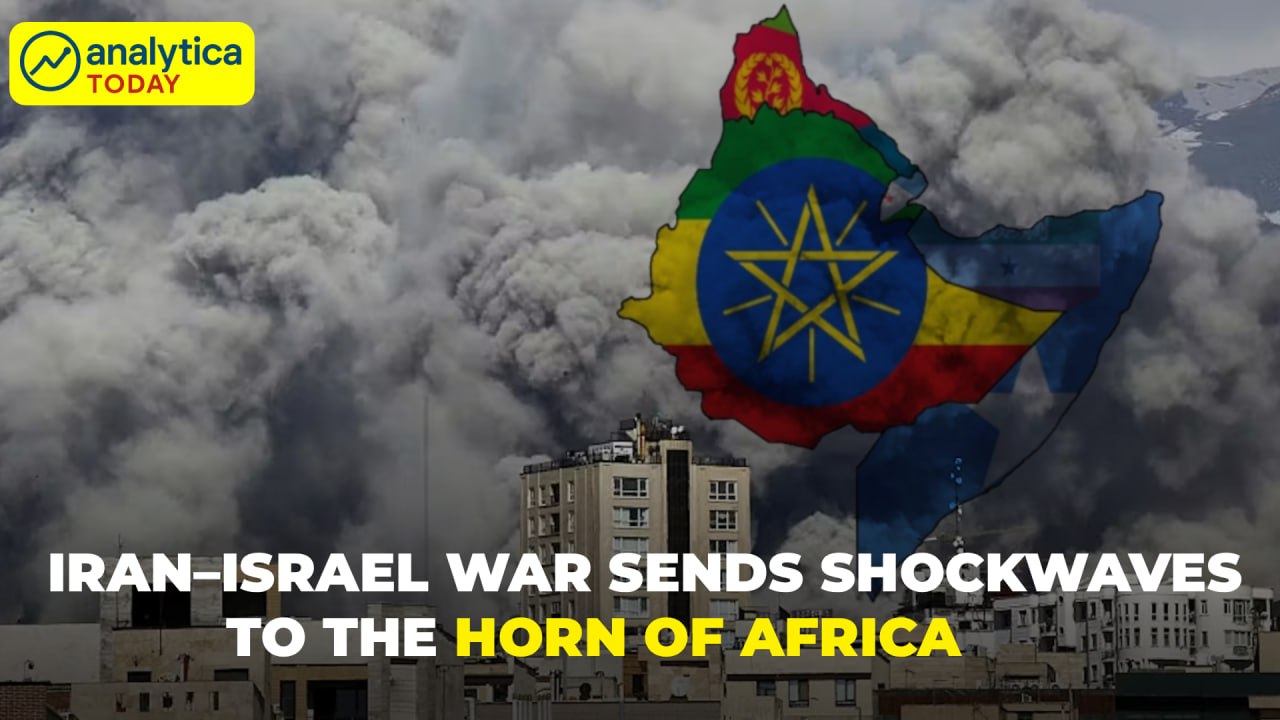
A rapidly intensifying conflict between Iran and Israel, compounded by the involvement of the United States and Gulf states, is reshaping security fault lines far beyond the Middle East and into the Horn of Africa. What began as targeted strikes and counterstrikes in the Persian Gulf and Red Sea has unfolded into a broader geopolitical crisis with tangible impacts on security, military alignments, maritime commerce, and regional balances of power along Africa’s eastern flank.
The Horn’s strategic geography anchoring the Bab al-Mandeb Strait and gateway to the Red Sea has positioned it at the centre of this turbulent reordering, directly linking regional disputes to global conflict dynamics.
The Iran–Israel war has elevated the security threat emanating from Yemen’s Houthi movement into a regional flashpoint that directly affects Horn of Africa littoral states. Although the Houthis have not yet launched direct retaliatory attacks under Iran’s broader campaign against Israel and its Gulf partners, analysts warn that they could target foreign military positions in the Horn, including Emirati, Israeli, or U.S. assets, as part of a coordinated regional escalation. This stems from Iranian outreach to allied proxies and the strategic imperative to leverage Red Sea routes in response to strikes in the Gulf.
Military infrastructure built by Gulf states in the Horn particularly in Berbera Port underscores the Horn’s rising profile in what is effectively a widening theatre of conflict. The UAE’s modernized facilities in Berbera and discussions over Israeli basing rights there have drawn explicit warnings from Houthi leadership, asserting that any Israeli military presence in Somaliland would be a legitimate target.
Alongside Berbera, the U.S. base at Camp Lemonnier in Djibouti critical for counterterrorism and maritime security efforts lies less than 100 miles from Yemen. Although Djibouti’s non-confrontational stance and support for Palestinian causes may have reduced immediate targeting incentives, the density of foreign military bases around the Horn increases the risk of incidental escalation, miscalculation, or collateral engagement as the broader conflict evolves.
Proxy Linkages and Militant Cooperation:
Beyond state actors, expanding operational links between Yemen’s Houthis and al Shabaab in Somalia present a compounded security threat that could anchor destabilization on both sides of the Gulf of Aden. Prior assessments flagged how this collaboration has already heightened risks to maritime traffic, with increased piracy incidents and expanded disruptive capacities for both groups. These factors mean that broader Middle Eastern confrontations can propagate through Herman inter-group networks to affect inland and littoral security in East Africa.
The potential for militant cooperation to exploit maritime insecurity has direct implications for Somalia’s sovereignty and economic interests, with piracy and attacks on commercial shipping threatening to further marginalize maritime trade corridors that are critical to regional economies.
Economic Shocks and Supply Chain Realignment
Shipping disruptions stemming from Red Sea insecurity have global ripple effects that also touch Horn economies dependent on overseas trade. With major routes being rerouted around Africa’s Cape of Good Hope — a shift already underway given heightened risks through the Red Sea and Bab al-Mandeb — freight costs and transit times have surged. These disruptions are not abstract; they translate into real costs for import-dependent nations in East Africa, where delays and elevated insurance premiums strain already fragile trade networks and consumer markets.
Suez Canal avoidance further burdens Djibouti, Ethiopia, Somalia, and Sudan, all of which are integrated into Red Sea maritime networks that underpin commerce and logistics. These shifts could undermine investment flows and depress economic growth projections in countries already grappling with internal instability and climate-induced shocks.
Shifting Alliances: Regional Bargains and Strategic Deals
Geopolitical alignments in the Horn are in flux as Gulf states recalibrate their engagement strategies in light of the Iran–Israel conflict. Saudi Arabia’s recent defense pact with Somalia illustrates the Kingdom’s intent to mature its security footprint in the region, partly as a counterweight to Iranian influence and partly to secure Red Sea shipping lanes vital to global commerce. This cooperation represents a strategic hedge, binding Somali security interests to broader Gulf security architectures and reflecting a recalibration of Gulf–Horn strategic linkages.
At the same time, the controversial recognition by Israel of Somaliland’s independence has injected a new layer of political tension in the Horn. While proponents argue this expands strategic depth and early warning capacity against Houthi threats, it also fuels contestation around Somalia’s territorial integrity and highlights how Middle Eastern actors are leveraging Horn disputes to consolidate influence.
Coupled with competitive rivalries between Saudi Arabia and the UAE — which have crystallized rival visions of Red Sea security and economic integration — these developments indicate a fragmentation of regional approaches to Horn security. The prioritization of counter-Iran strategies versus intra-Gulf competition may ultimately shape how effectively external actors can contribute to or undermine stability in East Africa.
Potential for Escalation in Internal Conflicts
Outside direct maritime and military flashpoints, the Iran–Israel war may also affect internal conflicts within the Horn. Analysts note that tensions linked to Red Sea competition could impact civil wars and insurgencies in Sudan and northern Ethiopia, either accelerating hostilities or providing openings for diplomatic resolution depending on how external actors prioritize their engagements.
For instance, the Sudanese civil war, which already has been exacerbated by foreign competition for influence, could attract deeper involvement from Gulf states seeking to secure favourable alignments in a broader anti-Iran security posture. Similarly, northern Ethiopia’s complex conflict dynamics might absorb ancillary pressures as Red Sea security imperatives shift investment, diplomatic energy, and arms flows.
Conclusion: The Horn at a Strategic Inflection Point
The spillover of the Iran–Israel war into the Horn of Africa underscores the region’s growing strategic salience and vulnerability to external geopolitical shocks. Security threats range from direct military targeting and proxy militant cooperation to economic dislocation through disrupted maritime trade. At the same time, shifting alliances and competition for influence among Gulf and regional powers are reshaping political calculations in East Africa. How Horn states navigate this inflection point will define regional stability and security trajectories in the coming years.