

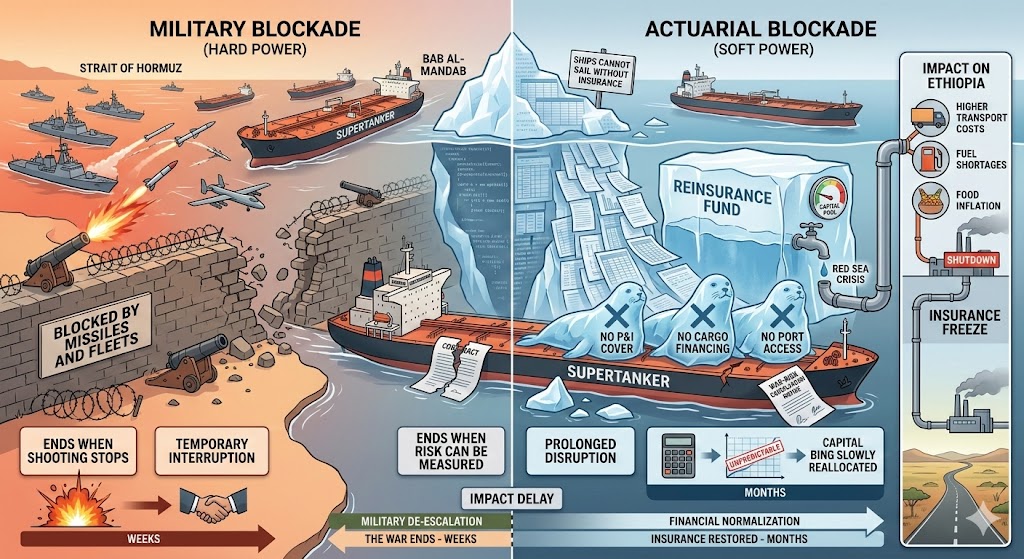
Before Hormuz, there was the Red Sea.
For nearly two years, attacks around the Bab al-Mandab forced vessels to reroute around Africa. Insurance premiums surged. Transit volumes dropped. War-risk capacity was slowly drained from the system. Countries like Ethiopia felt that shock directly. Landlocked and heavily dependent on trade through Djibouti, Ethiopia watched freight rates jump. Insurance costs climbed. Delivery times stretched. Fuel became more expensive. Cooking oil, fertilizer, spare parts … everything cost more by the time it reached Addis Ababa.
That was from disruption. Now imagine shutdown. Most people think this crisis is about missiles, naval fleets, and how long the fighting will last. A few weeks of escalation, then things calm down. Oil spikes, then stabilizes. That’s the familiar script.
But the Strait of Hormuz did not close because of warships. It closed because insurance companies stepped away. Within 24 hours, tanker traffic through Hormuz collapsed. Not because the channel was mined. Not because a navy blockaded it. But because major maritime insurers covering roughly 90% of global commercial shipping issued cancellation notices for war-risk coverage.
When insurance disappears, ships don’t sail. No insurance means no port access. No cargo financing. No charter contracts. A supertanker instantly becomes commercially unusable. And just like that, the world’s most important energy chokepoint moving about one-fifth of global oil supply freezes.
This is not a military blockade. It is an actuarial one. A military blockade ends when the shooting stops. An insurance blockade ends when insurers decide the risk can be measured again. Those timelines are not the same.The global maritime insurance system is highly concentrated. A small group of Protection and Indemnity (P&I) clubs insure most of the world’s ships. Behind them sit a handful of reinsurers, many connected to Lloyd’s of London. Here’s the structural problem: war risk is not widely spread across global capital markets like hurricane or earthquake risk. There is no massive shock absorber. When risk becomes too unpredictable, insurers don’t simply raise prices, they withdraw.
And they withdrew in seventy-two hours. Why so fast? Because the system was already weakened. The Red Sea crisis had been draining capital for months. Premiums surged. Claims accumulated. Fewer ships meant fewer premiums flowing into the pool. Hormuz didn’t hit a strong market. It hit a tired one. Now the consequences are bigger. Hormuz carries roughly one-fifth of global oil consumption. If disruption there lasts longer than expected, global fuel prices rise further. For import-dependent economies like Ethiopia, that means higher transport costs, higher food prices, and greater pressure on foreign-exchange reserves.
The market assumption is simple: once the bombs stop, oil flows again. But insurers do not operate on political timelines. They operate on risk models. To restore coverage, reinsurers must reassess probabilities of missile strikes, drone attacks, escalation scenarios. They must renegotiate treaties and reallocate capital. That process takes months ,sometimes longer.
Look at the Red Sea. Even after attacks slowed, insurance premiums stayed elevated. Risk perception lingers long after headlines fade. Insurance markets move slower than armies. This crisis is not just about geopolitics. It is about trust. Insurers are not saying every tanker will be attacked. They are saying they cannot confidently calculate the probability. When risk cannot be measured, it cannot be priced. When it cannot be priced, ships stay in port.
For Ethiopia, that gap between military de-escalation and financial normalization matters. A prolonged insurance freeze tightens currency shortages, increases import bills, and fuels inflation far from the battlefield. The war may last weeks. The insurance freeze could last far longer. And until underwriters, not admirals decide the Strait is insurable again, the disruption remains. This is not only a military crisis.It is a capital crisis. And capital, once shaken, takes much longer to return.