

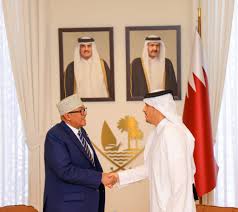
A single trip to Qatar.
A quiet nod from the U.S. Congress.
And a game-changing deal with Ethiopia. Somaliland’s long-shot diplomatic campaign is suddenly gaining traction but in a region where foreign agendas dominate, new opportunities may come with hidden costs.
A Historic Visit Meets Familiar Resistance
Last week, Somaliland President Abdirahman Mohamed Irro made headlines with a landmark visit to Doha the first by any Somaliland leader to Qatar. For a self-declared republic seeking international recognition, this was no small gesture. For a moment, it looked like a diplomatic breakthrough.
But within hours, Qatar’s Foreign Ministry issued a familiar statement: full support for “the sovereignty and territorial integrity of Somalia.” Somaliland’s aspirations were once again brushed aside.
Yet the visit wasn’t meaningless. The mere fact that Doha hosted Irro despite its traditional alignment with Mogadishu suggests that even Qatar sees value in engaging with Hargeisa. Whether symbolic or strategic, the optics were clear: Somaliland is being noticed.
A State Without Recognition, but With Rising Relevance
Since declaring independence in 1991, Somaliland has functioned as a de facto state complete with its own currency, democratic institutions, and relative peace in a volatile region. But it remains unrecognized by the international community.
Somaliland’s leaders argue their case through history. Once a British protectorate, it voluntarily united with Italian Somalia in 1960 only to be bombed and brutalized under Siad Barre’s regime. Its withdrawal from that union, Somaliland says, is both legal and legitimate.
For decades, that argument fell on deaf ears. But the regional context is changing fast.
From the war in Gaza to Houthi threats in the Red Sea, the Horn of Africa has become a critical frontier. Foreign powers are no longer indifferent to Somaliland’s strategic geography. They’re circling—with investment, diplomacy, and influence campaigns.
Qatar, the UAE, Turkey, Egypt, the U.S., and Ethiopia are all vying for access. But not all want Somaliland to succeed.
Qatar’s Double Game and the Red Sea Chessboard
Qatar’s engagement with Somaliland is a sharp turn. Doha has historically supported Somalia’s federal government and its Turkish-aligned policies. Hosting Irro risks upsetting this alignment but may also reflect a recalibration of priorities.
Qatar, after all, gained its own independence in 1971 rejecting political union with Bahrain and the UAE. Yet it now opposes a similar breakaway movement in Somaliland. Critics have called out the contradiction. One Somali official quipped: “If Qatar won’t share its gas with Egypt, why does it expect Somaliland to share its future with Mogadishu?”
The visit highlights a deeper issue: Gulf states and global powers are treating Somalia not as a sovereign space but as a chessboard. And Qatar isn’t playing alone.
The Horn’s New Cold War: Who’s Pulling the Strings?
Somalia and Somaliland are no longer just local actors they’re pieces in a much larger contest.
- Turkey backs Mogadishu militarily and economically.
- The UAE invests heavily in Berbera Port, building up Somaliland as a commercial hub.
- Egypt uses Somalia as leverage in its Nile disputes with Ethiopia.
- The U.S. flirts with recognizing Somaliland Congress is now debating a bill to do just that.
- Ethiopia seeks an escape from landlocked isolation and has inked a naval deal with Somaliland.
But here’s the core issue: the powers shaping Somali politics are mostly not African. Their interventions—whether commercial, diplomatic, or military are fueling mistrust, widening divisions, and turning internal disputes into regional crises.
Instead of mediating between Hargeisa and Mogadishu, foreign actors are deepening the splitting local politics to Red Sea chokepoints, Gulf rivalries, and anti-Iran strategies.
Recognition, Reality, and the Cost of Geopolitical Games
Somaliland’s quest for recognition is legitimate. So is Somalia’s desire to preserve its unity. But both are increasingly sidelined by foreign agendas.
This is no longer just a matter of statehood. It’s about agency.
If African states and institutions don’t reclaim ownership over Somali diplomacy, others will continue dictating the terms. In that future, the Horn of Africa won’t just be influenced by foreign powers—it will be shaped by them.
The Road Ahead: Opportunity or Orchestration?
Somaliland has momentum—from Doha to Washington to Addis Ababa. But whether this moment leads to recognition or renewed gridlock depends not just on diplomacy—but on whose interests prevail.
Is this the beginning of Somaliland’s formal statehood? Or another chapter in the region’s long history of external manipulation?
One thing is clear: the fate of Somalia and Somaliland shouldn’t be written in foreign capitals.
It should be decided in Mogadishu, in Hargeisa and across the Horn.