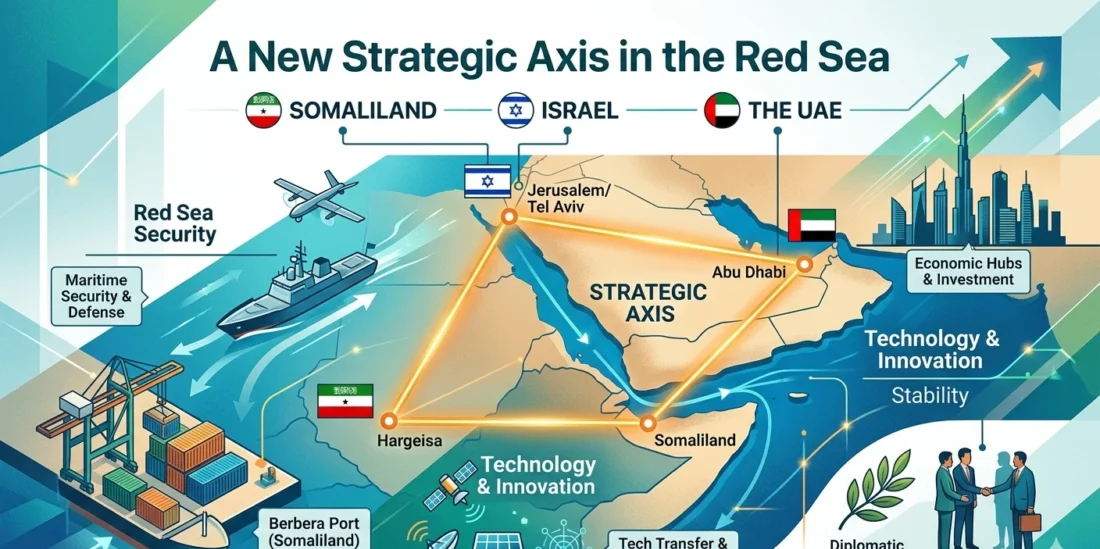
Forget ceremonial summits, signed declarations, and polished photo ops. Diplomatic communiqués are easy to generate, but the real power alignment in the Horn of Africa and the Gulf of Aden operates silently on the ground. When you strip away the political theatre and examine pure economics and security, a distinct operational reality emerges: the Ethiopia–Israel–UAE network, centering Somaliland or we can call it the Berbera Axis.
This alignment does not exist on a piece of paper. It exists in deep-water berths, fiber-optic lines, radar coverage, cargo throughput, and physical transport corridors. While traditional regional alliances rely on public pacts, the Berbera Axis functions through hard, transactional synergy. It brings together four entities with complementary assets: Emirati capital, Israeli technology and intelligence, Ethiopian market scale, and Somaliland’s geographic coastline.
At its core, this axis operates as an integrated commercial ecosystem designed to dominate trade around the southern gate of the Red Sea. Rather than relying on state subsidies or vague economic agreements, each player brings a non-negotiable economic variable to the table:
The UAE (Capital & Infrastructure): Abu Dhabi acts as the financial and logistical architect. Through DP World and sovereign investment funds, the UAE transformed the Port of Berbera into a modern, deep-water container terminal capable of handling global cargo. By funding the surrounding Berbera Special Economic Zone and connecting transport arteries, the UAE secures its position as the premier maritime operator along the Gulf of Aden.
Ethiopia (The Essential Market): A landlocked economic titan of over 120 million people, Ethiopia provides the critical mass of volume required to make the entire corridor viable. For Addis Ababa, Berbera offers a vital diversification route away from near-total reliance on Djibouti. Secure, cost-effective access to the sea feeds Ethiopia’s agricultural exports and industrial imports, turning Berbera into a primary national trade engine.
Somaliland (The Strategic Gateway): Positioned along 850 kilometers of Gulf of Aden coastline, Somaliland monetizes its geography. By leasing port infrastructure, offering trade concessions, and building transport corridors, Somaliland converts its land into foreign direct investment, transit revenue, and long-term economic integration with regional powerhouses.
Israel (Technology & Agritech Integration): Israel’s economic contribution sits at the top of the value chain. Israeli firms provide advanced cybersecurity systems for port management, logistics software, dual-use infrastructure technology, desert agriculture solutions, and water desalination tech essential for sustaining dry coastal trade hubs Beyond commerce, the primary driver of this alignment is hard security along the Bab el-Mandeb strait one of the world’s most vulnerable maritime chokepoints. Rather than issuing joint defense statements, the Berbera Axis maintains security through coordinated operational capabilities:
Maritime Domain Awareness (MDA): For Israel, maintaining strategic visibility over the Red Sea and Gulf of Aden is a critical security imperative, particularly regarding anti-ship threats, drone proliferation, and hostile non-state actors along the coast. Somaliland’s geography provides the ideal physical platform for signals intelligence (SIGINT), coastal radar installations, and maritime surveillance directly overlooking maritime traffic.
Hard Defense & Tactical Integration: Israel provides elite counter-terrorism training, electronic warfare systems, counter-drone tech, and perimeter defense capabilities. Combined with UAE logistics and funding, this technology creates a hardened security bubble around the Berbera corridor and its critical supply routes.
Corridor & Coastline Defense: Ethiopia provides the landward muscle required to protect cargo movement from the interior to the coast, while Somaliland’s coast guard and internal security forces benefit from advanced equipment, intelligence sharing, and tactical instruction.
Action Over Rhetoric: Why the Berbera Axis Works
What makes this network remarkably effective is that it operates entirely through geographical convergence rather than ideological posturing:
Transactional Realism: Every member pursues distinct, self-interested goals. The UAE secures trade dominance; Ethiopia guarantees maritime access; Israel secures maritime lines of communication; Somaliland gains economic survival and regional leverage.
Plausible Deniability & Operational Flexibility: Without a formal binding treaty, each actor retains total diplomatic maneuvering space. They do not need to defend each other in public forums; they simply need to keep the trade corridors open and the sea lanes secure.
Physical Assets on the Ground: Joint statements can be torn up, but asphalt roads, container cranes, radar towers, and deep-water ports remain. The alignment exists because the infrastructure is physically built In pure economic and security terms, the Berbera Axis is an unwritten reality: a functional machine where capital, technology, volume, and geography meet at the edge of the Red Sea.