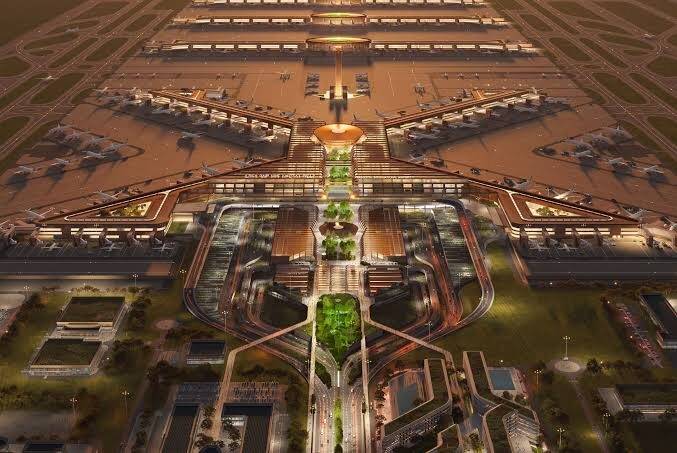
Every great aviation story begins with a runway that has run out of room. For Ethiopian Airlines, that runway is Bole International. The airport that carried the national carrier to continental dominance was built for a smaller era and can handle roughly 25 million passengers a year, a ceiling it is already pressing against. With further structural expansions at Bole no longer viable, Addis Ababa’s answer is not to temper its growth, but to build something unprecedented.
Construction of Bishoftu International Airport began on January 10, 2026, roughly 40 kilometers southeast of the capital. Carrying an estimated price tag of $12.5 billion, Prime Minister Abiy Ahmed has called it the largest aviation infrastructure project in Africa’s history. Ethiopian officials speak of it less as an airport than as a statement of intent: that the continent’s primary mega-hub can be designed, owned, and operated from within Africa.
That ambition carries weight because of who is driving it. Ethiopian Airlines was once again named Africa’s Best Airline at the 2026 Skytrax World Airline Awards, outpacing regional peers like EgyptAir, Air Mauritius, Royal Air Maroc, and RwandAir. Its commercial expansion continues unabated evidenced by the December 11 launch of daily Boeing 737 MAX service to Durban, restoring the route nine years after its suspension. In Ethiopia’s telling, an airline that has grown to this scale largely on its own operational revenues has earned the right to plan a hub of this magnitude.
Yet projects of this scale naturally invite scrutiny, and Bishoftu is no exception. Group CEO Mesfin Tasew confirmed that the project requires approximately $9 billion in syndicated financing for its initial phase, with lenders currently conducting feasibility work alongside preliminary expressions of interest. Concurrently, the selection timeline for primary contractors was pushed from August 2026 to early January 2027 to give international consortia adequate time to finalize complex engineering and financial packages.
Where critics might see delay, Ethiopian officials read thoroughness. Bidders requesting more time is a natural byproduct of a project this intricate. Lenders are actively structuring financial models, and the airline has been transparent about ring-fencing the project’s risk. A $12.5 billion hub is not financed overnight, and sequencing financial closure before final contractor awards reflects standard capital discipline.
What makes Bishoftu’s financing narrative compelling is the geopolitical interest surrounding it. Washington has actively explored diplomatic and commercial avenues to participate linking infrastructure involvement to Boeing fleet expansions even as a major Chinese institution pledged $500 million in preliminary support. While external observers depict the airport as a new arena of U.S.–China rivalry, Ethiopian commentators see strategic leverage. A state courted by competing global powers is a state with choices. Addis Ababa has long maintained that it will partner with any entity willing to align with its development terms; Bishoftu is the ultimate test of that non-aligned pragmatic diplomacy.
The human and spatial footprint is equally significant. Securing the 35-square-kilometer greenfield site required relocating roughly 2,500 farming households. Backed by a $350 million resettlement budget, the airline confirmed that replacement housing, livelihood support programs, and local job placements were finalized and handed over early this year. For the state, executing this transition humanely forms a key part of its case that mega-infrastructure can uplift surrounding communities rather than displace them.
Architecturally, Bishoftu is not conceived as a generic functional terminal. Designed in partnership with Zaha Hadid Architects, the master plan is explicitly landmark architecture. Beyond aesthetics, the facility is engineered for multi-decadal expansion: an initial phase targeting 60 million passengers annually, scaling long-term to four parallel runways and over 110 million passengers dwarfing any hub currently on the continent.
Furthermore, Ethiopian Airlines operates as a global cargo powerhouse, and Bishoftu’s design reflects that dual mandate. A state-of-the-art logistics hub means rapid processing of perishables, pharmaceuticals, and high-value manufactures a critical catalyst for Ethiopia’s industrial parks and export diversification goals. It also bolsters the broader initiative to open African airspace under the Single African Air Transport Market (SAATM), proving that intra-African connectivity is commercially lucrative.
If Bishoftu delivers on its timeline aiming for operational readiness around 2029 to 2030 the economic dividends will reverberate across the continent. It promises more direct intra-African routes, reduced dependency on Middle Eastern and European transit hubs, and a sovereign anchor for trade and tourism. For a continent that has historically paid a premium to route its people and cargo through foreign hubs, Bishoftu represents a shift in geography. Ethiopia intends to be the center through which the rest of the world connects.