

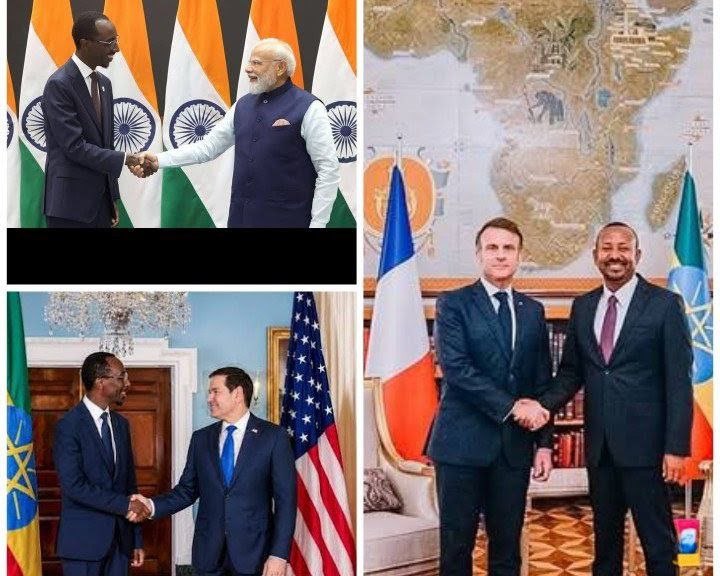
In the complex arena of 21st-century geopolitics, Ethiopia has emerged as a master of strategic balancing. Under Prime Minister Abiy Ahmed’s leadership, the country pursues an “Ethiopia First” foreign policy that prioritizes national development, sovereignty, and economic interests above ideological alignments. This approach is vividly illustrated by high-level diplomatic activities in mid-May 2026, showcasing Ethiopia’s ability to engage multiple power centers simultaneously without compromising its core objectives.
The week’s itinerary highlights this dynamic perfectly. Prime Minister Abiy Ahmed attended the Africa Forward Summit in Nairobi, Kenya, focusing on green industrialization, energy transition, and economic transformation for the continent. He returned to Addis Ababa and promptly welcomed French President Emmanuel Macron on May 13 for the latter’s third official visit to Ethiopia. The two leaders discussed strengthening bilateral ties, with concrete outcomes including a €54.6 million French loan for green energy and digital projects, plus a roadmap for geothermal partnership. Macron’s visit, part of a broader East Africa tour, also touched on regional stability and Ethiopia’s pursuit of secure sea access through dialogue.
Meanwhile, Ethiopian President Taye Atske Selassie traveled to Uganda to attend President Yoweri Museveni’s presidential inauguration ceremony, reinforcing strong ties with a key East African neighbor and underscoring Ethiopia’s commitment to regional solidarity within the Horn of Africa and the African Union framework.
Adding to this whirlwind of activity, Foreign Minister Gedion Timothewos Hessebon wrapped up engagements in the United States including meetings with U.S. Secretary of State Marco Rubio and a think-tank appearance at the Hudson Institute before flying directly to New Delhi for the BRICS Foreign Ministers’ Meeting (May 14-15). It was a very tight turnaround classic high-level diplomatic scheduling. This reflects Ethiopia’s active balancing of relations with both Western partners (like the U.S.) and the BRICS bloc.
This multi-vector diplomacy is not accidental but rooted in a clear “Ethiopia First” doctrine. Since Abiy took office in 2018, Ethiopia has emphasized economic diplomacy, regional stability, and strategic autonomy. The country leverages partnerships across the spectrum: infrastructure and investment from China and other BRICS members, development finance and security cooperation with Western institutions like the IMF, World Bank, EU, and U.S., and bilateral ties with European powers like France.
Ethiopia’s full membership in BRICS (alongside Egypt, Iran, UAE, and others) provides a platform to advocate for multipolar governance reform, greater use of local currencies in trade, and a stronger voice for the Global South. At the same time, engagement with Washington and Paris ensures access to technology, markets, and conflict-resolution support. This hedging strategy allows Addis Ababa to diversify risks in a fragmented world order while advancing domestic priorities such as poverty reduction, industrialization, and post-conflict reconstruction.
Critics sometimes portray this as opportunistic, but it reflects pragmatic realism. Ethiopia, with its large population, strategic location, and ambitious development goals (including Grand Ethiopian Renaissance Dam-related energy exports), cannot afford zero-sum alignments. By maintaining open channels from Nairobi to Paris, Washington to New Delhi, and Kampala to BRICS forums Ethiopia maximizes leverage for its national interests.
Recent engagements also highlight continuity in regional focus. The Kenya summit and Uganda inauguration reinforce Ethiopia’s role as a pillar of East African stability and integration. France’s renewed interest, evidenced by energy deals and support for peaceful Red Sea access, complements Ethiopia’s outreach to traditional Western partners even as it deepens BRICS ties.
Looking ahead, this balancing act will face tests. Geopolitical tensions from Middle East conflicts influencing BRICS discussions to great-power competition demand careful navigation. Yet Ethiopia’s track record suggests resilience. Abiy’s government has consistently framed foreign policy around tangible benefits: investment inflows, technology transfer, debt sustainability, and diplomatic support on issues like Nile water rights or counter-terrorism.
In essence, Ethiopia’s diplomacy embodies “principled pragmatism.” It engages the West without subservience, partners with BRICS without exclusivity, and strengthens African ties as a foundation. This “Ethiopia First” lens ensures that every bilateral meeting, multilateral summit, or cross-continental flight serves the ultimate goal: building a prosperous, secure, and influential Ethiopia capable of thriving in a multipolar era.
As global power shifts accelerate, countries like Ethiopia demonstrate that strategic autonomy need not mean isolation. Instead, through agile scheduling and clear priorities, they turn complexity into opportunity. The coming months, including further BRICS activities under India’s chair, will likely offer more evidence of this sophisticated approach in action.
In a world increasingly divided by geopolitical rivalry, Ethiopia is pursuing a different path, one rooted in flexibility, strategic autonomy, and national interest. Rather than locking itself into any single bloc, Addis Ababa is building relationships across competing power centers while keeping its focus firmly on development, stability, and sovereignty.
The flurry of diplomatic activity in May 2026 was more than symbolic. It demonstrated how Ethiopia intends to navigate a multipolar world: engaging the West without dependency, deepening BRICS ties without isolation, and strengthening African partnerships as the foundation of its regional influence.
For Ethiopia, diplomacy is no longer just about political alignment, it is about securing investment, energy, technology, markets, and strategic leverage. And in an era where global competition is intensifying, Ethiopia’s “Ethiopia First” approach may prove to be not only pragmatic, but necessary for its long-term ambitions.