

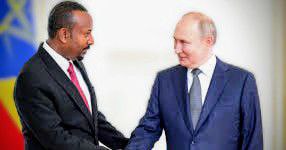
Ethiopia’s Minister of Foreign Affairs, Gedion Timothewos, arrived in Moscow on October 20, 2025, marking a significant step in the deepening partnership between Addis Ababa and the Russian Federation.
The visit follows closely after the signing of a nuclear cooperation action plan, reflecting Ethiopia’s broader pursuit of economic reform, energy diversification, and strategic autonomy.
The discussions, focusing on trade expansion and nuclear technology transfer, represent a multipronged agenda aimed at consolidating bilateral relations built over decades.
Historical Context of Ethiopia–Russia Relations
Ethiopia and Russia’s ties trace back over a century, rooted in mutual respect and anti-colonial solidarity.
During the Cold War, the Soviet Union played a critical role in Ethiopia’s defense and economic development, notably through support during the 1977–78 Ogaden War.
The relationship transformed after 1991 into a pragmatic partnership, with Russia emerging as a key supplier of wheat, fertilizers, and defense technology.
Since Prime Minister Abiy Ahmed’s rise to power in 2018, bilateral engagement has accelerated.
The Ethiopian–Russian Intergovernmental Commission on Economic, Scientific, and Technical Cooperation and Trade has institutionalized collaboration, co-chaired by Gedion Timothewos and Russia’s Minister of Economic Development, Maksim Reshetnikov.
Momentum grew further after Abiy’s 2025 Moscow visit, which yielded agreements on naval access to the Red Sea and expanded energy dialogues.
Although trade volumes remain modest—around $500 million annually—they grew by more than 100% in early 2025, driven by Russian grain and Ethiopian coffee exchanges.
Gedion’s latest mission thus builds upon a rapidly strengthening foundation.
Economic Cooperation and WTO Accession
At the center of Gedion’s Moscow talks was the commitment to deepen economic cooperation, notably through Russia’s renewed endorsement of Ethiopia’s bid to join the World Trade Organization (WTO).
This support is strategic, as Ethiopia’s WTO accession, which stalled since 2003, has entered an advanced phase, with broad member consensus emerging during the sixth Working Party meeting in Geneva in September 2025.
Russia’s advocacy carries diplomatic weight.
As a G20 economy and a WTO member since 2012, Moscow’s backing counters Western hesitations linked to human rights concerns and state intervention in Ethiopia’s economy.
Ethiopia’s WTO accession aligns with its broader liberalization agenda, complementing its drive toward regional integration through the African Continental Free Trade Area (AfCFTA).
The revival of the Intergovernmental Commission in August 2025 produced tangible progress, including agreements on trade facilitation and joint ventures in agro-processing.
While trade imbalances still favor Russia, discussions in Moscow likely addressed ways to promote balanced growth, including investment in Ethiopia’s Special Economic Zones.
Such initiatives are consistent with Ethiopia’s vision of achieving 12% GDP growth by 2030 and integrating more deeply into continental and global value chains.
Nuclear and Energy Cooperation: From Roadmap to Implementation
A major focus of the visit was Ethiopia’s engagement with Rosatom, marking a new era in the country’s energy diversification strategy.
On September 25, 2025, Rosatom Director General Alexei Likhachev and Gedion Timothewos signed an Action Plan with the Ethiopian Electric Power Corporation (EEPCo);
establishing a framework for feasibility studies, site selection, training, and financing mechanisms for a potential 1,000–1,500 MW nuclear power plant by the early 2030s.
This partnership builds upon Ethiopia’s 2019 IAEA roadmap for peaceful nuclear development but accelerates implementation through Russian expertise.
With hydropower accounting for 70% of Ethiopia’s energy and facing climate-related vulnerabilities, nuclear power represents a viable alternative to stabilize the grid.
Rosatom’s small modular reactor (SMR) technology, designed for developing grids, offers an adaptable solution.
For Russia, it strengthens its growing nuclear footprint in Africa, alongside projects in Egypt, Rwanda, and Uganda.
For Ethiopia, it promises greater energy security, industrial reliability, and regional competitiveness—though it carries challenges related to cost, safety, and regulatory compliance.
Geopolitical Dimensions: Ethiopia’s Multipolar Realignment
Gedion’s Moscow mission takes place amid a changing geopolitical landscape.
Internally, Ethiopia is managing post-conflict reconstruction in Tigray and instability in Amhara, while externally it faces GERD-related tensions with Egypt and Sudan.
Aligning more closely with Russia provides Ethiopia a diplomatic hedge against Western pressures and diversifies its partnerships beyond Gulf actors such as the UAE.
For Russia, Ethiopia is a strategic partner in its “Russia–Africa” agenda, solidified at the 2023 St. Petersburg Summit.
Beyond trade, Russia’s involvement in Ethiopia’s energy and defense sectors anchors its influence in the Horn of Africa.
The 2024 Red Sea naval access memorandum and growing nuclear cooperation signify Moscow’s broader strategy of establishing logistical and strategic footholds in Africa.
However, this alignment is not without friction. Western nations remain wary of Ethiopia’s Russian tilt, while regional actors, particularly Egypt, view Ethiopia’s nuclear ambitions with concern.
Nevertheless, Ethiopia’s readiness to host the third Russia–Africa Summit in 2026 underscores its commitment to sustaining and expanding this partnership.
Challenges and the Path Forward
Ethiopia’s deepening cooperation with Russia offers clear benefits but also significant challenges.
Domestically, financing nuclear infrastructure amid external debt pressures, currently around 30% of GDP, will be difficult.
Public skepticism about nuclear safety also persists.
Internationally, compliance with IAEA safeguards and WTO obligations remains essential, requiring institutional capacity and transparency.
Despite these hurdles, the prospects are promising.
Successful implementation could lead to the establishment of a national nuclear training center in Addis Ababa, boosting local expertise and regional leadership in energy technology.
Economically, WTO accession would enhance investor confidence, potentially attracting $2–3 billion in foreign direct investment, with Russian firms positioned to benefit.
If sustained, these developments could triple bilateral trade by 2035 and anchor Ethiopia as a key energy and trade hub in Eastern Africa.
Conclusion
Gedion Timothewos’s visit to Moscow symbolizes more than routine diplomacy; it signals Ethiopia’s strategic entry into a multipolar phase of its foreign and economic policy.
Russia’s backing for WTO membership and its nuclear cooperation agreement align with Ethiopia’s pursuit of self-reliant growth, energy diversification, and continental integration.
As Ethiopia consolidates its AfCFTA participation and advances toward WTO accession, these partnerships will shape the nation’s next developmental chapter.
Balancing ambition with accountability, Ethiopia’s engagement with Russia exemplifies the emerging agency of African states in redefining global partnerships for shared progress.