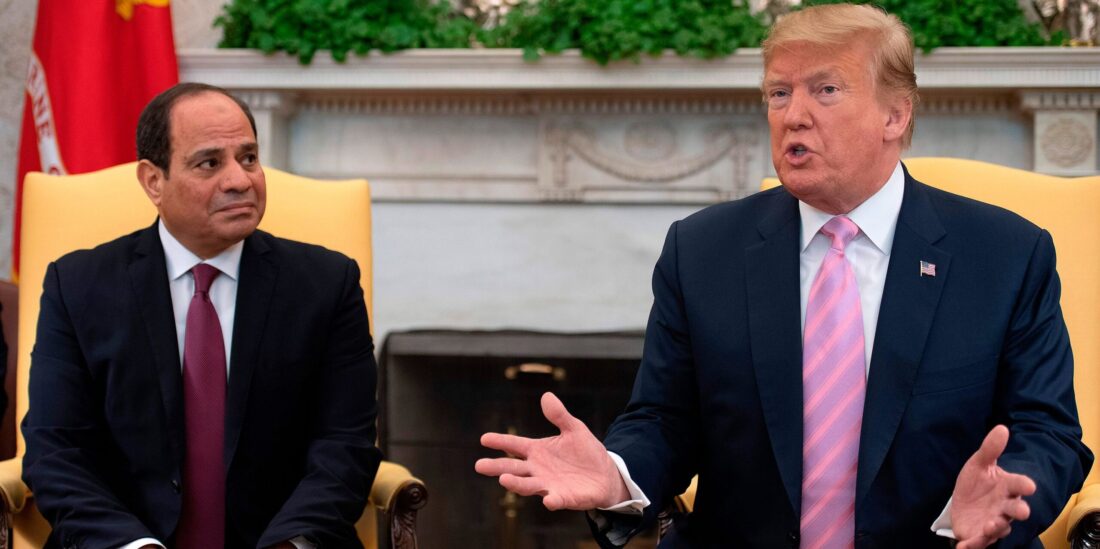
A new headline, the same old mindset. When Cairo cannot secure a favorable outcome in Africa, it runs to Washington, asks for pressure, and calls it diplomacy. The language changes. The objective does not. Egypt may ask President Trump to pressure Ethiopia into a “joint operation” framework for the Grand Ethiopian Renaissance Dam (GERD), involving experts from all eleven Nile Basin countries and the African Union. Cairo wants U.S. backing for a treaty that would block Nile Basin states from building dams without “consultation.” This is not about cooperation. It is about control.
Let us translate the proposal honestly.
Consultation becomes permission.
Cooperation becomes control.
A shared river becomes a permanent veto.
That is the architecture being proposed.
Ask a basic question: how would this even work in practice?
When turbines require real-time operational decisions, do we call eleven capitals?
When grid stability is threatened, do engineers wait for committee politics?
When dam safety decisions must be taken in minutes, do operators pause for “basin consensus”?
This is not engineering. It is political control wearing a lab coat.
GERD is not an abstract regional asset floating in neutral space. It is a physical structure inside Ethiopia. It was designed for Ethiopian development, financed by Ethiopian citizens, and built through national sacrifice. You cannot boycott the construction, refuse to contribute a single dollar, then arrive at the finish line demanding the keys. “Joint operation” is not a technical term. It is a governance term. Shared operation only makes sense when there is shared ownership. Genuine joint projects exist because parties share costs, risks, liabilities, and benefits. GERD does not meet that test. Ethiopia carried the burden alone.
The treaty proposal is even more dangerous.
A rule that prevents Nile Basin countries from building dams without “consultation” is not cooperation. It is a basin-wide permission system. A basin-wide veto. It freezes upstream development while locking in downstream advantage indefinitely.
This is not how international rivers are governed in the 21st century. No river system anywhere gives one or two downstream states the right to pre-approve upstream development forever. That logic belongs to the colonial era, not modern international law. Yes, Egypt has water security concerns. So does Sudan. So does Ethiopia. So do Kenya, Uganda, Tanzania, Rwanda, Burundi, South Sudan, and the Democratic Republic of Congo. Concern is universal. Entitlement is not.
Concern does not grant ownership over another country’s infrastructure.
Concern does not justify externalizing African disputes to Washington.
Concern does not transform negotiation into coercion.
The deeper issue is mindset. Cairo continues to treat upstream development as a threat to be neutralized, not a reality to be managed. It treats consultation as consent and cooperation as compliance. That approach has failed repeatedly, yet it keeps returning each time with a different mediator, each time with the same demands. If Egypt wants real cooperation, it must act like a normal basin partner.
That means accepting that upstream countries will develop.
That means abandoning the fantasy of veto power.
That means negotiating technical safeguards, not political dominance.
Ethiopia’s position, by contrast, can be firm and mature at the same time.
Yes to transparency and structured data exchange.
Yes to dam safety coordination and emergency communication protocols.
Yes to drought mitigation guided by hydrology, not fear.
Yes to African Union led facilitation rooted in regional ownership.
But also:
No to joint operation of a sovereign Ethiopian dam.
No to any treaty that permanently restricts upstream development.
No to imported pressure disguised as partnership.
The Nile is a shared river. That does not mean shared sovereignty. It does not mean shared command over national infrastructure. And it certainly does not mean that development rights flow downstream while obligations flow upstream.
This moment is not about GERD alone. It is about precedent.
If Ethiopia accepts joint operation today, every future project becomes negotiable property. If a basin-wide veto is normalized, upstream Africa’s development is frozen by design. That is why this debate matters far beyond one dam. Cooperation is possible. Coordination is necessary. But control is not on the table. The Nile can be shared without being weaponized. Regional stability can be protected without political submission. African problems can be solved without running to Washington. GERD will operate. Ethiopia will develop. And sovereignty will not be subcontracted.
No, Cairo.
Not now.
Not ever.