

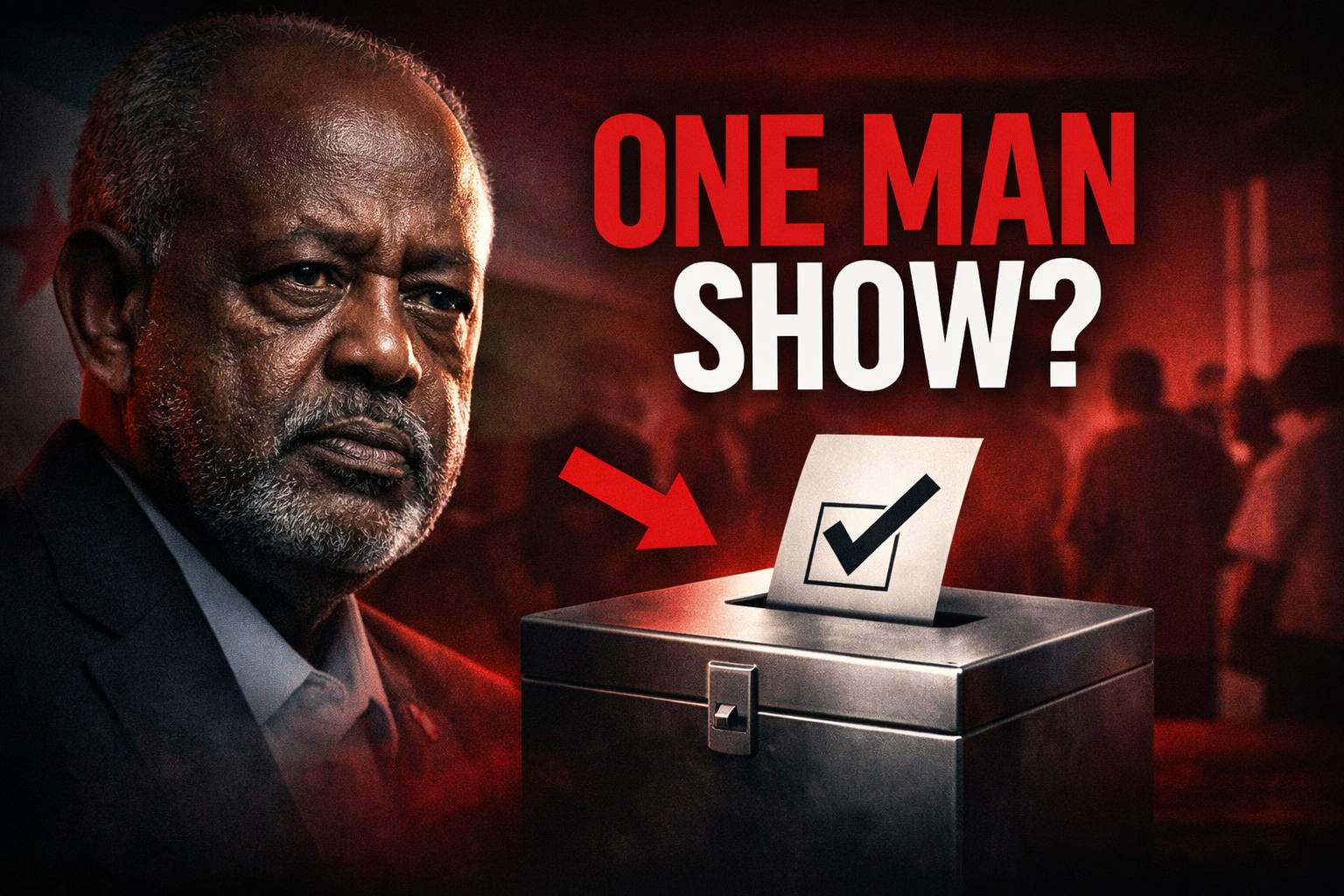
In a country of barely a million people, one 78-year-old man has decided the script for the next six years. On April 10, Djiboutians will go to the polls in what is being billed as a presidential election. In reality, it is a coronation with a single walk-on extra.
President Ismail Omar Guelleh, in power since 1999, is seeking a sixth term after lawmakers obediently scrapped the 75-year age limit last November. His only registered challenger is Mohamed Farah Samatar, a former member of the ruling party and leader of the Unified Democratic Center (CDU), a party that holds exactly zero seats in parliament and commands zero national profile. An independent analyst told AFP what everyone already knows: “There is little doubt about the outcome.” Guelleh took 97 % in 2021. The 2026 edition is simply the encore. The man who once promised renewal has turned the state into a family-and-clan franchise. His Mamassan subclan of the Issa Somali community controls the presidency, the defence ministry, the security services and the central levers of the economy. Token Afar faces appear in minor posts; real power remains off-limits. The ruling People’s Rally for Progress is an Issa machine. Opposition figures who try to play by the rules such as former adviser Alexis Mohamed suddenly discover they cannot obtain “security guarantees” to even return home and file papers.
This is not democracy wearing a thin disguise; it is dictatorship running the same tired play for the 27th year.
Behind the palace walls, the deeper fracture festers. Djibouti’s two main ethnic groups are the Issa Somalis (roughly 60 %) and the Afar (roughly 35 %). Afar activists insist the numbers are inverted that they form the actual majority and control 80 % of the land. Whatever the exact headcount, the reality on the ground is unambiguous: the Afar pastoralists of Tadjoura, Obock and Dikhil have been pushed to the margins since independence in 1977. French colonial administrators favoured the Issa, moved the capital to their stronghold, and left Afar regions starved of roads, schools, clinics and water. Guelleh’s uncle, Hassan Gouled Aptidon, perfected the one-party Issa state. Guelleh inherited the playbook and upgraded it with constitutional amendments, foreign military rents and relentless repression.The Afar response has been predictable and tragic. The Front for the Restoration of Unity and Democracy (FRUD) fought a civil war in the 1990s for basic representation. Peace accords in 1994 and 2001 were signed, then quietly ignored. Today FRUD is branded “terrorist,” yet in January 2026 its fighters inflicted serious defeats on government forces in Afar heartlands. The retaliation was swift and sectarian: Issa militias torched Afar homes in Djibouti City, drone strikes (some reportedly using Turkish technology) hit civilian zones on both sides of the Ethiopia border, and reports of dead children have surfaced from Dikhil. Afar leaders are using the words “ethnic cleansing” and “genocide.” Human Rights Watch and Reporters Without Borders which ranks Djibouti 168th out of 180 on press freedom document the same pattern: arbitrary arrests, torture, banned protests, and a political system closed to anyone outside the presidential clan.
Economically, the ports boom. U.S., French, Chinese and other bases pour in rents. The Issa elite and foreign partners get richer. The Afar north and southwest stay mired in unemployment, poverty and deliberate neglect. Youth frustration is boiling. Ethiopia’s push for sea access threaten even the port monopoly that keeps the regime afloat. Instead of reform, Guelleh answers with iron-fist stability: the same constitution-twisting, the same single-candidate ballot, the same message that only one man can steer the ship.
The upcoming vote is the clearest proof yet that Djibouti is not a republic but a one-man stage production. One candidate with no infrastructure, no seats, no visibility. One incumbent who rewrote the rules so he could never be forced to leave. One ethnic bloc that has monopolized power for half a century while the larger, land-rich other scrapes by on the edges. As one FRUD leader put it, this fight is no longer just about land; it is about ending an inverted reality where a minority rules the majority and calls it democracy. Until that inversion is corrected, Djibouti’s “election” will remain exactly what it is today: a solo performance by President Ismail Omar Guelleh, with the rest of the country forced to sit in the dark and applaude.