

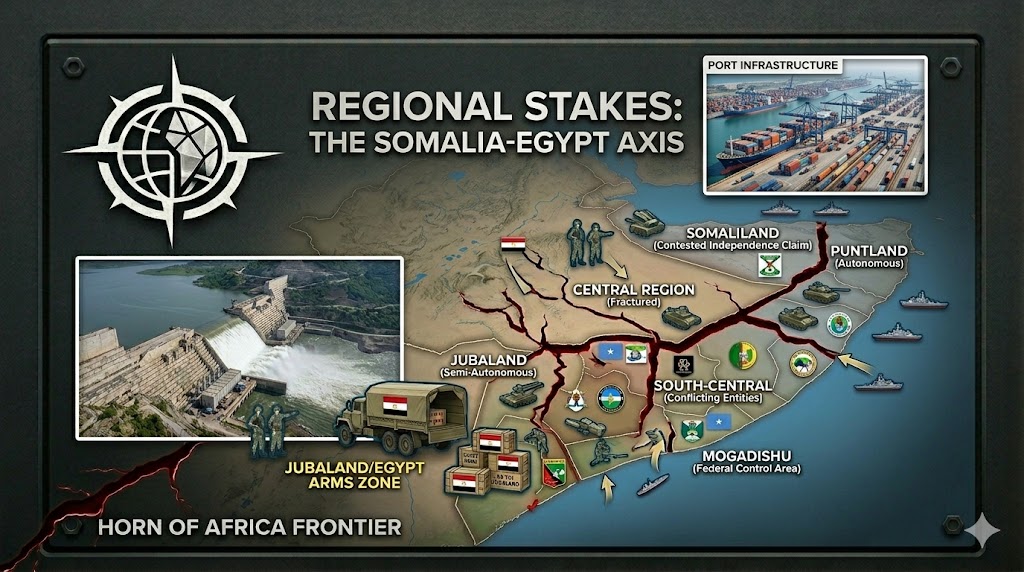
Weapons intended to defend a nation are now reportedly being used against it from within. In Somalia, South West State Speaker Dr. Ali Said Fiqi has accused the federal government of diverting Egyptian-supplied arms originally meant for national defense into internal political conflicts and civil strife.
On its own, this could be dismissed as another episode in Somalia’s long history of political tension.
But taken in a broader context, it points to something more concerning External military support is increasingly colliding with internal political fragmentation, producing outcomes that undermine stability rather than reinforce it.
As Somalia struggles with federal disputes, insurgency threats, and fragile governance, the misuse of foreign-supplied weapons raises a deeper question:
Are external actors strengthening the state or unintentionally accelerating its internal fractures?
Recent developments in Somalia have brought renewed attention to the risks associated with external military assistance in politically fragmented environments. The controversy surrounding Egyptian-donated weapons comes at a time when Somalia is already facing mounting internal pressures, including disputes between federal and regional authorities and ongoing security challenges.
The warning from South West State is not just a political complaint it reflects a structural vulnerability. When military aid enters a system where authority is divided and trust is limited, its use can quickly become contested.
This analysis examines what this incident reveals about Somalia’s internal dynamics, Egypt’s regional approach, and the broader implications for stability in the Horn of Africa.
EXTERNAL ARMS, INTERNAL CONSEQUENCES
Egypt’s provision of arms to Somalia is part of a broader strategy to strengthen an allied government and expand its influence in the Horn of Africa. Supporting Somalia’s security sector aligns with efforts to counter extremist threats and maintain stability along critical maritime routes.
However, the effectiveness of such support depends on how it is managed after delivery. The allegation that these weapons are being used in internal disputes suggests a breakdown in that process. Instead of reinforcing national defense capabilities, the arms appear to be entangled in political competition.
In fragile states, military assistance does not remain neutral. It interacts with existing power structures, rivalries, and institutional weaknesses. Without strong oversight, it can be redirected in ways that contradict its original purpose. This transforms external support from a stabilizing factor into a potential source of instability.
SOMALIA’S FRAGMENTED POLITICAL LANDSCAPE
A delicate balance between federal and regional authorities defines Somalia’s political system. While this structure is intended to distribute power, it often produces tension over control, legitimacy, and resource allocation.
The criticism from South West State highlights these underlying divisions. When military resources especially those provided by external actors are perceived to be controlled by one side, it disrupts the balance.
This can intensify mistrust and increase the risk of confrontation. Political disputes, which might otherwise remain contained, can escalate when backed by access to armed groups. The situation reflects a broader challenge: state-building efforts are still incomplete, and national institutions do not yet have full authority or cohesion. In this context, external support can amplify existing fractures rather than resolve them.
EGYPT’S STRATEGIC CALCULUS UNDER PRESSURE
For Egypt, engagement in Somalia is driven by strategic considerations. Expanding influence in the Horn of Africa, securing Red Sea interests, and countering regional rivals are all part of its broader geopolitical approach.
However, the reported misuse of its military assistance introduces new complications. Influence is not simply about providing resources it is about shaping outcomes. If the outcomes diverge from the intended plan, the strategy comes under pressure.
The situation in Somalia highlights a recurring challenge: projecting influence without ensuring control over how it is exercised. In complex environments, this gap can lead to unintended consequences that weaken rather than strengthen strategic positioning.
For Egypt, the issue is not only operational but also reputational. Perceptions of ineffective or destabilizing engagement can affect its standing with partners and competitors alike.
SECURITY PRIORITIES VS POLITICAL REALITIES
At the heart of the issue is a misalignment between security goals and political realities.
The primary objective of the arms transfer was to support Somalia’s fight against extremist groups. This remains a critical priority, both for Somalia and for regional stability.
However, internal political dynamics complicate this objective. When institutions are contested and authority is fragmented, security resources often become tools of political leverage.
This creates a cycle where political competition undermines security efforts, and weakened security further intensifies political rivalry.
In such conditions, even well-intentioned external support struggles to achieve its mission. Instead, it risks reinforcing the very instability it seeks to address.
REGIONAL AND STRATEGIC IMPLICATIONS
The implications extend beyond Somalia’s borders.
The Horn of Africa is already experiencing overlapping challenges, including conflict, political instability, and strategic competition. Developments in one country can quickly affect neighboring states.
Instability in Somalia has direct consequences for regional security, trade routes, and population movements. It also complicates the calculations of external actors operating in the Red Sea corridor.
For countries engaging in the region, the lesson is clear: military assistance alone is not sufficient. Without strong institutions and coordinated governance, its impact is unpredictable.
This raises broader questions about how external powers approach fragile states and whether current strategies are aligned with on-the-ground realities.
CLOSING
The controversy surrounding Egyptian arms in Somalia is a clear example of the risks inherent in external engagement within fragmented systems. It highlights the limits of military assistance when oversight is weak, the dangers of politicizing security resources, and the challenges of operating in complex political environments.
Somalia’s internal divisions are longstanding. But when external support becomes entangled in those divisions, the consequences become more severe.
For regional actors, the key challenge is not just to project influence but to ensure that it produces stable and predictable outcomes. In the Horn of Africa, where crises are increasingly interconnected, that distinction is becoming more important than ever.