

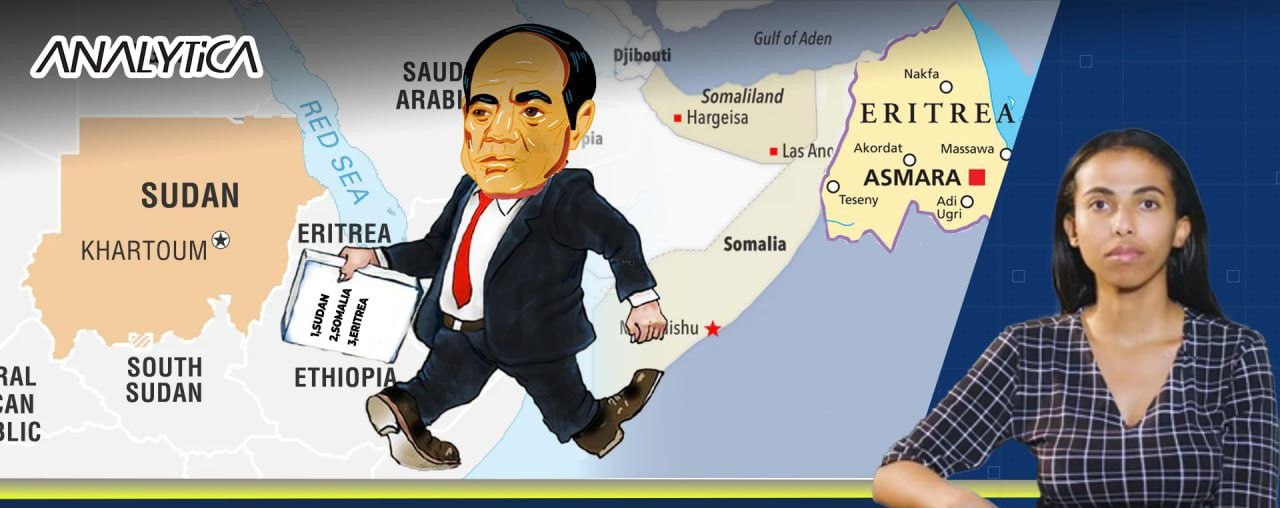
President Abdel Fattah El-Sisi’s recorded speech at the 8th Cairo Water Week on October 12, 2025, frames Ethiopia’s management of the Grand Ethiopian Renaissance Dam as “unrestrained” and an immediate threat to Egypt’s water security. He appeals to the United States and the international community to intervene and “save” Egypt. This narrative deserves careful scrutiny. While Egypt’s concerns about the Nile are real and longstanding, labeling Ethiopia’s actions as reckless ignores history, international law, scientific assessments, Ethiopia’s legitimate development needs, and the value of African-led solutions. First, context matters. The Nile’s Blue Nile, which supplies about 85 percent of the river’s water, originates in Ethiopia. Yet for decades, Egypt relied on two colonial-era agreements, the 1929 Anglo-Egyptian Treaty and the 1959 Nile Waters Agreement that allocated roughly 66 percent of the Nile’s flow to Egypt and 22 percent to Sudan. Ethiopia, never a party to those treaties and never a British colony, received zero allocated share despite contributing the vast majority of the water. These pacts effectively gave downstream states veto power over upstream development. Ethiopia rightly calls this arrangement outdated and inequitable – a colonial legacy that no modern international law supports.
The GERD itself is a hydropower project, not an irrigation scheme. Unlike consumptive uses that permanently remove water, the dam generates electricity and then releases the water downstream. Independent modeling, including studies published in peer-reviewed journals such as Communications Earth & Environment (2024), shows that cooperative operation of the GERD produces almost no additional net loss to downstream flows in average or wet years. Even in prolonged drought scenarios, optimized policies allow Ethiopia to generate 87 percent of maximum hydropower while avoiding any extra shortage for Egypt beyond what natural variability already causes. Average evaporation losses from the reservoir are modest roughly 1.6 to 1.9 billion cubic meters annually and the dam actually provides downstream benefits: it traps silt that would otherwise clog the Aswan High Dam, reduces flood risks in Sudan, and can help regulate seasonal flows.
Ethiopia has not acted without restraint. For over a decade it engaged in trilateral talks with Egypt and Sudan. It has shared hydrological data, invited technical experts, and repeatedly stated it will not cause “significant harm” – the exact standard required under the 1997 UN Watercourses Convention, which emphasizes equitable and reasonable utilization. Ethiopia’s position aligns with that framework: a country of 120 million people, many without reliable electricity, has a sovereign right to develop its own resources for poverty reduction and clean energy. The GERD fulfills a generational aspiration without violating international norms.
Egypt’s water security challenges are serious, but they are not caused solely or even primarily by the GERD. Egypt’s population has doubled in the last 30 years. Per-capita water availability has fallen sharply due to inefficiency: traditional flood irrigation still dominates, and urban leakage remains high. Climate change will increase evaporation and demand regardless of any upstream dam. Framing the GERD as the existential villain distracts from domestic reforms that could save billions of cubic meters.
Ethiopia’s official response to President El-Sisi’s speech was measured. It rejected the “colonial mentality” accusation and reaffirmed its commitment to development without significant harm to neighbors. Moreover, President El-Sisi’s direct appeal to the United States and the international community bypasses Africa’s own institutions and regional actors. The African Union has repeatedly mediated GERD talks – most notably in 2020-2021 under its “African solutions to African problems” principle – and continues to offer platforms for dialogue. Ethiopia has consistently supported AU-led processes and the Nile Basin Initiative, which includes all 11 riparian states. By turning instead to Washington, the appeal risks undermining pan-African solidarity and continental ownership of shared challenges. External intervention may feel appealing in the short term, but it often complicates rather than resolves disputes among African neighbors.
Rather than escalation, the record shows repeated offers of technical cooperation. The international community should not be asked to “save” Egypt from a dam that Ethiopia built on its own territory using its own resources. Instead, the call should be for genuine cooperation based on equitable sharing, transparent data, and joint benefit under African-led frameworks. The Nile Basin Initiative and the Cooperative Framework Agreement already ratified by several upstream states point toward a modern, inclusive governance model that replaces colonial quotas with shared prosperity.
President El-Sisi is correct that the Nile is a lifeline for all. But treating it as Egypt’s exclusive lifeline in 2025 is neither fair nor sustainable. True water security for the basin comes from partnership, not pressure. Ethiopia is not the villain here; it is exercising the same sovereign development rights every nation claims. A balanced international approach would encourage technical dialogue and mutual guarantees through the AU and regional actors rather than reviving outdated privileges or external appeals that risk polarizing a shared river that belongs to eleven African nations. That is the path to stability.