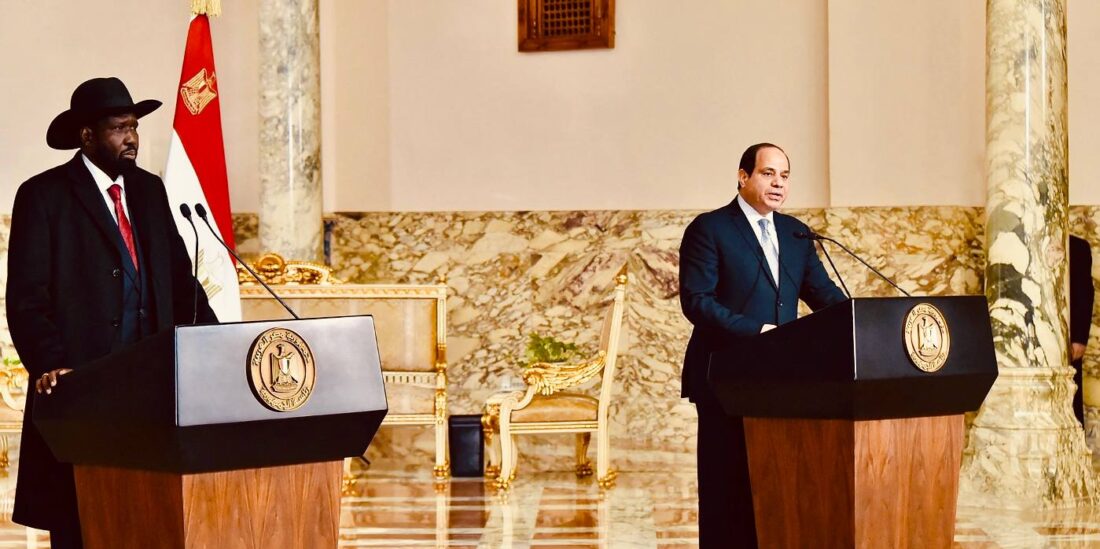
On 2 June, Egyptian President Abdel Fattah al-Sisi held a discreet closed-door meeting with Defence and Military Production Minister General Ashraf Salem Zaher and Military Operations and Intelligence Chief General Mohamed Rabie. The catalyst was South Sudan’s decision to order the closure of Egypt’s military facility in the Pagak (Jute-Pagak) area of Upper Nile State, near the Ethiopian border.
Official channels may portray this as a minor adjustment in bilateral military cooperation. In truth, the withdrawal of approximately 260 Egyptian personnel from this forward outpost represents a tangible erosion of Cairo’s regional posture. Established around 2020, the base was far more than a standard training or cooperation site. Its proximity to Ethiopia’s Benishangul-Gumuz region and the Grand Ethiopian Renaissance Dam (GERD) provided Egypt with valuable intelligence, surveillance, and monitoring capabilities at a critical strategic flashpoint.
The key question is not why Juba acted. It is what this episode reveals about the fraying edges of Egypt’s broader strategy toward Ethiopia and the shifting realities in the Nile Basin.
Egypt has long presented its engagement with South Sudan as rooted in development aid, infrastructure support, and shared stability goals since Juba’s independence. These elements remain part of the relationship.
However, the Pagak facility operated on a different plane, a discreet forward presence blending training, technical assistance, logistics, and intelligence gathering. Its closure deprives Cairo of a tangible on-the-ground asset in the upstream Nile arena, exposing the limits of relying on such outposts in a region where host governments must balance competing pressures.
For South Sudan, the move reflects a pragmatic desire to avoid entanglement in the downstream-upstream rivalry. Hosting an Egyptian base so close to Ethiopia risked positioning Juba as a proxy in the GERD dispute, a high-stakes game offering little upside for a fragile state prioritizing its own survival and ties with Addis Ababa.
At the heart of the episode is Egypt’s sustained effort to monitor and constrain Ethiopia’s regional rise, with the GERD as the central symbol. Facing stalled negotiations and an operational dam, Cairo has pursued alliances and footholds across Ethiopia’s neighbors as part of a de facto encirclement approach aimed at exerting diplomatic, political, and security pressure.
The Pagak site exemplified this logic: a listening post near the dam and western Ethiopian territory. Its loss, however, underscores the vulnerabilities in that strategy. South Sudan’s decision signals that upstream and equatorial states are increasingly unwilling to serve as platforms for anti-
Ethiopian positioning. Juba appears to be prioritizing regional connectivity, economic pragmatism, and stable relations with Addis over downstream leverage, a clear indicator that Egypt’s encirclement architecture is encountering resistance and realignment at key nodes.
This does not eliminate Cairo’s concerns, but it highlights the diminishing returns of forward outposts when host states recalibrate their own interests.
The closure fits into a wider pattern of Nile Basin shifts. Sudan’s ongoing instability has already complicated Egypt’s downstream cohesion, while South Sudan’s pivot further fragments the hoped-for united front against Ethiopian upstream assertiveness. Juba’s move prioritizes its position within the Nile Equatorial Lakes region and its practical ties with Ethiopia, reflecting broader upstream solidarity dynamics.
For Egyptian military and intelligence planners, the discreet 2 June meeting likely centered on assessing the intelligence gap, exploring alternatives (diplomatic intensification, remote capabilities, or other partnerships), and recalibrating upstream strategy. The episode demonstrates that traditional tools of influence including discreet military footprints are proving fragile amid local priorities and evolving regional power balances.
Sisi’s closed-door session with his top defence and intelligence officials was not routine housekeeping. It was a high-level acknowledgment of a strategic erosion: the quiet dismantling of one node in Egypt’s effort to encircle and constrain Ethiopian ambitions through neighboring footholds.
The real significance of the Pagak closure lies in what it reveals about the limits of Cairo’s approach. As South Sudan steps back from serving as a forward platform against Addis Ababa, it signals that Egypt’s encirclement strategy is facing meaningful pushback and fragmentation in the Nile Basin. Downstream powers can no longer assume automatic alignment from upstream neighbors, whose calculations increasingly favor pragmatism, connectivity, and risk avoidance over proxy positioning.
This development may push Egypt toward renewed diplomatic creativity or alternative leverage points. Yet it also reinforces a broader geopolitical truth in the Horn of Africa: influence built on forward outposts and selective alliances is inherently contestable and in this case, visibly fraying. The Pagak episode is less an isolated bilateral footnote than another marker of a changing regional order where Ethiopia’s position proves more resilient than encirclement efforts anticipated.