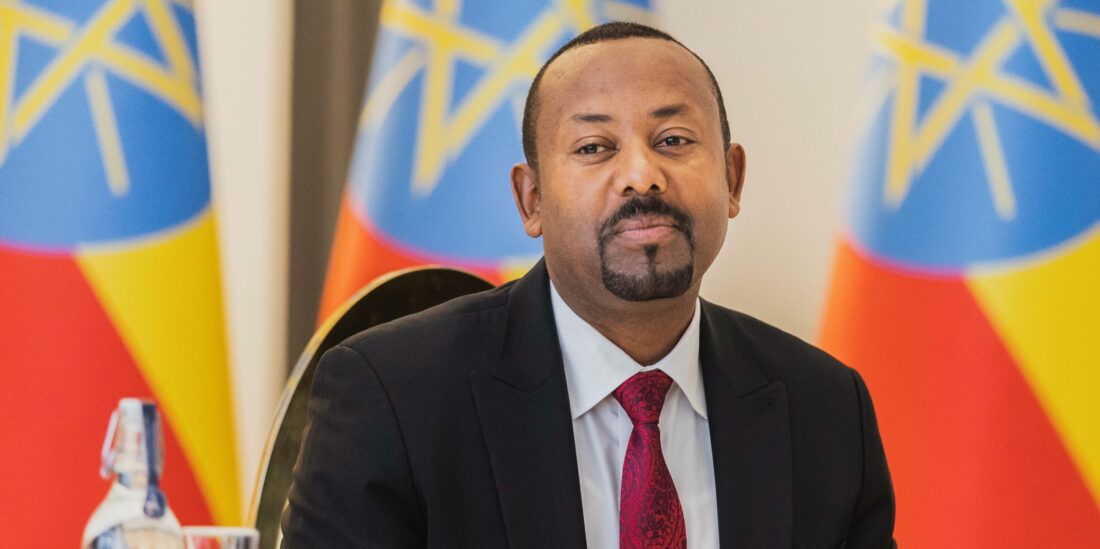
Abiy Ahmed’s latest two-part interview on ETV was framed as a discussion on manufacturing it quickly evolved into something far more consequential. The Prime Minister devoted significant attention to Ethiopia’s landlocked status, delivering pointed and carefully crafted remarks that go beyond routine political messaging. This was not just another interviewit was a calculated display of strategic communication with clear domestic and regional implications..
First, the big frame Abiy is using: existential necessity. He calls the lack of a sea port ‘the biggest obstacle’ to Ethiopia feeding its people, staying independent, and competing on the world stage. Remember, Ethiopia has the 10th-largest population on Earth. For a country this massive to be cut off from the ocean? Abiy says that’s not just inconvenient, it’s literally holding back the entire nation’s future. He ties it straight to manufacturing: higher costs, slower supply chains, everything. You can feel the frustration when he says the impact is visible on ‘every single citizen.
Next, he introduces a fresh angle we haven’t heard this strongly before, privacy and strategic vulnerability. Abiy explains that because internet data cables run through other countries, Ethiopia has zero secrecy. ‘Data is not private,’ he says. Same with trade: every import and export goes through foreign ports, so rivals can see exactly what you’re buying, selling, when, and where. He warns that when everyone knows your every move, ‘your journey can be cut short.
This is smart. he’s not just talking economics; he’s talking digital sovereignty and national security.”
Then comes the regional cooperation message. Abiy is careful but firm. He says the port issue must be solved ‘as peacefully as possible’ but it is necessary. He reminds viewers that Ethiopia once had a coastline from Massawa all the way to the tip of Mogadishu. Getting access back, he argues, is totally doable through ‘commercial law, negotiation, and the principle of give and take.’ He pushes back on critics who say Ethiopia is being unreasonable, calling the current situation a lose-lose for the whole Horn of Africa.”
Here’s the most powerful rhetorical move: Abiy contrasts ‘small countries’ versus ‘capable’ nations. He says critical sea lanes, think Bab el-Mandeb and the Red Sea cannot be guarded only by small states. Countries like Ethiopia, with huge populations and growing economies, must participate in protecting these routes. It’s a subtle but brilliant repositioning: Ethiopia isn’t asking for charity; it’s offering to be a responsible stakeholder.
Abiy anchors everything in today’s headlines. He points to the recent chaos in the Strait of Hormuz after the Iran-related conflicts and asks: ‘If the Red Sea is closed, whose agenda would it be more important than ours?’ East Africa is already feeling the energy shocks differently from the rest of the continent. By linking Ethiopia’s 20-year-old problem to fresh global maritime crises, he makes the world suddenly understand why this matters right now.”
“So who is this message for? Domestically, it’s rallying Ethiopians behind the government’s agenda and shutting down critics who think the port talk is just noise. Regionally and internationally, it’s a calm but clear signal: we want win-win deals, not conflict. No invasion talk, just negotiation and mutual benefit. He even says keeping Ethiopia landlocked forever hurts everyone in the neighborhood.”
Overall, this interview is a textbook example of developmental nationalism mixed with realist geopolitics. Abiy connects sky-high logistics costs (50–100 % more than neighbors), manufacturing struggles, data privacy risks, and Red Sea security into one tight, compelling argument. It’s coherent, adaptable, and timed perfectly with global headlines.
It humanizes a complex issue and makes it feel urgent for every Ethiopian.
Bottom line: Prime Minister Abiy has kept Ethiopia’s maritime future front and center. Whether this leads to real diplomatic breakthroughs with Djibouti, Somaliland, or Eritrea, one thing is clear Ethiopia refuses to stay landlocked forever.
What do you think? Is Ethiopia’s demand reasonable? Drop your thoughts in the comments, hit like if this analysis helped, and subscribe for more breakdowns of African geopolitics. I’ll see you in the next one – stay informed!”