Three years into a war that has killed tens of thousands, displaced over 14 million, and become the world’s largest humanitarian crisis, the international community is finally trying something different.
In Berlin, on the grim anniversary of Sudan’s civil war, civilians are being given a seat at the table not as observers, but as architects.
The question is whether this long-overdue shift can succeed where years of military-focused diplomacy have failed.
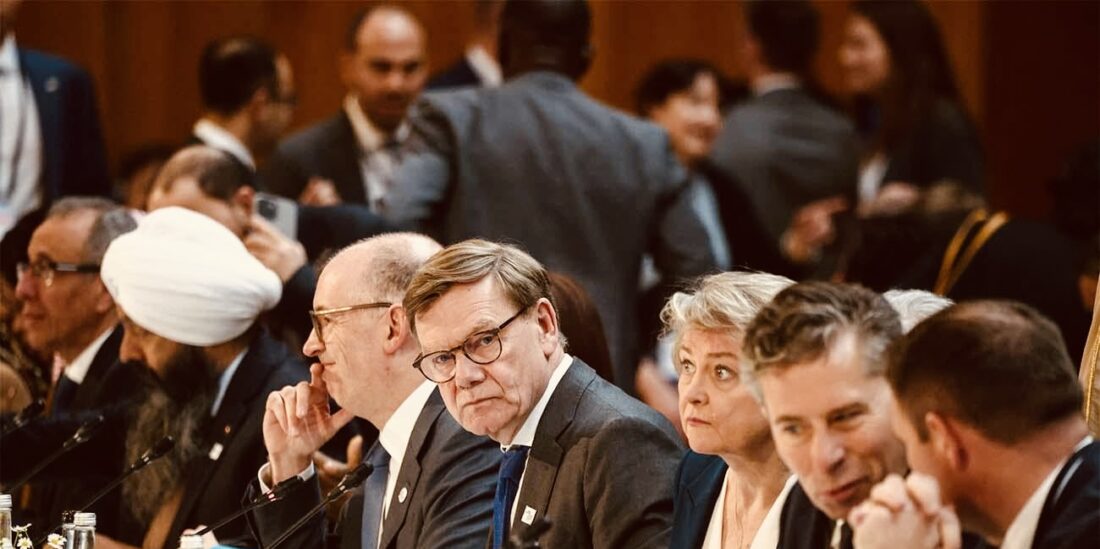
On April 15, 2026 the third anniversary of the outbreak of fighting between the SAF and the RSF, international actors gather in Berlin for a ministerial conference co-hosted by Germany, the African Union, the European Union, France, the UK, and the United States.
But unlike previous summits in Paris and London, this one features something new: a dedicated civilian forum of around 40 Sudanese civil society representatives. Former Prime Minister Abdalla Hamdok has hailed it as an “important shift,” the first time civilian voices are being formally included in international efforts to end the war.
This analysis examines whether Berlin represents a genuine turning point or merely another diplomatic ritual in a conflict that has defied resolution.
The Context: Three Years of Failure
The numbers are staggering. Over 14 million displaced. Famine looming. Widespread atrocities including sexual violence and the weaponization of food aid. Both the SAF and RSF stand accused of war crimes, and neither has shown capacity or willingness to achieve outright military victory. The Paris conference in 2024 and the London conference in 2025 yielded no ceasefire, no credible political framework, and little beyond rhetorical pledges.
The reason, critics argue, is simple: those processes prioritized engagement with the warring parties often through indirect channels or parallel initiatives like the Quad (US, UAE, Egypt, Saudi Arabia) roadmap without anchoring negotiations in broader Sudanese society.
Civilians were largely absent, reducing outcomes to elite bargaining that ignored root causes: fragmented military-economic interests, Islamist resurgence within SAF structures, and external meddling fueling the stalemate. Berlin marks a deliberate pivot. Organizers describe it not as a “peace conference” but as a forum for humanitarian diplomacy paired with civilian empowerment. The message is clear: after three years, the international community is acknowledging that there is no military solution to this war.
The Civilian Paradigm: Hamdok’s Gamble
Former Prime Minister Abdalla Hamdok, who leads the Somoud (Civil Democratic Alliance) coalition, has been the most vocal advocate of this shift.
Traveling to Berlin, he stated: “The only assured way is to go through a political process that will address the root causes of the conflict. We have been saying from day one, there is no military solution to this war.”
The civilian delegation spanning political coalitions, civil society organizations, and technocrats aims to issue a unifying declaration against the war, pushing for humanitarian access, civilian protection, and a political track. Analysts from the German Institute for International and Security Affairs (SWP) call this a “long-overdue change of perspective”: moving away from SAF-RSF power-sharing, which risks fragile and violence-embedded transitions, toward supporting a civilian-led order.
The Tensions: Who Is Missing and Why It Matters
Not everyone is celebrating. Sudan’s military-backed government has protested and boycotted the conference, viewing the format as illegitimate without its input and accusing invitees of bias. Some of the civilian participants have been linked to RSF sympathies or external patrons, raising questions about the forum’s neutrality. Critics argue that excluding the belligerents dooms any immediate breakthrough. Without SAF and RSF buy-in, implementation risks stalling. Perceptions of bias could harden military positions, especially amid rising Islamist influence within Khartoum’s power structures.
The conference may therefore achieve little more than aid mobilization and diplomatic signaling important, but far from a ceasefire.cThis tension highlights Berlin’s core innovation and its vulnerability.
By elevating civilians, the conference tests whether a “civilian-centered perspective” can generate legitimacy and pressure that top-down talks could not. Amani Africa analysts frame it as a potential catalyst for a technocratic transitional authority: a limited-mandate civilian administration to facilitate humanitarian access and political space, followed by a national convention for constitutional reforms. This would bypass the SAF-RSF deadlock that incentivizes endless fighting.
The Stakes: Why Berlin Could Be a Turning Point
Prospects hinge on execution. Success could yield a unified civilian declaration amplifying calls for unhindered aid, accountability for atrocities, and a quintet-backed political roadmap with timelines and milestones. This could pressure warring parties indirectly through diplomatic isolation and funding conditionality. Humanitarian gains are urgent.
Donors must commit flexible, frontline NGO funding amid catastrophic shortfalls.
ERRs and civil society could gain ownership, preserving social cohesion amid the de facto partition of Sudan.
If civilians can forge a declaration that transcends factionalism, they could disrupt what one analyst called the “glorification of the people with guns” by creating a neutral diplomatic locus But challenges abound.
Without SAF and RSF engagement, parallel initiatives must align to avoid fragmentation.
Funding alone, without protection mechanisms, risks perpetuating dependency Regionally, Sudan’s fragility threatens neighbors and beyondRed Sea security, refugee flows, and extremism linkages all hang in the balance.
Fundamentally, Berlin interrogates whether international actors have learned from three years of failure.
Military solutions entrench division. Sustainable peace requires addressing civilian agency, root grievances, and state legitimacy Hamdok’s optimism that this is the “most direct and promising initiative” rests on civilians seizing this moment.
No one expects an immediate ceasefire to emerge from Berlin. The guns will not fall silent on April 16 But the conference marks a structural evolution in how the international community approaches Sudan’s war.
For the first time, civilians are not being treated as victims to be rescued or obstacles to be managed, but as agents of their own political future.
Whether this shift translates into sustained, civilian-led support or whether Sudan’s tragedy remains a managed crisis rather than a resolved one will be determined in the months ahead The stakes, for 48 million Sudanese and for regional stability, could not be higher. Berlin is not the end of the road. But it may finally be the beginning of a different path.