

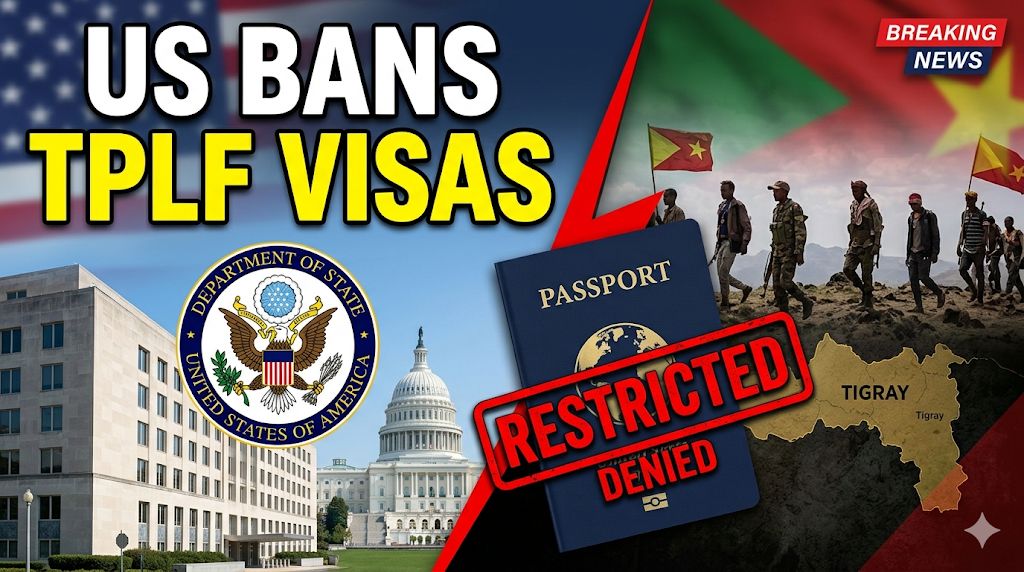
In a significant move aimed at preserving fragile peace in Ethiopia’s northern Tigray region, the United States has announced visa restrictions targeting “hardline members” of the Tigray People’s Liberation Front (TPLF) and their immediate family members. Secretary of State Marco Rubio is implementing measures against individuals deemed responsible for or complicit in undermining resolution efforts in Tigray.
The State Department stated that the policy targets those whose actions risk reigniting devastating conflict. This decision comes amid rising tensions that have already led to clashes, displacements, and fears of broader regional instability involving Ethiopia and Eritrea.
TPLF, once a dominant force in Ethiopian politics as a key member of the former ruling EPRDF coalition, led the Tigray region into a brutal two-year war starting in November 2020. Fighting between the TPLF’s Tigray Defense Forces (TDF) and the Ethiopian National Defense Force (ENDF) resulted in hundreds of thousands of deaths estimates often exceed 600,000 including civilians, widespread atrocities and one of the world’s worst humanitarian crises in decades. Millions were displaced, and the region suffered massive destruction.
The November 2022 Pretoria Agreement, brokered by the African Union and signed between the Ethiopian federal government and the TPLF, brought a formal end to major hostilities. Key provisions included a permanent cessation of hostilities, disarmament and demobilization of TPLF forces, withdrawal of foreign troops, restoration of federal authority, and commitments to humanitarian access, transitional justice, and eventual elections.
The TPLF has reasserted influence, reinstating elements of its pre-war regional governance in some areas and challenging the federally backed interim administration. Analysts warn that moves to control key towns and unresolved grievances could trigger wider fighting, potentially drawing in Eritrea amid its own strained relations with Addis Ababa over issues like Red Sea access and border security.
Such a relapse would be catastrophic, not only for Tigray but for the Horn of Africa, exacerbating refugee flows, food insecurity, and proxy dynamics. The US Visa Policy and Its RationaleSection 212(a)(3)(C) allows the Secretary of State to deny visas if an individual’s entry or activities could have potentially serious adverse foreign policy consequences for the United States. This tool has been used in various contexts globally to promote accountability and deter destabilizing behavior.
By focusing on “hardline members” and immediate families, the US aims to apply targeted pressure without broad sanctions that could harm ordinary Tigrayans still recovering from war. The policy signals strong US support for full Pretoria implementation and warns spoilers that undermining peace carries personal costs, such as restricted travel, access to education, business, or diaspora networks in the US.
Tigrayan voices are more divided. Some hardliners decry it as external interference favoring Addis Ababa, while moderates and civilians hope it pressures all. Broader calls exist for the US and international community to address spoilers across all factions. The move underscores the limits of elite power struggles in post-conflict settings. Visa restrictions are symbolic and personal but carry weight in an interconnected world. They complement diplomatic efforts, humanitarian aid, and potential incentives for compliance.
Sustainable peace in Tigray requires more than restrictions. Full disarmament, inclusive political processes, transitional justice mechanisms, and economic reconstruction are essential. The African Union, IGAD, and partners like the US and EU must intensify mediation to bridge divides between the federal government, TPLF factions, and other regional actors.
For the people farmers, families, and youth desperate for normalcy the stakes are existential. Renewed war would erase hard-won gains and risk another humanitarian disaster. The US policy highlights a clear international consensus: hardline obstructionism that risks reigniting conflict is unacceptable. As Secretary Rubio’s announcement makes clear, the path to stability lies in good-faith implementation of peace agreements, not renewed confrontation. Whether this targeted pressure yields progress will depend on the response from TPLF leaders and Ethiopia’s broader political actors in the coming months