For years, Ethiopia chose restraint in dealing with Eritrea.Despite worsening relations, accusations of interference and increasing regional competition, Addis Ababa kept diplomatic channels open. Now, that approach has changed. Ethiopia has
closed its embassy in Asmara and declared ten Eritrean diplomats persona non grata, accusing them of activities that posed a direct threat to Ethiopia’s national security. But this decision did not emerge from a single diplomatic disagreement.
It comes after months of accusations of Eritrean military activity inside Ethiopian territory, alleged support for armed opposition and an increasingly open alignment between Eritrea and forces seeking to challenge the federal government. The question is no longer simply why Ethiopia is angry with Eritrea The question is whether Addis Ababa has finally concluded that its strategic restraint has been exhausted.
Ethiopia’s Foreign Ministry says the decision was taken in response to Eritrea’s direct and indirect acts of hostility and belligerence. It also specifically accused ten Eritrean diplomats of involvement in activities that threatened Ethiopia’s national security.That decision comes as fighting has returned to northern Ethiopia and as the political landscape around the TPLF has changed dramatically The TPLF is no longer fighting in isolation. It has joined a broader alliance of armed opposition groups whose stated objective is to remove Prime Minister Abiy Ahmed’s government.
At the same time, Ethiopian officials have accused Eritrea of financing and supporting the TPLF, while authorities in Afar have accused Eritrean forces of entering Afar and participating in the offensive. Eritrea denies these allegations This makes the diplomatic rupture much more consequential than a normal dispute betwee neighbouring governments The ten diplomats are the immediate trigger for the latest decision, but the underlying confrontation is much older.
In February, Ethiopia formally accused Eritrea of military aggression and said Eritrean forces had occupied Ethiopian territory along parts of the shared border. Addis Ababa also accused Eritrea of providing material support to armed groups operating inside Ethiopia and conducting military manoeuvres with Ethiopian armed groups Those accusations were already serious. But the situation has now moved beyond allegations concerning the border.
As fighting expanded into Afar, the administrator of the Afar region told Al Jazeera that Eritrean soldiers had crossed into Afar to join the opposition offensive Reuters subsequently reported the allegation while noting that it could not
independently verify it. Eritrea has not accepted responsibility for the alleged deployment.
If confirmed, this would represent a fundamentally different level of involvement. Supporting an Ethiopian opposition movement from outside the country is one thing Sending troops across an international border into Ethiopian territory is something else entirely That is the distinction that makes the current diplomatic rupture so serious.
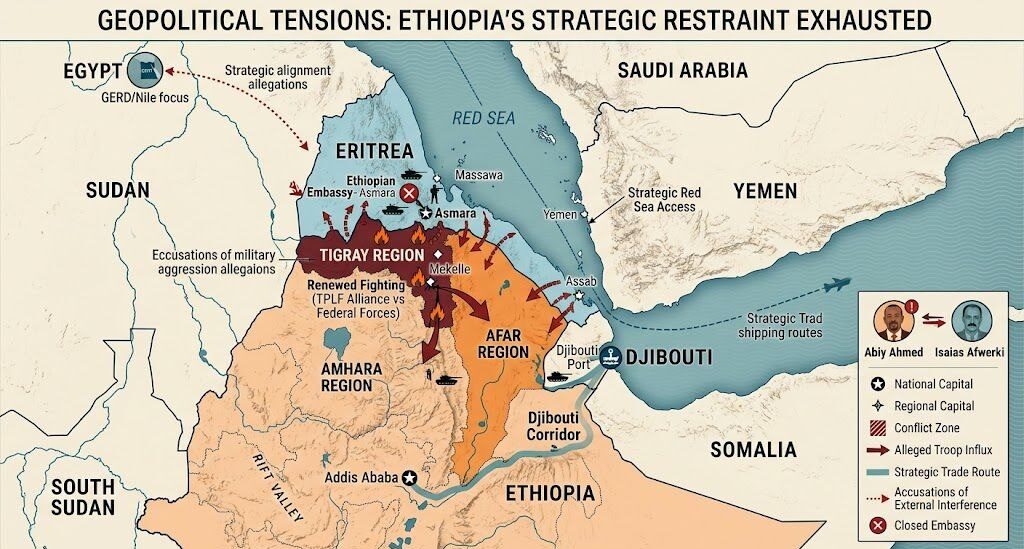
The Afar allegations matter because of geography. Afar is not some isolated corner of the conflict. It connects northern Ethiopia to the Djibouti corridor and sits directly beside Eritrea. Control over territory there has implications for military mobility, trade routes and Ethiopia’s wider
northern security architecture.
The opposition alliance has already fought federal forces in Afar and captured several towns during the renewed offensive. Ethiopian forces have subsequently reported regaining some positions. The fighting demonstrates that the conflict is no longer confined to Tigray and is increasingly connected to Ethiopia’s wider territorial security That means the alleged Eritrean involvement is strategically significant even before considering the wider political objective.
If Eritrean forces are operating alongside Ethiopian opposition groups inside Afar, the issue is no longer simply about Eritrea trying to influence Ethiopian politics It becomes a question of whether a neighbouring state is directly participating in an armed campaign taking place inside Ethiopian territory That would explain why Addis Ababa has increasingly framed the Eritrean issue in terms of national security rather than ordinary diplomatic disagreement.
The other major development is the transformation of the TPLF’s political position. The TPLF has now joined the Ethiopian Peoples’ Forces Alliance for Survival, a coalition involving seven armed opposition groups. The alliance has explicitly positioned itself against the federal government and has stated its objective of removing Abiy Ahmed’s government and establishing a transitional administration.
That matters because the current conflict cannot simply be described as another Tigray federal dispute.The political objective has become much broader.The TPLF is operating alongside armed movements from other parts of Ethiopia, creating multiple fronts against Addis Ababa. The alliance therefore has the potential to transform a regional confrontation in Tigray into a nationwide struggle over political power This is where Eritrea becomes particularly important.
Ethiopian officials have accused Eritrea of financially supporting the TPLF and facilitating external assistance to the opposition. Eritrea rejects the allegation The contrast with the previous war is striking.During the 2020 to 2022 conflict, Eritrean forces fought alongside Ethiopia’s federal forces against the TPLF.Now, the two former adversaries are being accused by Addis Ababa of operating on the same side of a broader effort to challenge the federal government, although the precise extent of their coordination remains disputed.
Then there is Egypt.Cairo an Asmara have developed increasingly close political relations, while Ethiopia and Egypt remain locked in long running disputes over the Nile, the Grand Ethiopian Renaissance Dam and regional influence. Ethiopia has
accused Egypt, Eritrea and Sudan of supporting the opposition alliance. All three reject the accusations. Calling Eritrea an Egyptian “client” would go beyond the publicly established evidence.
But Addis Ababa clearly has reason to view the relationship through a strategic lens. Eritrea is Ethiopia’s northern neighbour. Egypt is Ethiopia’s principal rival over the Nile. Sudan is directly connected to the western security environment. And the TPLF is fighting the federal government from inside Ethiopia. From Addis Ababa’s perspective, these are not necessarily separate problems. They can potentially reinforce one another That does not prove the existence of a single coordinated regional plan to overthrow the Ethiopian government. But it explains why Ethiopian officials increasingly describe the situation as an external effort to destabilize the country rather than simply an internal political dispute.
This is why the embassy closure matters.Diplomatic relations are useful when they provide mechanisms for managing rivalry. But if Ethiopia believes Eritrean diplomatic personnel are involved in activities that threaten national security while Eritrean forces are allegedly operating across the border and supporting armed groups, maintaining business as usual becomes increasingly difficult The decision therefore establishes a new boundary. Ethiopia is effectively saying that diplomatic representation cannot be separated from the conduct of the state that operates it. And the timing is important.
The diplomatic rupture comes while armed opposition groups are attempting to widen the conflict geographically and politically. The TPLF is no longer simply defending a regional administration. It is part of an alliance explicitly seeking to remove the federal government That gives the embassy decision a much broader strategic meaning. Addis Ababa is not merely expelling diplomats It is signalling that it will no longer treat Eritrean involvement in Ethiopia’s internal conflict as something that can be managed through diplomatic patience alone.
For years, Ethiopia had a powerful incentive to avoid another confrontation with Eritrea.Another interstate war would carry enormous military, economic and humanitarian costs It could also destabilize the entire northern Horn and potentially pull Sudan and other regional actors deeper into the crisis. That made restraint rational. But restraint depends on the expectation that the other side will also respect certain limits Once Addis Ababa believes those limits have been crossed, continued restraint can begin to look less like de-escalation and more like strategic vulnerability.
That appears to be the calculation behind the latest move.
Ethiopia is accepting the diplomatic costs of severing normal relations because it appears to believe that the security costs of maintaining the previous arrangement have become greater The danger is what comes next If Ethiopia and Eritrea move from diplomatic confrontation toward direct military confrontation, the current conflict could become a regional war involving Tigray, Afar, the Red Sea and potentially the wider Horn.
That is precisely why this moment is so consequential Ethiopia’s decision to close its embassy in Asmara did not happen in a vacuum It follows accusations of Eritrean military presence inside Ethiopian territory, allegations of support for armed opposition and the emergence of a TPLF led alliance openly seeking to remove the federal government The strategic picture is becoming increasingly difficult to ignore Ethiopia once chose restraint because another war with Eritrea was too costly
Now Addis Ababa appears to believe that allowing Eritrean involvement to continue unchecked may be even more costly Strategic restraint was never supposed to mean unlimited tolerance And Ethiopia appears to have decided that the limit has finally been reached.