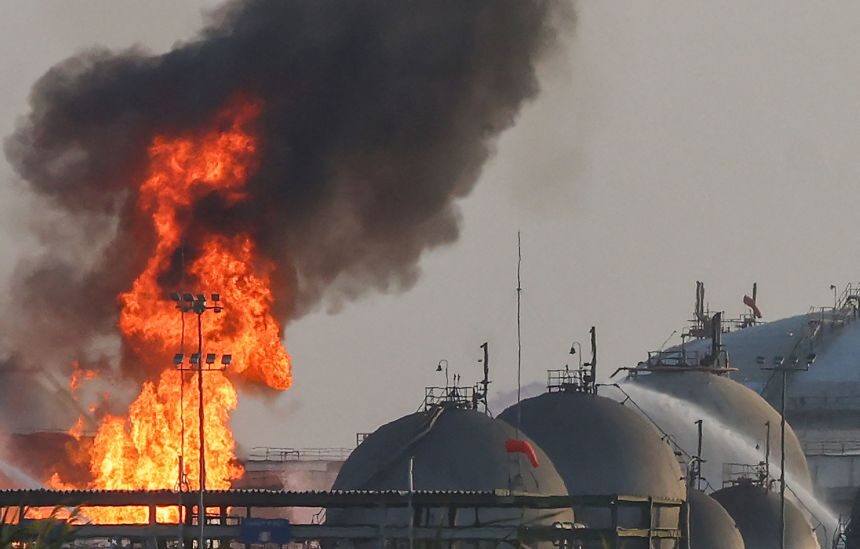
A red line has been crossed over the Arabian Peninsula The Houthi movement has claimed its most audacious strike however targeting King Khalid International Airport in Riyadh the Saudi capital itself. What was once a cross-border harassment campaign has now escalated into a direct challenge to Saudi Arabia’s core infrastructure and prestige.
The Houthis announced Monday that they had struck King Khalid International Airport in Riyadh, an Aramco refinery and other targets inside Saudi Arabia According to AFP loud explosions were heard in the Saudi capital after the claims were made This is not a symbolic gesture The targeting of Riyadh’s primary international airport signals that the Houthis now possess or credibly claim to possess the capability to reach the Kingdom’s most sensitive civilian and economic nodes.
The inclusion of an Aramco refinery in the same statement reinforces the group’s long-standing strategy of targeting oil infrastructure a tactic designed to inflict maximum economic pain and global market disruption The Houthis have also continued cross-border attacks against Saudi Arabia, including strikes targeting oil infrastructure and maritime routes in the Red Sea The message is clear the Houthis are not seeking a negotiated off-ramp. They are expanding the battlefield.
The Saudi-led coalition has responded with force Its naval forces struck Houthi military targets along Yemen’s Red Sea coast, destroying weapons depots, facilities holding explosive-laden boats and naval mines The coalition said the operation had disrupted a planned attack on shipping routes in the southern Red Sea This is a significant admission It confirms that the Houthis were preparing to escalate their maritime campaign a campaign that has already disrupted global shipping and raised insurance costs for vessels transiting the Bab al-Mandab Strait.
On the ground Yemeni military forces said they had pushed the Houthis from areas around the Bab al-Mandab Strait, including Mocha, Dhubab airport and Al-Omari military camp However, military sources stopped short of officially confirming the recapture of Mocha That caveat matters It suggests the situation on the ground remains fluid and that the Houthis, despite territorial losses, retain the capacity to counterattack and disrupt coalition gains.
The escalation comes as Saudi Arabia and its Yemeni allies pursue an offensive aimed at retaking territory controlled by the Houthis who have held much of northern Yemen including the capital Sanaa for more than a decade But this is no longer a Yemeni civil war It is now a regional confrontation with global implications The United Nations said it was “deeply concerned” by the sharp escalation and condemned continued Houthi attacks on Saudi Arabia.
The conflict has displaced more than 184,000 people in recent weeks according to the UN adding to the humanitarian crisis caused by years of war That figure will grow And the diplomatic front is shifting just as rapidly as the military one Saudi Arabia, Pakistan and Turkey held an emergency meeting in Riyadh on Monday under a mutual defense pact signed in August.
The countries agreed to take measures to provide and rapidly deploy military forces and capabilities to Saudi Arabia although they did not specify the troops’ role This is a pivotal development Pakistan and Turkey are not minor players. Their inclusion in a mutual defense framework with Saudi Arabia signals that the conflict is drawing in major regional powers with their own strategic interests at stake.
The clock is now measured in strikes, not statements The Houthi attack on Riyadh’s airport if confirmed represents a qualitative leap in the group’s capabilities and ambitions The Saudi-led coalition’s naval operations and the emergency defense pact with Pakistan and Turkey make clear that Riyadh is preparing for a prolonged and widening confrontation.
What is certain is that the Red Sea is no longer a transit corridor. It is a frontline The question now is whether the Houthis can sustain this level of escalation and whether the coalition’s countermeasures can prevent the conflict from spiraling into a full-scale regional war.