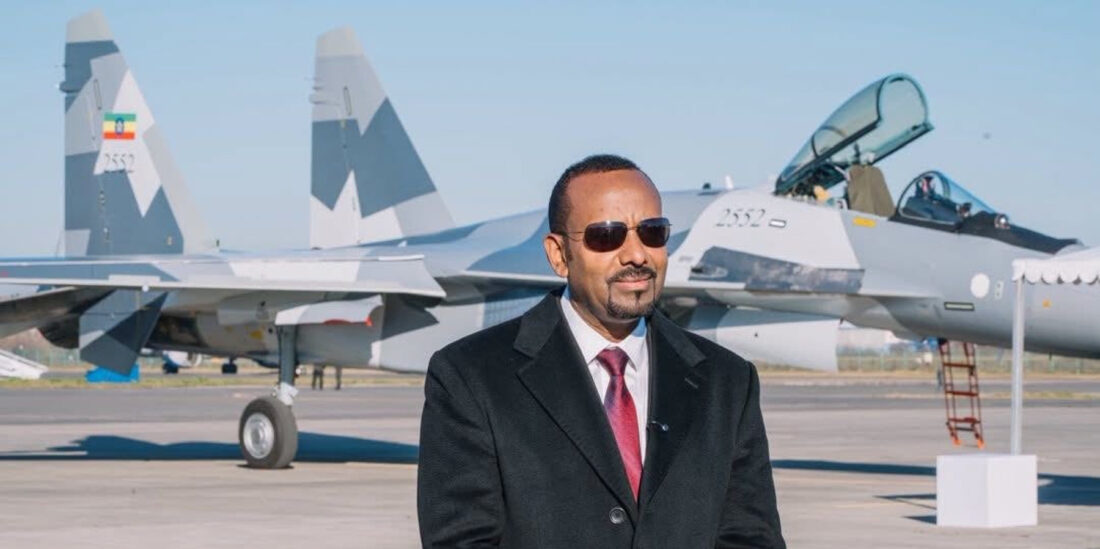
ADDIS ABABA– In a move that is already sending shockwaves through regional capitals and international policy circles, Ethiopia has formally stepped into a new tier of strategic deterrence. Prime Minister Abiy Ahmed announced the successful acquisition of 12 advanced 4++ generation Su-35 fighter jets alongside four S-400 air defense battery systems from Russia. Delivered a full year ahead of schedule, this development marks a defining moment for East African security architecture.
For a nation traditionally reliant on legacy systems, securing these high-performance platforms fundamentally alters the regional balance of power. The Su-35 is globally recognized as one of the most capable multirole fighters in existence, while the S-400 represents a gold standard in long-range, integrated air defense Coming against the backdrop of shifting alliances and regional anxieties particularly concerning Nile Basin dynamics and security frameworks stretching from the Horn to the Gulf this deployment sends a precise and unmistakable signal.
The Regional Ripple Effect and Cairo’s Calculus Across the Red Sea and down the Nile, the reaction has been swift. Commentary emerging from Egyptian media and political analysts reflects deep introspection regarding Western arms limitations. Analysts in Cairo are openly questioning the reliability of traditional Western defense partners, noting that restrictions, export controls, and political hesitations such as past policy constraints under U.S. administrations risk leaving regional players vulnerable to paralyzing maintenance and supply freezes during active crises.
The timing of this defense milestone, juxtaposed with broader geopolitical alignments in the Middle East and North Africa, has sparked fierce debate in Egyptian press circles. Pundits are urging Cairo to aggressively diversify its military procurement pipelines specifically looking toward strategic partners like China to prevent a widening technological gap in the skies.
Yet, framing Ethiopia’s sovereign military modernization purely through the lens of regional rivalry misses the broader strategic imperative. Prime Minister Abiy’s administration has consistently maintained that national defense upgrades are designed explicitly for pre-emptive deterrence, protection of vital infrastructure, and safeguarding territorial integrity.
A Call for Mutual Respect The underlying message resonating from Addis Ababa is clear: Ethiopia’s rapid economic growth and infrastructural rise must be matched by an uncompromising security architecture. The era of dictating regional terms through military monopolies or unilateral pressure is rapidly closing For sustainable stability to take root along the Nile Basin and the Horn of Africa, external anxieties must give way to pragmatic diplomacy.
The shifting military balance proves that coercion is a dead end. True regional security can only be achieved when all actors from Cairo to Addis Ababa recognize one another as sovereign equals, anchored in mutual respect, equitable cooperation, and international law As these advanced fourth-generation assets touch down on Ethiopian soil, the ball is now in the court of diplomats. The message to neighbors and global powers alike is simple: Ethiopia is here to stay as a secure, stable, and self-reliant pillar of regional peace.