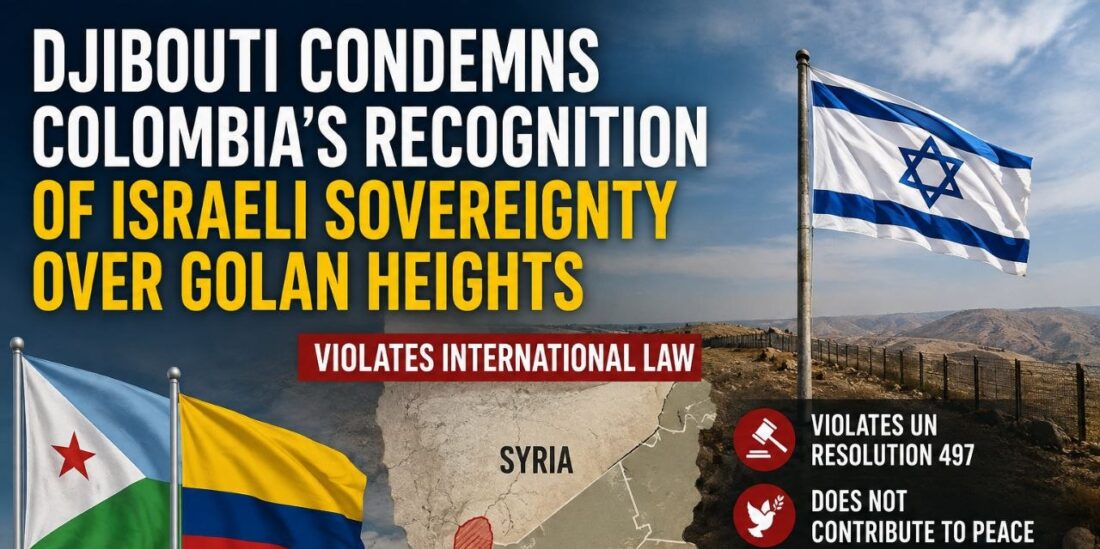
A new diplomatic dispute has come in the Middle East after Colombia became only the second country after the United States to formally recognise Israeli sovereignty over the Golan Heights Djibouti has strongly condemned the move, warning that such unilateral actions do not contribute to peace but instead deepen regional tensions.
The decision has drawn widespread international rejection with countries across the Arab world and beyond reaffirming that the Golan Heights remain Syrian territory under occupation The Government of Djibouti has condemned Colombia’s decision to recognise Israeli sovereignty over Syria’s Golan Heights saying the move contradicts fundamental principles of international law.
In a statement issued on 12 August, Djibouti’s Ministry of Foreign Affairs and International Cooperation said the recognition violates relevant United Nations resolutions, particularly UN Security Council Resolution 497 adopted in 1981 The resolution declared Israel’s imposition of its laws, jurisdiction and administration over the Golan Heights as null and without legal effect .
Djibouti warned that such unilateral actions do not contribute to achieving lasting and just peace in the Middle East, but could further deepen existing tensions and affect regional stability The government reiterated its position that the Golan Heights remain Syrian territory under occupation, saying any unilateral decision aimed at changing the legal, geographic or demographic status of the area has no legal validity .
Djibouti’s condemnation places it alongside a broad coalition of nations that have rejected Colombia’s decision Somalia similarly condemned the move, stating that any such recognition is null and void and violates international law and the United Nations Charter.
The Somali Ministry of Foreign Affairs affirmed that the Golan Heights constitutes occupied Syrian territory and called on all states to uphold international law and reject recognition of occupied territories Saudi Arabia, Qatar, Jordan, Egypt, and Turkey have also condemned the decision, with the
Turkish Foreign Ministry issuing a strong statement calling the move a grave violation of international law The Saudi Foreign Ministry stressed that such positions do not contribute to achieving peace but instead depart from the broad international consensus on the occupied Syrian Golan .
The Golan Heights are a mountainous area in southwestern Syria, overlooking northern Israel and parts of southern Syria Israel captured most of the territory from Syria during the 1967 Middle East war and passed legislation extending its laws, jurisdiction and administration to the territory in 1981 , a move widely regarded internationally as annexation UN Security Council Resolution 497, adopted unanimously in 1981, declared Israel’s decision null and void and without international legal effect.
The United States recognised Israeli sovereignty over the Golan Heights in 2019 under former President Donald Trump Colombia’s recognition under President Abelardo de la Espriella, announced on 10 August 2026, marks only the second formal recognition by a UN member state.
Djibouti’s warning that the decision could affect regional stability reflects broader concerns across the Middle East Qatar warned that any unilateral recognition of Israeli sovereignty would seriously undermine efforts to achieve regional peace The Arab League, through Secretary-General Ahmed Aboul Gheit declared that Colombia’s decision “has no legal validity,” emphasising that territorial sovereignty cannot be obtained through occupation or established by the political decisions of a nation .
Kuwait and Iraq condemned the move as creating a “dangerous precedent” that undermines principles of international law regarding sovereignty and territorial integrity The Golan Heights dispute remains one of the most enduring territorial conflicts in the Middle East.
Syria continues to claim the territory, while Israel maintains control over most of the area Colombia’s decision has reopened debate over the international status of the territory, with Djibouti and other nations arguing that its status must be determined in accordance with international law and UN resolutions .
The broad international rejection of Colombia’s recognition demonstrates the continuing strength of the consensus that the Golan Heights are occupied Syrian territory As the European Union has reiterated, it does not recognise Israeli sovereignty over the Golan Heights and refers to relevant UN Security Council resolutions .
Diplomatic disputes over occupied territory rarely remain isolated The question is whether Colombia’s decision will encourage other states to follow, or whether the international community will maintain its longstanding position that territorial sovereignty cannot be acquired by force.