A diplomatic about-face is redrawing the strategic map of the Horn of Africa Eritrea, once a willing interlocutor with Somaliland has now become one of its most vocal opponents framing its very existence as a threat to regional stability. This dramatic shift raises a fundamental question about the nature of foreign policy and the forces that drive it.
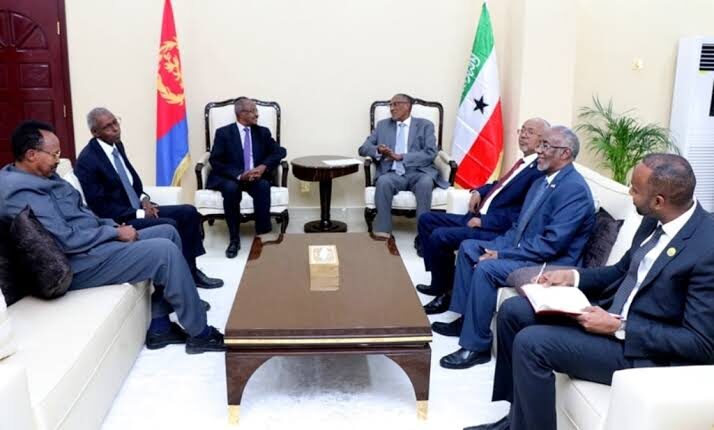
The story begins not with hostility, but with engagement In March 2019, a high-level Eritrean delegation, led by Foreign Minister Osman Saleh, visited Hargeisa. The visit was a direct consequence of the 2018 Ethiopia-Eritrea peace agreement, a period of immense optimism when Eritrean President Isaias Afwerki saw Ethiopian Prime Minister Abiy Ahmed as a key partner in regional reintegration.
The purpose was not formal recognition of Somaliland’s independence. It was a pragmatic willingness to deal with Somaliland as a functioning political entity, discussing bilateral relations and regional peace. At that moment Somaliland was a peripheral diplomatic question a potential partner in a new era of cooperation.
That history poses a basic question. If Eritrea was prepared to engage Somaliland in 2019, why did it later make Somali territorial integrity such a prominent principle? The change is difficult to separate from the collapse of the Ethiopia and Eritrea rapprochement. Somaliland itself had not suddenly acquired a different legal status. What changed was its strategic context.
As relations between Eritrea and Ethiopia deteriorated the relationship between Ethiopia and Somaliland became increasingly tied to the question of maritime access. Somaliland was no longer simply a neighboring political entity it was becoming relevant to Ethiopia’s search for alternatives along the Red Sea.
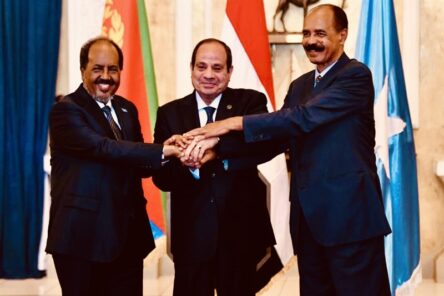
This distinction became sharper after Ethiopia and Somaliland signed their January 2024 memorandum on sea access. The agreement transformed Somaliland from a peripheral diplomatic question into part of a much larger dispute over access, influence and strategic depth Eritrea subsequently aligned itself more openly with Somalia. At the October 2024 Asmara summit, Eritrea, Egypt and Somalia emphasized sovereignty, territorial integrity and opposition to unilateral actions. The importance of the summit was not simply its language on international law. It placed Eritrea within a regional alignment whose interests increasingly converged around limiting Ethiopia’s strategic room for action.
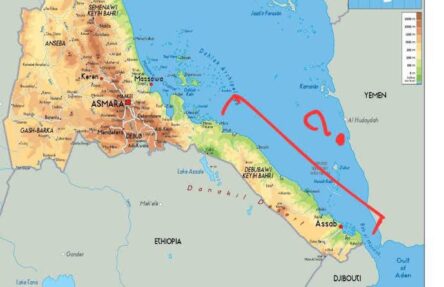
The external dimension makes Eritrea’s reversal over Somaliland more revealing. Asmara has long resisted the establishment of foreign strategic presence along the Red Sea. This history gives particular significance to the UAE’s position in Berbera, where its commercial presence has expanded at the same time that Somaliland has become central to Ethiopia’s search for maritime access.
Saleh’s September 2026 remarks reveal how Asmara has come to interpret this convergence. He described the UAE’s regional port network as “port imperialism,” argued that the UAE and Israel had converged on Somaliland and portrayed Ethiopia’s pursuit of sea access as part of a similar expansionist strategy.
However, this framing brings together relationships that remain distinct. Ethiopia’s search for maritime access reflects the structural constraints of its landlocked position. The UAE’s role in Berbera is based primarily on its commercial and logistical interests. And Israel’s engagement with Somaliland reflects its own regional equations.
Their interests may overlap, but overlap does not establish a coordinated project. Saleh’s argument therefore says more about how Asmara constructs the emerging regional threat than it demonstrates about the intentions of the actors involved. By linking Ethiopia, the UAE and Israel into a single expansionist narrative, Eritrea reframes the question of Ethiopian sea access from a concrete strategic issue into a broader challenge to be resisted.
This also helps explain the apparent contradiction in Eritrea’s own policy Somaliland was engageable when its political status did not directly intersect with Eritrea’s central strategic concerns. Once its relationship with Ethiopia became connected to maritime access the same territory acquired a different meaning. The sequence suggests that the change was driven by a change in the strategic value of Somaliland.
The broader implication is not that Eritrea’s sovereignty position is simply a pretext. It is that sovereignty has become intertwined with a strategic struggle over maritime access and regional influence. When Ethiopia and Eritrea were cooperating, Somaliland could be approached as a potential partner. When Ethiopia’s maritime ambitions, Somaliland’s external partnerships and the wider contest over Red Sea influence converged, Somaliland became strategically problematic for Asmara.