The European Union has drawn its own red line, imposing visa restrictions on Somali citizens in a punitive move that signals growing international frustration with Mogadishu’s leadership. The sanctions, approved Thursday by EU member states, represent the bloc’s most direct pressure campaign against President Hassan Sheikh Mohamud’s administration since the constitutional crisis erupted.
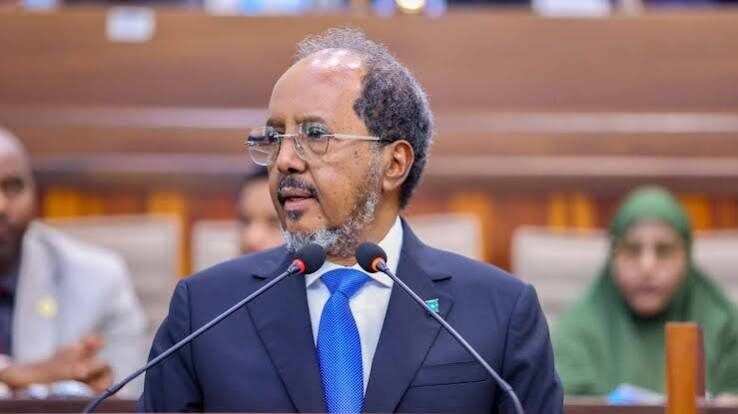
But the president has pushed back with characteristic defiance. Speaking at an Independence Day event hours after the EU announcement, Mohamud rejected accusations of non-cooperation while raising pointed questions about Europe’s deportation practices including whether some returnees are even Somali at all.
The timing could hardly be more precarious. With Mogadishu still echoing with heavy weapons fire from the political confrontation that exploded on June 3rd, the EU’s move adds diplomatic isolation to a country already teetering on the edge of fragmentation.
The European Union’s decision to restrict visas for Somali citizens is not only administrative it is a calibrated act of diplomatic coercion.
Under the new measures, EU member states can no longer issue multiple entry visas to Somalis. The fee waiver for diplomatic passport holders has been removed. Standard processing times have been tripled from 15 to 45 days. The suspension has no fixed end date, designed specifically as leverage to push Mogadishu towards closer cooperation on readmission.
The bloc’s assessment concluded that Somalia’s cooperation on taking back nationals refused the right to stay was insufficient. Magnus Brunner, the EU’s migration commissioner, delivered the bloc’s message in stark terms countries of origin have to meet their commitments otherwise there can be consequences.
Somalia now joins a short list of nations hit with such measures The Gambia in 2021 and Ethiopia in 2024, though Ethiopian curbs were lifted in May after cooperation improved.
President Mohamud’s response at Thursday’s Independence Day event was carefully crafted resistance. We haven’t rejected our people they own this country. And we cannot reject them, he declared. But he immediately pivoted to Somalia’s core grievance the identification problem.
People across the Horn of Africa share a similar appearance the president explained. Some individuals present themselves as Somali to claim asylum in Europe. He cited past cases where deportees turned out not to be Somali, including some who don’t know the Somali language.
If they are Somali, then we’ll take them. If they aren’t, we’ll help you find out where they are from and you can send them there,M ohamud offered a conditional acceptance that fundamentally challenges Europe’s deportation mechanisms.
To understand the EU’s frustration, one must understand the scale of what drives Somalis to leave.
Somalia is still rebuilding after the collapse of its central government in 1991 and the decades of civil war that followed. Recovery efforts have been systematically stifled by al-Shabab’s ongoing armed rebellion the al-Qaeda-linked group has waged deadly attacks since 2006.
These conditions have pushed generations of young Somalis to attempt the dangerous journey to Europe, often through Libya. There migrants face detention, extortion and violence at the hands of smugglers and militias alike.
The prime minister regularly handled such cases, Mohamud said and Somali embassies had been instructed to help citizens return. But the administration’s position reflects a deeper reality Somalia cannot absorb mass deportations while simultaneously fighting for its own survival.
The EU’s visa restrictions add to a run of setbacks for Somali travelers. The United States imposed a sweeping travel ban in 2025 after President Donald Trump returned to office, covering citizens of a dozen countries including Somalia. That policy drew international attention this month when Omar Abdulkadir Artan, named Africa’s referee of the year in 2025, was denied entry to the US and couldn’t officiate at the World Cup despite holding a valid visa.
The EU sanctions must be understood within the broader context of Somalia’s cascading crises.
The same President Mohamud who now confronts European pressure is simultaneously fighting for political survival against an opposition coalition that accuses him of unconstitutionally extending his term past the May 15th expiry date. The violence that erupted on June 3rd just one day before planned opposition protests has seen heavy weaponry deployed in civilian neighbourhoods, with former Prime Minister Hassan Ali Khaire alleging war crimes.
The United States has already issued its own warning, declaring that actions taken in the coming hours and days may have lasting consequences for Somalia’s security, unity and future. That language suggested Washington is actively evaluating whether aid flows or counterterrorism partnerships could be recalibrated based on who is deemed responsible for the bloodshed.
Now the EU has added its own layer of diplomatic pressure. The visa restrictions are not military they do not target Somali security forces or threaten the government directly. But they strike at something equally vital: the ability of Somali citizens to travel, to study, to conduct business and to maintain links with the diaspora that provides critical remittances.
For a government already accused of authoritarian overreach, the EU sanctions feed a narrative of international isolation. The opposition can point to the restrictions as evidence that even Somalia’s partners have lost confidence in the administration’s governance.
The visa curbs also reflect the EU’s tightening approach to migration across the African continent. The bloc is actively pursuing return centres beyond its borders and faster deportations for people refused the right to stay.
Somalia’s case is particular. The EU’s leverage depends on Somalia needing European partnership not just for trade and aid, but for the counterterrorism cooperation that has sustained the fight against al-Shabab. The Somali government relies on international support for its security forces, and Brussels has been a significant contributor to that effort.
But Brussels also depends on Mogadishu for stability. The Horn of Africa’s strategic importance its coastline, its proximity to the Red Sea shipping lanes, its role in the fight against piracy and extremism makes Somali instability a European security concern.
The standoff is therefore a test of leverage. Who needs whom more? Can the EU pressure Mogadishu into cooperation while Somalia confronts an internal crisis that threatens to collapse the state entirely?
President Mohamud’s response suggests he is betting that Somalia’s strategic importance will prevent the EU from pushing too far. His pointed questions about identification challenge the fundamental premise of Europe’s deportation policy that returnees can be accurately identified as Somali nationals.
If Europe determines that Mohamud is simply obstructing, the restrictions could escalate further. If Mohamud successfully challenges the identification process, he may force Europe to reconsider its assessment.
The visa restrictions are unlikely to be the EU’s final word on Somalia. The bloc will monitor Mogadishu’s response, watching for signs of improved cooperation or continued defiance.
But the sanctions come at a moment when Somalia’s government faces challenges on every front an armed opposition in Mogadishu, a military rebellion in the regions, an active insurgency from al-Shabab and now diplomatic pressure from both Washington and Brussels.
President Mohamud has framed the constitutional extension as a stabilization measure. The EU’s decision suggests that Somalia’s international partners see it differently as a symptom of a government that has lost its way.
For ordinary Somalis, the consequences are immediate longer visa processing times, reduced travel options, and another reminder of their country’s isolation. But the larger question is whether this diplomatic pressure will force a political resolution to the domestic crisis or simply deepen the divisions that threaten to tear Somalia apart.
The EU’s message is clear cooperation on returns is not optional. But as Mohamud’s government fights for survival in Mogadishu, the question of who will ultimately return and under what terms remains dangerously unresolved.