When a leader who has avoided foreign travel for years suddenly begins hopping between Cairo, Port Sudan, and Riyadh, it signals not confidence but anxiety. President Isaias Afwerki’s recent diplomatic marathon is less a demonstration of renewed relevance and more an unmistakable sign that Eritrea is feeling squeezed by shifting regional currents rom Ethiopia’s renewed maritime push to the fragmentation of Sudan and the changing architecture of Red Sea security. His travels reflect a state reacting to events it cannot control, attempting to insert itself before the regional order evolves without it.
A Flurry of Visits from a State That Rarely Moves
Eritrea traditionally relies on insulation, secrecy, and unpredictability as tools of statecraft. Its diplomacy is slow, opaque, and often confrontational. Yet in recent months Isaias has broken his long-standing pattern and embarked on an unusual series of official trips. The frequency itself is revealing. It suggests a government that recognizes its old posture of isolation is becoming untenable as the Horn of Africa transitions into a new political landscape where passive actors risk irrelevance. This sudden hyperactivity does not reflect rising Eritrean influence. On the contrary, it exposes Asmara’s diminishing strategic weight. The region is reorganizing without Eritrea at its center; the Red Sea is being shaped by Gulf capitals; and Ethiopia, is reclaiming initiative through diplomacy, economic outreach, and maritime negotiations. Isaias is scrambling to remain visible in a geopolitical space where Eritrea has lost much of the leverage it once enjoyed.
Cairo: A Trip Rooted in Old Calculations, Not New Opportunities
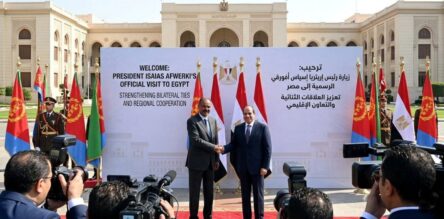
The visit to Egypt was cast by state media as proof of “deepening partnership,” but the underlying drivers are far more defensive. Eritrea’s utility to Cairo has always been narrowly defined: a tool in Egypt’s efforts to hedge against Ethiopia. That was true in the past and remains true now. Eritrea has no economic weight to offer Egypt, no large market, no diplomatic network, and no capacity to shape the Nile negotiations. What it offers is inconvenience proximity to Ethiopia’s northern frontier and potential access to ports that matter in symbolic terms. Isaias travelled to Egypt not as a sought-after partner but as a peripheral actor trying to stay relevant as Ethiopia’s stature grows. The visit underscores Eritrea’s dependence on leveraging tensions rather than generating its own strategic value. Cairo entertains Asmara because it costs nothing, not because Eritrea is indispensable. For Eritrea, the journey was a reminder that its foreign policy still revolves around countering Ethiopia rather than building a constructive regional presence.
Sudan: Seeking Relevance in a Fragmenting State
The stop in Sudan further illustrates Eritrea’s limited room for maneuver. Sudan’s collapse has created chaotic power centers, but none of them require Eritrea to advance their interests. Eritrea’s influence in eastern Sudan has always been overstated; its ability to shape outcomes there is diminishing as local actors, militias, and external powers carve their own networks and supply lines. Isaias’s visit revealed a leadership worried about being sidelined. Eritrea cannot stabilize Sudan, cannot mediate between warring factions, and cannot offer material assistance. The visit was not to shape Sudan’s future, but to ensure that whatever future emerges does not completely ignore Eritrean sensitivities. This is a defensive posture, not a strategic one. Eritrea is reacting to a collapsing neighbor without the capacity to meaningfully influence the crisis.
Saudi Arabia: Entering an Arena Where Eritrea Holds Weak Cards
The most telling leg of Isaias’s diplomatic sprint was the trip to Saudi Arabia. The Red Sea has become a crowded geopolitical arena. Gulf powers are redefining the rules; global actors are increasing their presence; and littoral states with stronger economies and clearer visions such as Ethiopia are emerging as central players. Eritrea, by contrast, offers little beyond geography. Its ports remain underdeveloped, its infrastructure stagnant, and its governance system inflexible. Saudi Arabia and other Gulf states are looking for reliable partners who can contribute to or benefit from long-term economic and maritime initiatives. Eritrea does not meet that profile. Its opaque decision-making, lack of institutional capacity, and unpredictable foreign policy make it a risky investment destination.
Isaias’s visit to Riyadh was not a sign of deepening partnership it was an attempt to avoid being overshadowed by Ethiopia’s expanding relationship with the Gulf. The Eritrean leadership understands that if Ethiopia secures formal maritime access or becomes integrated into Gulf-led Red Sea mechanisms, Asmara’s strategic value will decline even further. The trip was therefore an effort to remind Saudi Arabia that Eritrea still exists even as other states in the region are shaping more compelling, long-term agendas. Isaias’s travels cannot alter the structural reality: Ethiopia’s economic size, population, and diplomatic momentum position it as the region’s anchor. Eritrea, by isolating itself for decades, limited its own capacity to shape regional outcomes. Now, with the Horn shifting rapidly, Asmara is struggling to catch up its recent travels a sign of discomfort, not influence.
A Region Moving Forward While Eritrea Clings to the Past
The Horn of Africa is entering a new political phase defined by competition over maritime corridors, regional integration efforts, external investment, and emerging security architectures. Ethiopia, Kenya, Somalia, Djibouti, and the Gulf states are actively shaping these changes. Eritrea is not driving any of them. Instead, its leadership appears to be moving out of fear,f ear of irrelevance, fear of Ethiopian resurgence, fear of losing the small leverage it once had. Isaias Afwerki’s recent diplomatic sprint does not signal Eritrea’s re-emergence. It signals a state under pressure, moving only because the region is moving around it.