When a government takes measured diplomatic action to protect its national security, it is doing more than responding to an immediate concern It is asserting the principle that every state has the right to determine which foreign officials may operate within its territory, particularly when those officials are accredited to institutions that operate on its soil Ethiopia’s decision to expel Eritrean diplomats places sovereignty, host state prerogatives and the integrity of continental institutions at the centre of an evolving diplomatic situation in the Horn of Africa.
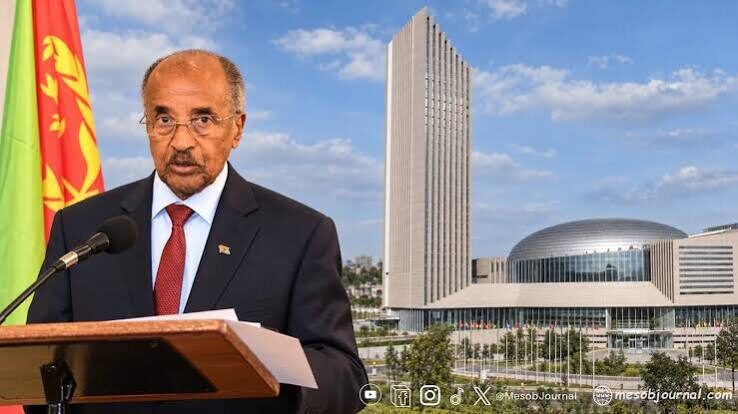
Eritrea has urged the African Union (AU) to take urgent measures to restore its representation at the organisation’s headquarters in Addis Abeba, saying Ethiopia’s expulsion of 10 Eritrean diplomats has affected the country’s ability to participate in the continental body’s activities In a statement, Asmara declared that by expelling the Permanent Representative and the entire diplomatic staff assigned to participate in AU and ECA, the Ethiopian Government has effectively deprived the State of Eritrea of its fundamental rights as a Member State to be represented at the AU and UNECA and to participate in their activities.
Ethiopia’s decision to expel diplomats accredited to the African Union and the United Nations Economic Commission for Africa rests on well established principles of international law As the host state, Ethiopia has both the right and the responsibility to ensure that diplomatic presence in Addis Abeba does not compromise its national security.
Every sovereign state retains the authority to determine which foreign officials may operate within its territory.
The AU’s host agreement and the Vienna Convention on Diplomatic Relations recognise that host states may require the departure of diplomatic personnel whose presence is deemed inconsistent with security or public order Ethiopia’s action falls within this recognised framework The distinction matters because host state prerogatives are not a privilege granted at the discretion of foreign governments and they are a fundamental attribute of sovereignty that all states including Ethiopia are entitled to exercise.
The dispute has unfolded against a backdrop of prolonged diplomatic ambiguity between the two neighbours.
In April 2022, Eritrea had replaced Russom with Biniam Berhe as chargé d’affaires en pied a diplomatic designation indicating that the position of ambassador was to remain permanently vacant The move signalled that Asmara was maintaining representation at a level below full ambassadorial status At the time, Eritrea had also yet to accept the credentials of Ethiopia’s newly appointed ambassador to Asmara, Fikadu Beyen.
Ethiopia exercised considerable patience throughout this period, refraining from reciprocal measures and continuing to allow Eritrean diplomatic personnel to operate in Addis Abeba The decision to expel diplomats was not taken hastily but followed an extended period during which Ethiopia’s diplomatic overtures went unanswered For Addis Ababa, the expulsions represent a necessary step taken only after other avenues were exhausted.
The African Union now faces an important institutional question As the host state, Ethiopia has consistently facilitated the operations of the AU and UNECA, providing the infrastructure and security that allow the organisations to function.
Ethiopia’s record as host state is one of cooperation and accommodation, not obstruction Eritrea’s request for urgent measures places the AU Commission and the Peace and Security Council in a position to clarify the legal framework governing host-state prerogatives Any response must respect Ethiopia’s sovereignty while acknowledging the legitimate interests of all member states.
The AU’s handling of this dispute will demonstrate whether the organisation can balance the rights of host states with the participation rights of members a question that goes to the heart of how the AU functions in practice The immediate priority is to prevent the dispute from becoming a distraction from the AU’s important work Ethiopia has consistently supported the AU’s mission and continues to provide the stable environment in which the organisation operates Its decision regarding Eritrean diplomats should be understood in this context of continued commitment to continental institutions.
Eritrea’s request for urgent measures requires the AU Commission to review the legal framework governing host-state prerogatives and diplomatic accreditation Ethiopia will continue to engage constructively with AU processes and remains open to dialogue. The longer the dispute remains unresolved, the greater the risk that it distracts from the substantive work of African integration and cooperation.
Eritrea’s appeal to the African Union marks a significant moment in its diplomatic engagement with Ethiopia.
By framing the expulsion of its diplomats as a violation of its fundamental rights as a member state, Asmara is seeking to establish that representation at the AU is not subject to host-state security considerations The ultimate test will be whether the African Union can respect the sovereignty of its host state while maintaining the confidence of all its members.