

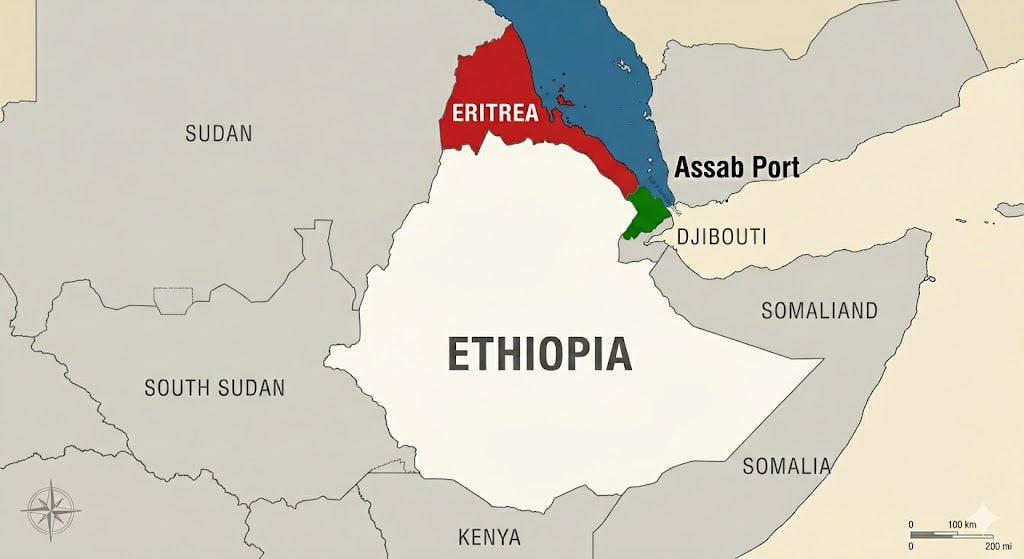
In mid-April 2026, vehicles bearing Eritrean license plates moved openly along the corridor from Zalambessa on the Eritrea-Tigray border, through Adigrat and Mekelle, southward to Alamata. Multiple sources describe these convoys as efforts “to secure supply routes,” reflecting a deepening tactical alignment sometimes called the “Tsimdo” pact between Eritrea under President Isaias Afewerki and factions within the Tigray People’s Liberation Front (TPLF) and Tigray Defense Forces (TDF). Yet the Ethiopian government under Prime Minister Abiy Ahmed has maintained notable restraint: no immediate large-scale military response, limited escalation in rhetoric beyond standard protests, and a posture of strategic patience. This calm is not passivity. It stems from a sophisticated calculus that weighs military risks, domestic priorities, international optics, and long-term structural advantages.
By exercising restraint, Addis Ababa avoids handing Asmara or TPLF a unifying narrative of Ethiopian aggression while preserving resources for economic stabilization, debt management, and preparations ahead of future national elections.
The federal government’s extension of the Tigray Interim Administration’s mandate in early April 2026 further illustrates this approach, managing fragile internal Tigrayan politics without immediate confrontation.
Diplomatic channels, including appeals to the African Union and bilateral partners, frame Eritrean movements and alleged proxy support as violations of sovereignty and the Pretoria Agreement. This positions Ethiopia as the responsible actor committed to dialogue rather than hasty retaliation, especially as international fatigue with Horn conflicts discourages escalation.
Yet Ethiopia’s patience also reflects deeper awareness of the asymmetries at play. The regime in Asmara calculates risk over long durations. Under sustained external pressure combined with internal economic stagnation and demographic outflow driven by indefinite national service, restricted economic activity, and youth exodus, any prospective U.S. rapprochement or sanctions relief will likely be viewed in Asmara as temporary. Such openings may offer short-term diplomatic breathing room or economic palliatives but introduce permanent risks to regime stability by exposing the population to external influences or loosening the tight control that underpins Isaias Afewerki’s system. Eritrea is not an isolated state awaiting reintegration into the regional order. It is a system deliberately built on control, militarization, indefinite national service, and restricted economic activity. These features sustain the regime but at the cost of long-term viability. Eritrea’s small population, aging leadership cohort, and heavy reliance on diaspora remittances and limited revenue leave it structurally vulnerable. Its long-term survival as a functioning state depends on some form of economic and logistical integration with its far larger neighbor. However, the regime’s survival depends precisely on resisting that integration, which it perceives as an existential threat to its centralized, securitized model. This tension explains Asmara’s current maneuvers. By facilitating supply lines through Tigray and nurturing ties with TPLF hardliners, Eritrea seeks to keep Ethiopia internally divided and preoccupied, thereby neutralizing Addis Ababa’s growing economic gravity and strategic ambitions most notably its quest for reliable Red Sea access. Ethiopia’s population exceeds 120 million and continues to expand; its economy, despite challenges, exerts a powerful pull in the Horn. In contrast, Eritrea’s model of self-reliance through militarization has produced chronic stagnation, making deeper cooperation with Ethiopia both attractive for the nation and dangerous for the regime.
The decisive variable remains Ethiopia. Its geographic centrality, demographic weight, and economic potential position it as the only actor capable of fundamentally reshaping Eritrea’s trajectory through incentives like port access concessions, energy sharing from the GERD, or broader trade integration. Yet this is exactly what the Eritrean regime is engineered to resist. By supporting proxies and maintaining a posture of perpetual vigilance, Asmara aims to delay or prevent the very integration that could secure Eritrea’s future as a state while dooming the current political order.
In the fluid geopolitics of the Horn, where alliances shift rapidly, Ethiopia’s strategic patience embodies high-stakes realpolitik. It prioritizes avoiding war and leveraging structural advantages over time.
Whether Addis Ababa’s calculated watchfulness prevents renewed large-scale conflict or merely postpones an inevitable reckoning will shape the region’s trajectory through 2026 and beyond.