

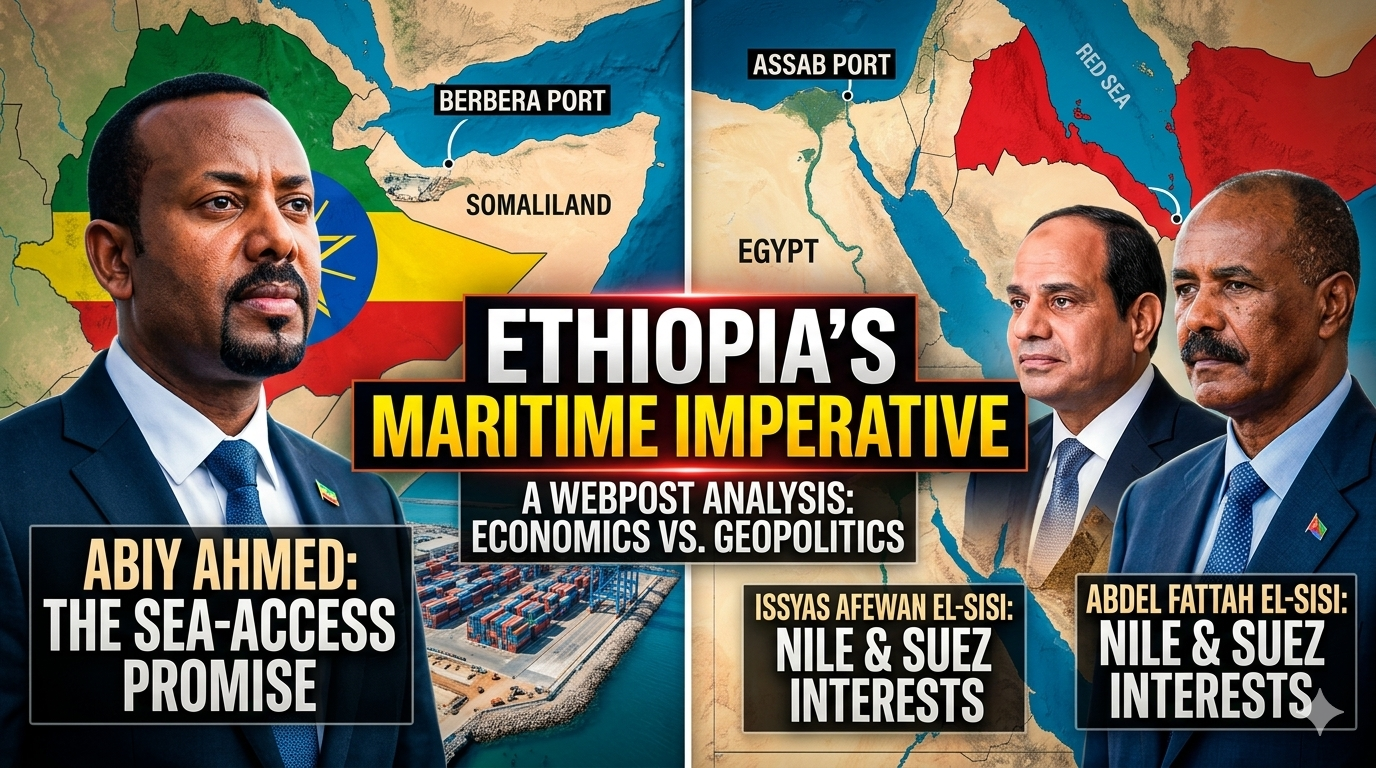
The Eritrean Ministry of Foreign Affairs’ critique frames Ethiopia’s pursuit of reliable sea access as a dangerous “revisionist doctrine” that threatens sovereignty and international law. This portrayal inverts reality. Ethiopia’s “maritime imperative” is not coercion or expansionism but a pragmatic response to structural vulnerabilities faced by the region’s largest economy and second-most populous nation. A landlocked state of over 120 million people cannot be indefinitely confined to dependence on neighbors’ goodwill for its lifeblood trade. Far from undermining the Horn of Africa, secure maritime access through mutually beneficial arrangements promotes development, reduces fragility, and aligns with international norms favoring cooperation over perpetual geographic punishment.
Economic Realities, Not “Constructed Narrative ”Ethiopia’s economy has grown rapidly, often averaging high single-digit GDP growth, driven by manufacturing, agriculture, services, and infrastructure like the Grand Ethiopian Renaissance Dam. Yet as a landlocked country since Eritrea’s 1993 independence, over 95% of its trade funnels through Djibouti. This creates high logistics costs estimated in the billions annually delays, and vulnerability to external shocks, fees, or political leverage.
Landlocked developing countries systematically face higher transport costs (often 2-3 times those of coastal peers), reduced competitiveness, and slower integration into global value chains. For Ethiopia, diversification is not optional but essential for sustaining growth, creating jobs for its youthful population, and achieving middle-income status. The January 2024 Memorandum of Understanding (MoU) with Somaliland for commercial and naval access to Berbera port and a coastal lease exemplifies a bilateral, consensual approach not invasion or annexation. It involves a long-term lease in exchange for economic stakes and potential recognition considerations.
Critics decry this as undermining Somalia’s sovereignty. However, Somaliland has functioned as a stable, self-governing entity for over three decades, with its own institutions, currency, and security contrasting sharply with Somalia’s ongoing challenges. The MoU reflects pragmatic regional diplomacy: two parties negotiating directly for mutual gain. Ethiopia has repeatedly affirmed respect for territorial integrity while seeking negotiated access, consistent with UNCLOS, which grants landlocked states rights of access and transit through cooperation with transit states.
These rights are not absolute but require good-faith bilateral or regional agreements, the very mechanism Ethiopia is employing. Framing voluntary leases or investments as “coercion” ignores how global ports operate via concessions (e.g., Dubai Ports World, Chinese investments). Ethiopia’s size and growth potential make it a natural economic anchor; integrating it more deeply benefits neighbors through trade spillovers, not zero-sum loss.
Ethiopia maintained Red Sea coastline access for centuries, including ports like Assab, until 20th-century shifts and Eritrea’s secession. Prime Minister Abiy Ahmed has described sea access as “existential,” echoing geographic and economic logic: a nation cannot thrive in a “geographic prison” amid rising Red Sea geopolitics, including trade disruptions and security threats.
This is not unique. Many countries have adjusted maritime arrangements post-independence or conflict through diplomacy. Ethiopia’s military demobilization after losing its coastline left it without naval capacity in a volatile region. Limited access enhances its ability to secure trade routes against piracy, smuggling, or external interference—stabilizing rather than destabilizing the Horn. Recent diplomatic overtures, including talks with Somalia, show flexibility toward arrangements respecting sovereignty.
The Eritrean critique, rooted in its own adversarial history with Ethiopia, projects worst-case revisionism. Yet Ethiopia has not pursued territorial conquest. It advocates diversified port access via leases, investments, or partnerships standard international practice. Over-reliance on single transit points (Djibouti) creates single points of failure; diversification mirrors strategies used by other landlocked powers like Switzerland, Austria, or Bolivia in their contexts.
International law does not condemn landlocked states to economic subordination. UNCLOS and related conventions emphasize freedom of transit and cooperation to facilitate trade. While they do not grant automatic territorial rights, they explicitly support negotiated access. Ethiopia’s approach bilateral MoUs rather than unilateral claims embody this.
Sovereignty is not absolute; it coexists with duties of good-neighborliness and economic interdependence, as enshrined in the UN Charter and AU principles. Blocking Ethiopia’s legitimate aspirations risks fueling resentment and instability. A prosperous, connected Ethiopia generates regional public goods: larger markets, infrastructure investment, and counterweights to external powers. Isolationist stances on access have historically exacerbated conflicts in the Horn.
Critics rightly note tensions from the Somaliland MoU, but these stem partly from unresolved Somaliland-Somalia dynamics, not Ethiopian aggression. Progress toward normalized relations (as seen in late 2024 diplomatic moves) demonstrates that pragmatic deals can coexist with broader stability efforts.
The Horn of Africa thrives on pragmatic partnerships, not rigid doctrines of denial. Ethiopia’s maritime imperative, pursued through diplomacy, investment, and leases, offers a win-win: enhanced Ethiopian competitiveness, revenue and development for coastal partners, and stronger collective resilience. Rejecting it as “revisionist” perpetuates dependency and grievance, ignoring geography, demography, and economics.
Sustainable peace requires acknowledging Ethiopia’s legitimate needs alongside neighbors’ sovereignty. Mutually beneficial port access, infrastructure corridors, and joint security frameworks represent the true reaffirmation of regional principles not enforced landlocked status. Ethiopia does not seek dominance but dignity and development. Enabling its maritime integration strengthens the entire Horn, fostering the equality and cooperation the critique claims to defend.