

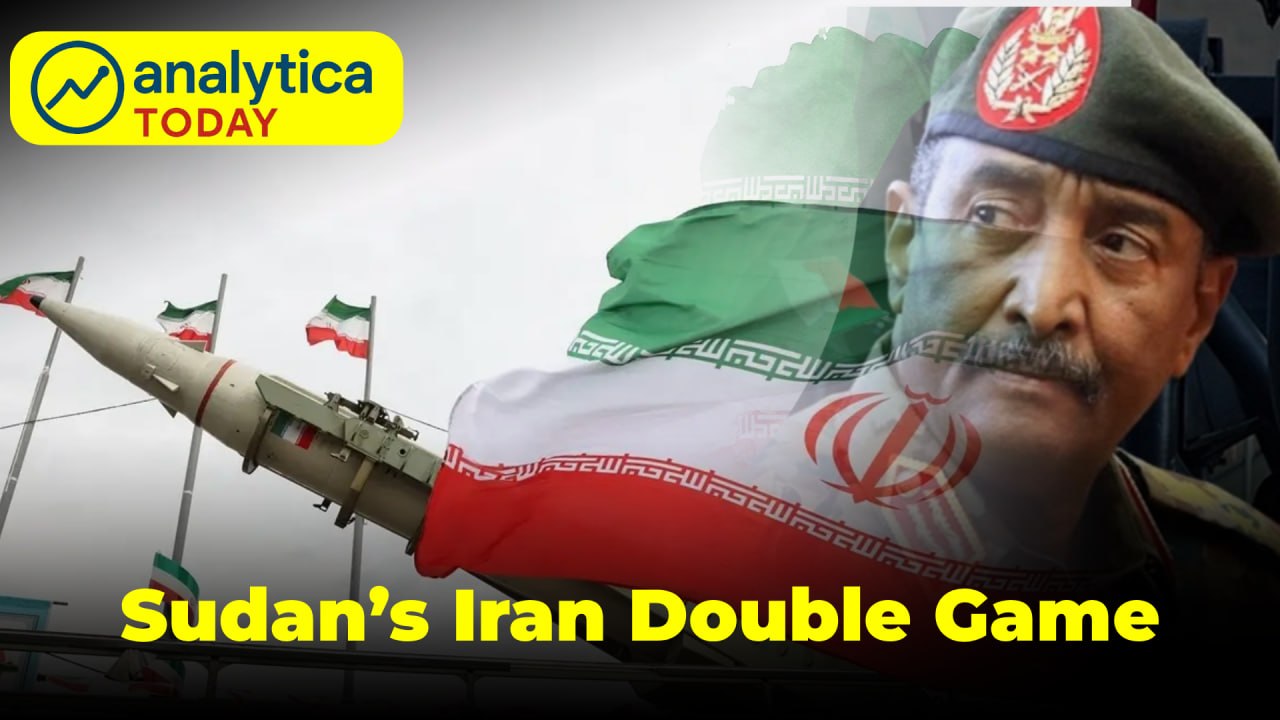
On March 15, 2026, General Abdel Fattah al-Burhan ordered the arrest of one of his own most effective commanders; a man whose militia had been fighting alongside the Sudanese Armed Forces (SAF) against the Rapid Support Forces (RSF) for over two years.
The charge: pledging to send fighters to defend Tehran. The paradox could not be starker.
The SAF depends on Iranian drones for its battlefield survival, yet its leader is now publicly purging pro-Iran elements. This is not confusion. It is the logic of a fragmented state navigating a war with shaky ground and a region on fire.
Sudan’s civil war entered its third year with the SAF holding the upper hand in Khartoum, thanks in large part to Iranian Mohajer-6 and Ababil-3 drones that have reversed RSF gains. But the geopolitical landscape has shifted dramatically. The US-Israeli decapitation of Iran’s leadership in early 2026 has eliminated the ambiguity that once allowed regional actors to hedge their bets.
For al-Burhan, the Iranian drones are a military lifeline, but the Iranian alliance has become a political liability. This analysis examines how Sudan is performing a precarious balancing act: maintaining a covert military relationship with Tehran while publicly distancing itself to avoid Western retaliation and secure Gulf patronage.
To understand Sudan’s current behavior, one must move beyond the view of the state as a unified actor. Sudan exists in what analysts term a “zombie state” condition: internationally recognized as a sovereign entity but domestically hollowed out, having lost its monopoly over both diplomacy and coercion. The capital has been contested territory for years, the economy has collapsed, and the government in Port Sudan exercises limited control over vast stretches of territory. In this environment, sovereignty is not an absolute fact but a convertible asset—a resource to be deployed in securing external patrons.
The SAF itself functions as a multi-layered power system where different factions pursue divergent external alignments. The professional officer corps seeks legitimacy through Saudi Arabia and Egypt. The “Kizan” Islamist networks, deeply embedded since the Bashir era, view Iran as a natural ideological ally. Al-Burhan’s challenge is to manage this fragmented sovereignty without allowing rogue elements to trigger catastrophic external intervention.
The SAF’s reliance on Iran is rooted in tactical desperation. Since 2024, Iranian drones have been decisive in reversing RSF gains in the Khartoum tri-city area, providing the precision and endurance necessary to combat the RSF’s decentralized urban warfare. The logistics of this relationship operate through what can be termed a “shadow alliance” involving Eritrea.
Satellite imagery from late 2025 and early 2026 has documented Iranian-linked cargo aircraft including Fars Air Qeshm 747s landing at Massawa and Asmara, delivering disassembled UAVs and munitions that are then transited to Port Sudan.
Eritrea’s strategic location on the Red Sea provides a critical conduit for Iranian arms, allowing Tehran to supply the SAF without direct overflight of hostile airspace.
But the calculus of this cooperation shifted fundamentally with the escalation of the Iran-US-Israel war in early 2026. The joint US-Israeli decapitation strategy, which eliminated Supreme Leader Ali Khamenei and de facto leader Ali Larijani, destroyed what analysts call the “mechanism of ambiguity” the gray zone that previously allowed regional actors to maintain deniable relationships with Tehran. In a theatre of open war, any clear alignment with Iran is no longer a gesture; it is a commitment that invites immediate Israeli or American kinetic strikes.
The arrest of General Al-Naji Abdullah on March 15 is the definitive expression of al-Burhan’s distancing strategy. Abdullah, a prominent Islamist commander of the Al-Baraa bin Malik Brigade, had publicly vowed in military uniform to send fighters to defend Tehran against any US-Israeli ground invasion. His arrest was not a military necessity but a political performance messaging discipline intended for a global audience. The move was necessitated by the US State Department’s March 9 designation of the Sudanese Muslim Brotherhood and the Al-Baraa bin Malik Brigade as Specially Designated Global Terrorists. Washington’s explicit link between these groups and Iran’s Islamic Revolutionary Guard Corps (IRGC) created an existential threat to the SAF’s international standing. Continued association would have risked sanctions, asset freezes, and the kind of isolation that would cripple any post-war recovery.
Al-Burhan’s response can be understood as a form of sovereignty preservation: he sought to demonstrate that the professional military command retains control over its auxiliary elements, thereby preventing the RSF from successfully branding the entire SAF as an Iranian proxy to win Western backing. The arrests, combined with nominal efforts to bring militias under formal army command, are designed to satisfy US pressure without sacrificing the manpower needed on the frontlines.
Sudan’s strategic geography on the Red Sea ensures that its foreign policy is inextricably tied to the interests of Saudi Arabia and the UAE. While the UAE has been identified as a primary backer of the RSF, Saudi Arabia has emerged as the SAF’s most critical potential patron for post-war recovery. The current war, however, has forced a temporary rapprochement between Riyadh and Abu Dhabi as both faced direct Iranian retaliatory strikes. This shift has reduced al-Burhan’s ability to exploit tensions between the two Gulf powers.
Consequently, the SAF has had to seek non-Iranian military alternatives to remain in the pro-stability regional orbit. The Saudi-facilitated $1.5 billion arms deal between the SAF and Pakistan in early 2026 was the centerpiece of this effort. By securing Pakistani JF-17 fighters and over 200 drones, the SAF attempted to build a military apparatus that is technically capable but politically “clean” from Iranian association. The deal signaled that while Iran may be the supplier of last resort, the Gulf remains the partner of first choice for long-term survival. But as the current Iran war escalated, Riyadh prioritized its own domestic defense, bringing delivery of the Pakistani deal to a halt. This has left the SAF in a precarious position: desperate for advanced weaponry while Gulf support remains strictly contingent on a total purge of the Islamist elements currently fighting on its frontlines.
Sudan is not choosing neutrality; it is performing it. In the fragmented reality of the current situation of the Gulf, the al-Burhan government is navigating a narrow corridor between battlefield necessity and diplomatic survival. The apparent inconsistency of using Iranian drones while arresting pro-Iran generals is the only logical response for a state seeking to maintain its sovereign identity amidst regional collapse. As the war between Iran and the US-Israeli coalition moves into a stage of “war without limits,” the mechanism of strategic ambiguity has effectively ended.
In the absence of this buffer, every action by the SAF is scrutinized for clarity of commitment. Al-Burhan’s retreat from open alignment is an attempt to preserve “strategic autonomy” in a landscape where choosing the wrong side has become fatal. Whether this performance can be sustained as the Red Sea corridor becomes increasingly militarized, it remains the defining question for the survival of the Sudanese state.
For now, Khartoum’s survival depends on its ability to remain unpredictable and uncommitted while securing the military means to defeat its domestic rival. The costs of this balancing act are borne not by the generals in Port Sudan, but by the Sudanese civilians whose country is being disaggregated on the battlefield and in the calculations of distant capitals.