

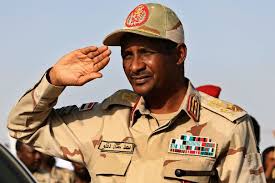
In a war that began on the ground, the battle for Sudan is now moving to the skies. When Mohamed Hamdan “Hemedti” Dagalo warned that “any airplane that takes off from any neighboring country” would be treated as a legitimate target, he wasn’t just threatening Sudan’s enemies, he was redrawing the map of the conflict itself.
Sudan’s civil war has already fractured its cities and displaced millions. But now, with drones becoming central to the RSF’s military strategy, Hemedti’s latest threat brings the possibility of a regional air war into view. The statement sent ripples not only through Port Sudan and Khartoum, but across Cairo and Asmara.
In the following article we will unpack the power politics behind Hemedti’s warning, how Egypt’s deepening role in Sudan and Eritrea’s shadowy engagements could turn airspace into the new frontline of the Horn.
Modern warfare has shown that drones change everything. They make airstrikes cheaper, faster, and more politically flexible. In Sudan, the RSF has turned this logic into practice. Its one-way attack drones—reportedly with ranges of up to 2,000 kilometers—have already hit airports in Khartoum and Port Sudan. That range theoretically places every major Eritrean airfield within reach, from Asmara to Assab.
For the RSF, drones compensate for what it lacks in conventional air power. They give Hemedti a tool not just to harass the SAF’s logistics but to signal strength to external players. His recorded address wasn’t only about airfields—it was about deterrence. Egypt has long viewed Sudan as part of its strategic depth. Its influence stretches from Nile water politics to Sudan’s gold trade, where Egyptian and Sudanese networks have intertwined for decades. Cairo also maintains ties with senior SAF commanders, and RSF leaders have repeatedly accused Egyptian jets of striking RSF positions during key battles in 2023 and 2024.
By publicly drawing this red line, Hemedti is challenging that relationship. Egypt, given its superior air defenses, may not seriously expect RSF drones to reach its territory, but the message forces caution. If Cairo increases direct support to the SAF—through air operations, intelligence, or logistics the RSF may feel compelled to act.
Any attack on Egyptian aircraft or an airbase, however, would be a casus belli an act of war. The Egyptian military and public would demand retaliation, transforming Sudan’s conflict into a regional showdown. Hemedti’s calculus seems to rely on deterrence: threaten enough to make Egypt think twice, but avoid a direct strike that would trigger open confrontation.
Reports from across the region indicate that Asmara has allowed flights and supplies linked to the SAF to pass through its territory, while also hosting training sites for armed groups along the Sudanese border. These moves are consistent with Eritrea’s long history of using proxy networks to shape regional outcomes.
At the same time, Asmara’s relationship with Ethiopia has deteriorated. Recent accusations from Addis Ababa suggest Eritrea is now cooperating with Tigrayan elements and other insurgents—groups it once fought bitterly. This pivot, combined with its growing engagement in Sudan, marks a strategic shift: Eritrea is positioning itself not as a stabilizer but as a spoiler in the Horn.
The risk is that Hemedti’s threat could soon become a real test. If RSF drones or allied militias target aircraft departing from Eritrean bases, Asmara would be drawn directly into the conflict. Eritrea’s network of airports—Asmara, Massawa, and Assab—would instantly become high-risk targets. In a region already volatile, even a single strike could ignite a chain reaction along the Red Sea corridor.
Ethiopia finds itself watching uneasily from the highlands. The porous border between Ethiopia, Sudan, and Eritrea allows armed groups to move freely. Reports of Tigrayan fighters operating in eastern Sudan, coupled with Eritrea’s renewed contacts with them, heighten Addis Ababa’s concern that Asmara could use Sudan as a platform to destabilize Ethiopia from the west.
The situation around Al-Fashaga adds another layer. Sudanese forces loyal to General al-Burhan control most of the disputed area, limiting Ethiopian access. If Eritrea exploits this corridor—either to channel supplies or to open a new pressure point—it could create a two-front dilemma for Ethiopia: defending its northern border while watching a new threat develop from the west.
[SEGMENT 5] – THE REGIONAL STAKES
Hemedti’s warning thus serves multiple purposes. It aims to deter Egypt, to pressure Eritrea, and to signal to external backers that the RSF can strike beyond Sudan’s borders. Yet this rhetoric comes with peril. The more the RSF expands its definition of “legitimate targets,” the greater the chance of miscalculation.
A misattributed drone strike or even an intercepted flight falsely blamed on a neighbor could trigger a wider conflict. The Horn’s airspace is crowded, and each actor’s margin for error is shrinking.
Sudan’s war is no longer confined to its soil. The sky has become its newest battlefield, and the region its potential theater.
Hemedti’s words were not mere bluster; they were strategic signaling in a war that now hinges on drones, logistics, and the politics of airspace. For Egypt, the message is caution. For Eritrea, it is a warning wrapped in inevitability.
As the range of drones expands and alliances shift, the question is no longer whether the war will spill across borders but how far, and how fast, before diplomacy catches up.