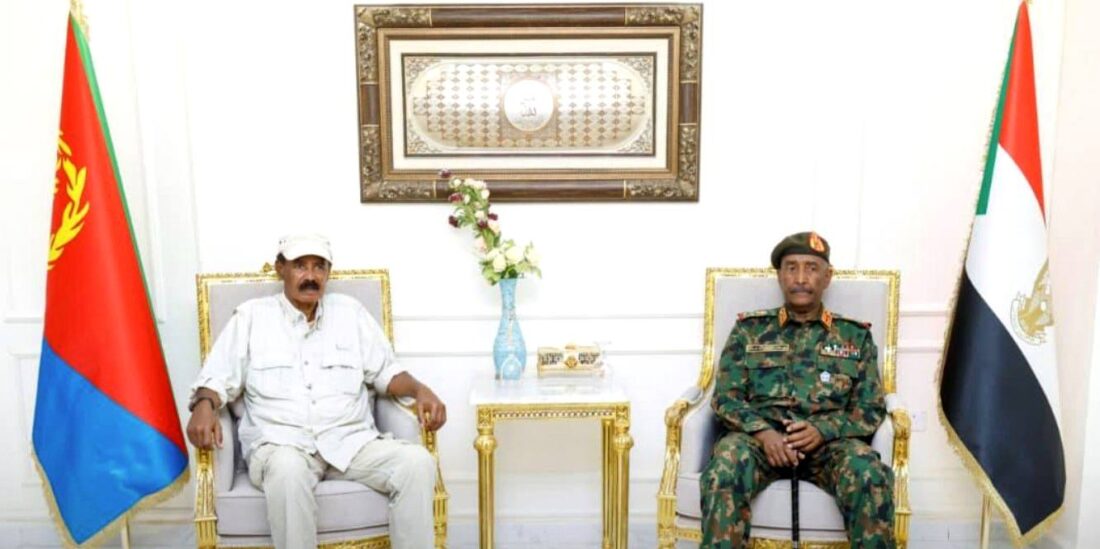
When Eritrean President Isaias Afwerki chose to enter Port Sudan by land, escorted by Sudanese military officials and greeted by cheering crowds, it was more than symbolic pageantry. It was a message to Ethiopia, to the Red Sea region, and to every actor with a stake in the Horn’s future. A fragile region, already strained by war, sea-lane militarization, and border tensions, may have just witnessed the birth of a new strategic axis. On November 29, 2025, President Isaias Afwerki arrived in Port Sudan for a rare, high-visibility visit. General Abdel Fattah al-Burhan welcomed him on the outskirts of the city, in full military attire, flanked by top ministers. Crowds lined the streets. State media emphasized unity, sovereignty, and “historic ties.” Sudanese commentators called it “solidarity in adversity.” Ethiopian analysts called it something else: a recalibration of regional power with consequences for Addis Ababa’s security and Red Sea ambitions.
Why Now? The Strategic Logic Behind the Visit
The timing of Afwerki’s visit reveals deliberate calculations in both Asmara and Port Sudan driven by war fatigue, shifting alliances, and the Red Sea’s escalating geopolitical stakes.
For Sudan’s military leadership, the optics were crucial. Embattled by two years of civil war, diplomatically isolated, and fragmented internally, Burhan needed a show of regional backing. Eritrea, a neighbour with a consistent pro-Khartoum stance since April 2023, provided exactly that. By bringing Afwerki in by road not via airport the Sudanese Armed Forces (SAF) sent a coded message: security coordination is deep, territorial control is stable, and Sudan’s eastern front remains tightly aligned with Asmara.
For Afwerki, the visit accomplishes three objectives. First, it reinforces Eritrea’s self-appointed role as a regional stabilizer, contrasting with accusations of interference elsewhere. Second, it solidifies an anti-fragmentation narrative, directly countering fears that Sudan’s war could spill eastward.
Third, it strengthens Eritrea’s bargaining position vis-à-vis Ethiopia at a moment when Addis Ababa is openly pursuing alternative maritime corridors. In short, the Port Sudan visit is not ceremonial. It is strategic signalling directed most clearly at Ethiopia.
The Red Sea Chessboard ,What This Means for Ethiopia
The Horn’s geopolitics have reorganized rapidly over the past two years, and this emerging Eritrea–Sudan partnership sits at the centre of those shifts.
For Ethiopia, two implications stand out.
1. Regional alignments are tightening without Addis Ababa at the table.
Burhan’s government, weakened yet determined, now sees Eritrea as a critical ally as it resists both RSF advances and international pressure. This alignment also folds into Cairo’s strategic interests, given Egypt’s security partnerships with SAF and long-standing hostility toward Eritrea–Ethiopia rapprochement.
2. Maritime access calculations are shifting.
Ethiopia’s pursuit of Red Sea access through negotiation, partnership, or maritime investment now operates in a region where its neighbours are forming blocs.
If Eritrea and Sudan coordinate more tightly on border security, transit, and coastal strategy, Addis Ababa may find fewer unilateral avenues and more resistance to any bold or creative access proposals.
This is the heart of the concern for Ethiopian planners: a new axis means new constraints.
But it also means Ethiopia must move smarter, faster, and more diplomatically.
The Human Stakes and the Stability Question
Behind the political optics lies a fragile region where millions of civilians are caught between war zones, collapsing economies, and erratic state institutions. Sudan remains the world’s largest displacement crisis. Famine conditions persist. Eastern Sudan closer to Eritrea is now one of the conflict’s most volatile humanitarian theatres.
If Eritrea and Sudan begin coordinating more tightly on border control, intelligence, and population movement, the humanitarian corridor dynamics could shift overnight. For Ethiopia, instability in Sudan is never distant. It affects: Benishangul-Gumuz and Amhara border security, cross-border arms flows, refugee pressure, and Nile River diplomacy.
A closer Eritrea,Sudan partnership could either stabilize this shared frontier or militarize it further.
Much depends on whether Asmara’s involvement dampens militia activity or deepens it.
The Structural Barriers Why This New Friendship Might Not Bring Peace
Despite the headlines, several hard realities remain unchanged.
First, both SAF and Eritrea have strategic incentives to maintain strong security postures.
Second, neither side has articulated a long-term political roadmap only tactical alignment.
Third, external actors remain active: Egypt, the UAE, Saudi Arabia, and global naval powers all have distinct agendas on the Red Sea.
Ethiopia sits geographically at the centre of this competition but increasingly at the margins of its negotiations.
Without active Ethiopian diplomacy, the Eritrea,Sudan alignment risks forming a security bloc that excludes Addis Ababa, potentially complicating maritime negotiations, border stabilization efforts, and regional counterterrorism architecture.
What Ethiopia Must Do Now
The Port Sudan visit is not a crisis but it is a warning.
Addis Ababa must:
1. Intensify regional diplomacy, especially with Sudan’s military and civilian blocs, Djibouti, and Red Sea partners.
2. Pursue maritime access through multilateral frameworks, not exclusivist bilateral deals.
3. Strengthen its eastern command and border stabilization efforts without escalating militarization.
4. Lead not follow in shaping a Red Sea security architecture grounded in shared economic and geopolitical interests.
The Eritrea,Sudan embrace is a reminder that the Horn’s tectonic plates are shifting quickly and Ethiopia must position itself before new alignments harden into new realities.