

The war between Iran and the alliance of Israel and the United States is no longer just a Middle Eastern conflict. Its economic shockwaves are spreading across the world and regions far from the battlefield, including the Horn of Africa, are already beginning to feel the consequences.
From rising fuel prices to global inflation risks, the conflict has disrupted key energy routes, shaken financial markets, and created new pressure on economies that depend heavily on imported fuel. For countries like Ethiopia, which rely on imported petroleum to power transportation and industry, the impact could be particularly serious.
Energy Shock from the Strait of Hormuz
At the center of the economic disruption is the strategic Strait of Hormuz one of the most important energy chokepoints in the world. Nearly 20 percent of global oil and gas supplies pass through this narrow waterway.
Since the war began in late February, Iranian retaliatory strikes and attacks on vessels in the Gulf region have sharply reduced traffic through the strait. The uncertainty has immediately pushed global energy prices higher.
Brent crude oil, the global benchmark, jumped from about $72 per barrel to more than $106, a surge of over 40 percent within days. Liquefied natural gas prices have climbed even faster, rising by nearly 60 percent after attacks disrupted production in Qatar, one of the world’s largest LNG suppliers.
These rising prices are not just numbers in energy markets. They ripple through nearly every sector of the global economy transportation, agriculture, manufacturing, and even food prices.
Warning Signs for the Global Economy
The war is already producing several “tell-tale signs” of economic stress worldwide.
First, fuel prices are climbing across dozens of countries. According to energy data trackers, more than 85 countries have reported petrol price increases since the conflict began.
In some places the increases are dramatic:
Cambodia: petrol prices up nearly 68 percent
Vietnam: about 50 percent
Nigeria: roughly 35 percent
Higher fuel costs raise the price of everything shipping goods, running factories, and even growing crops. As a result, economists warn that global productivity could fall while inflation rises.
The concern has reached the highest levels of international finance. Kristalina Georgieva, Managing Director of the International Monetary Fund, warned that a prolonged war could fuel global inflation and economic instability.
Historically, sharp oil price spikes have often preceded economic downturns. Major energy shocks in 1973, 1978, and 2008 were all followed by recessions in parts of the world.
Governments Already Rationing Fuel
Some governments have already begun taking emergency measures to cope with the surge in energy prices.
Several countries have introduced fuel-saving policies:
Pakistan introduced a four-day workweek for government employees.
Thailand made working from home mandatory for many public workers.
Sri Lanka implemented QR-code fuel purchases to regulate demand.
Myanmar restricted cars to driving on alternate days.
These policies highlight how quickly a geopolitical crisis can translate into everyday economic hardship.
Why the Horn of Africa Is Especially Vulnerable
For the Horn of Africa, the economic risks are particularly serious.
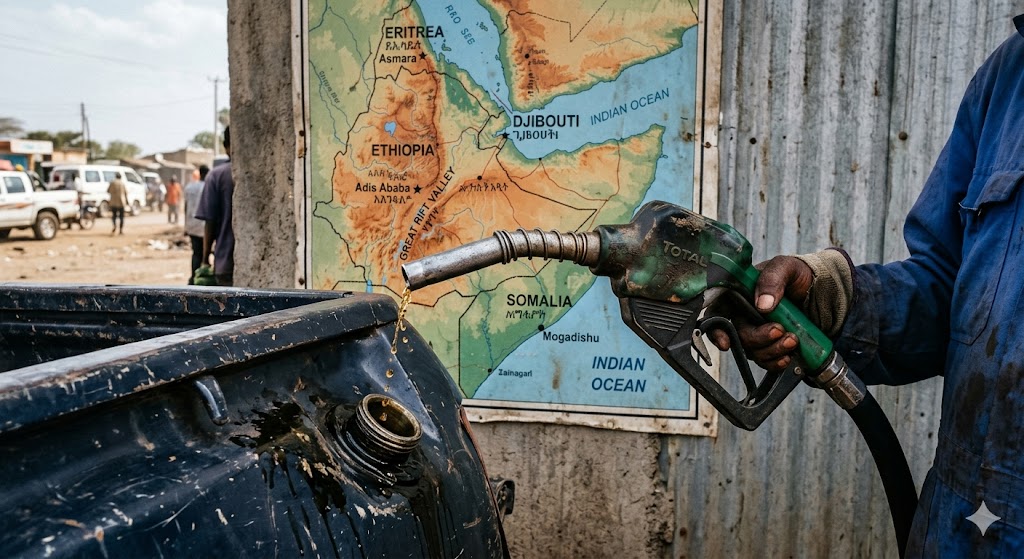
Most countries in the region including Ethiopia, Kenya, and Somalia import nearly all of their petroleum. When global oil prices rise, the region feels the shock almost immediately through higher fuel costs, transport prices, and inflation.
Higher shipping costs also raise the price of imported goods such as wheat, fertilizer, and machinery. That can intensify already existing cost-of-living pressures across East Africa.
Air travel is also becoming more expensive. With parts of Middle Eastern airspace restricted due to the war, airlines are taking longer routes, burning more fuel. Jet fuel prices have surged from about $85–$90 per barrel to as high as $200, forcing many airlines to raise ticket prices.
For countries dependent on trade and tourism, these disruptions can slow economic activity.
Ethiopia’s Call for Fuel Discipline
In response to rising global energy pressures, Ethiopia’s leadership has already begun urging citizens to be cautious about fuel consumption.
Abiy Ahmed, the Prime Minister of Ethiopia, recently emphasized the importance of using fuel wisely and reducing unnecessary consumption, warning that global energy disruptions could affect the country’s economy.
The message reflects a broader reality: Ethiopia’s rapid economic growth and expanding transport sector depend heavily on imported petroleum products. If global oil prices remain high for months, the country could face increased pressure on its foreign currency reserves and transportation costs.
Encouraging fuel efficiency, expanding renewable energy, and strengthening domestic power production especially from hydropower are increasingly seen as strategic economic priorities.
Markets Are Already Reacting
Financial markets around the world are also showing signs of anxiety.
Since the war began, major stock markets have fallen:
Japan’s Nikkei index dropped about 11 percent
India’s benchmark index fell roughly 7 percent
European markets declined about 6 percent
The downturn reflects investor fears that prolonged conflict could slow global growth.
Ironically, some oil-exporting countries particularly Russia have seen stock gains, as higher energy prices boost their revenues.
A Crisis Still Unfolding
For now, economists say the ultimate impact depends on how long the conflict lasts.
If fighting subsides quickly and shipping through the Strait of Hormuz returns to normal, oil prices could fall again by the end of the year.
But if the war continues or escalates, energy prices could surge even further potentially reaching $130 to $150 per barrel.
For the Horn of Africa, that scenario would likely mean higher fuel prices, rising inflation, and slower economic growth.
In other words, while the missiles and drones may be thousands of kilometers away, the economic aftershocks of this war are already arriving one fuel bill at a time.