

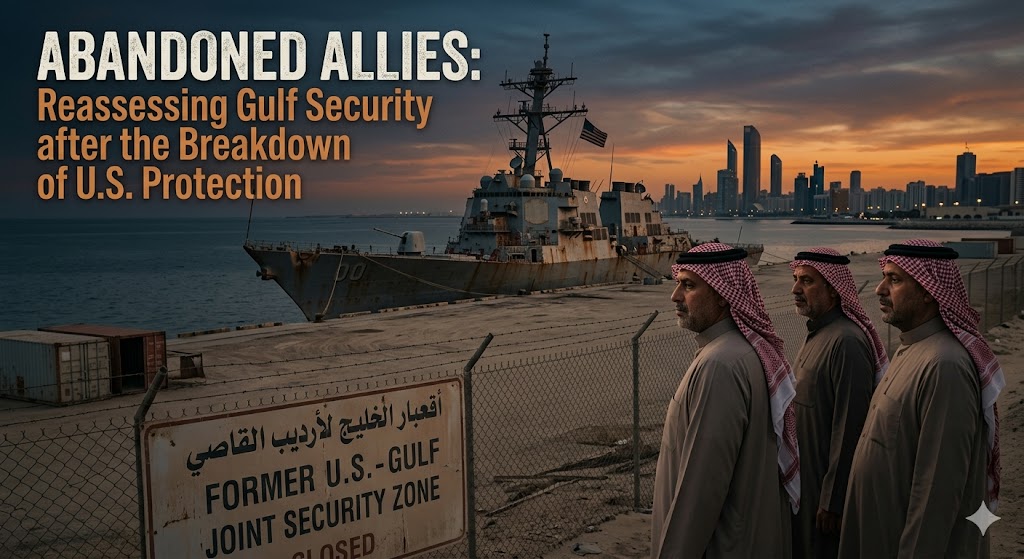
The Gulf hosted the shield. It became the target. For decades, its security rested on one promise from the United States: protection in exchange for presence. But when the missiles came, that promise did not hold.
Recent escalations involving Iran have exposed a critical vulnerability in this long-standing arrangement. Despite hosting extensive U.S. military infrastructure, several Gulf states found themselves directly exposed to retaliatory strikes. This moment has triggered a deeper reassessment within the region: Does the presence of U.S. forces guarantee security, or does it increase exposure to conflict?
The Strategic Breakdown – When Protection Becomes Exposure
At the core of this reassessment lies a growing perception that American strategic priorities are no longer fully aligned with those of its Gulf partners. In the current confrontation, Washington’s military posture has been closely intertwined with its support for Israel. For many in the Gulf, this has reinforced the belief that U.S. engagement in the conflict is driven less by regional stability and more by alliance commitments that do not necessarily reflect Gulf security interests.
As a result, Gulf states have found themselves in a precarious position. Hosting U.S. military assets, While simultaneously absorbing the consequences of escalation, This dynamic has produced a strategic paradox.
The very military presence intended to deter adversaries is now perceived as a factor that may invite retaliation. Iran’s posture has made this explicit, signaling that states hosting U.S. forces could be considered legitimate targets in the event of confrontation.
The implication is clear, Security dependence may now carry direct security costs.
Expanding Threat Perception – Beyond Iran
However, the implications extend beyond Iran alone. A more profound concern is beginning to surface within regional strategic thinking:
If both the United States and Israel demonstrate a willingness to take unilateral military action against states they perceive as adversaries, then Gulf nations may no longer view the threat environment as coming from a single direction. Instead, the risk becomes multidimensional. For Gulf policymakers, this raises an unsettling question:
What prevents similar actions from being taken in the future against other states under shifting geopolitical calculations?
This concern is further amplified by long-standing anxieties regarding Israel’s regional posture. Israel remains the only state in the region widely believed to possess nuclear capabilities, and its strategic doctrine has historically emphasized military superiority and preemptive action. In parallel, narratives surrounding expanded regional influence, often framed in political discourse as ambitions tied to a “Greater Israel” continue to generate unease across parts of the Arab world.
While such narratives are contested, their persistence contributes to a broader perception of strategic uncertainty. For Gulf states, the issue is not only capability, but intent.
And in an already volatile environment, that perception alone carries weight.
The Return of the Arab Joint Force – From Idea to Necessity
This evolving threat perception is contributing to a broader erosion of trust. The Gulf states are not only evaluating the effectiveness of U.S. protection, but also questioning its long-term reliability and strategic alignment. This is not merely a tactical concern. It is a structural one. It is within this context that discussions surrounding an Arab joint force have re-emerged with renewed urgency. The concept itself is not new. It was notably advanced in 2015 by Abdel Fattah el-Sisi, who called for the establishment of a unified Arab military force to address regional security threats. The proposal gained initial backing within the Arab League, but ultimately stalled due to political divisions and lack of implementation mechanisms.
Today, however, the idea is resurfacing under markedly different conditions. With key actors such as Egypt, Saudi Arabia, and the United Arab Emirates revisiting forms of military coordination, the concept is increasingly framed not as an aspirational project, but as a strategic necessity.
The objective is clear:
To reduce reliance on external security guarantees, To mitigate exposure to external conflicts and to establish a more autonomous regional deterrence framework.
The Gulf is no longer confronting a single adversary. It is confronting a shifting security landscape in which threats, alliances, and guarantees are becoming increasingly uncertain. And as that uncertainty grows, the region is being pushed toward a new strategic reality:
Security can no longer be outsourced, it must be constructed.