

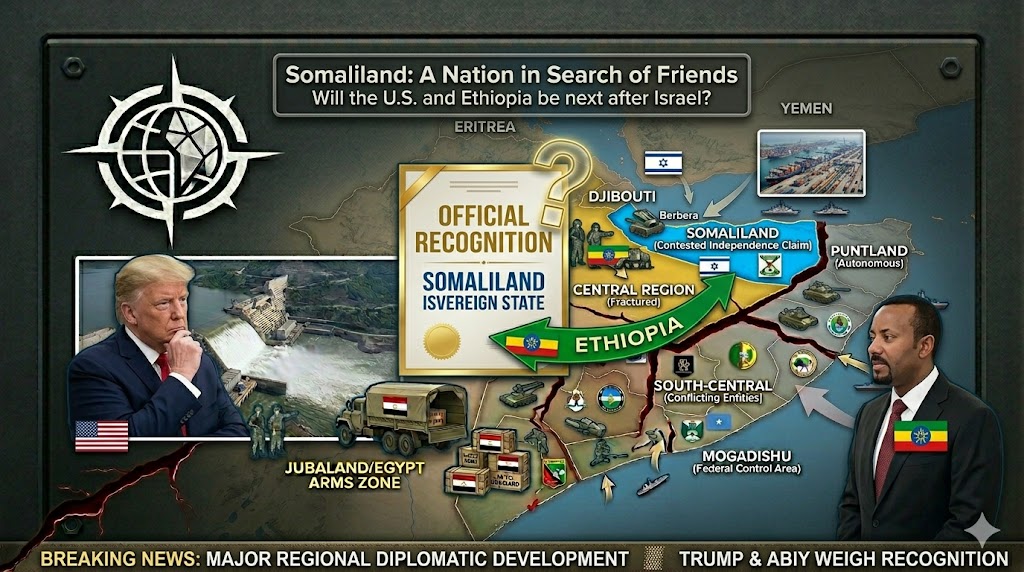
On December 26, 2025, Israeli Prime Minister Benjamin Netanyahu did what no UN member state had dared in 34 years: he formally recognized the Republic of Somaliland as a sovereign nation. In Hargeisa, the capital, streets erupted in celebration. In Mogadishu, Somalia’s government raged, summoning an emergency UN Security Council session and branding the move “illegal.”
Israel’s decision was no sentimental gesture. It was cold-eyed strategy. Somaliland sits astride the Gulf of Aden, gateway to the Bab el-Mandeb Strait through which 12–15 percent of global trade flows. With Houthi missiles menacing Red Sea shipping and Iran probing the region, Tel Aviv sees Berbera port and its modernized airfield as a potential forward operating post—Israel’s return to the Red Sea after decades of absence.
Now the question ricocheting through Washington, Brussels, and Addis Ababa is whether the United States and its allies will follow Israel’s lead. Or, more provocatively, whether Washington will quietly push Ethiopia to honor its own 2024 bargain with Somaliland and finally grant the breakaway republic diplomatic recognition. With U.S. midterm elections looming in November 2026, the political clock is ticking.
Somaliland is not a fiction on a map. Since declaring independence from Somalia in 1991, it has built a functioning democracy in one of the world’s toughest neighborhoods. It holds regular multiparty elections, maintains its own currency and passport, and has kept al-Shabaab at bay while Somalia proper struggles for basic control of Mogadishu. Supporters call it “Africa’s best-kept secret” a reliable, pro-Western partner that has never asked for a dime in foreign aid handouts the way Somalia has.
For Washington, the upsides are tantalizing. First, military basing. The U.S. already operates Camp Lemonnier in Djibouti, but that tiny nation hosts a Chinese naval facility and has occasionally dragged its feet on counter-Houthi operations. Berbera offers deep-water access, a 15,000-foot runway upgraded by the UAE, and a government eager to host American forces. Pentagon planners quietly describe it as “Djibouti without the strings.”
Second, countering great-power competition. China, Russia, and Iran are all courting ports along the Red Sea. A recognized Somaliland aligned with the West would blunt Beijing’s influence and give the U.S. a stable foothold in a region where al-Shabaab still threatens shipping and terrorism pipelines.
Third, democracy promotion with teeth. Unlike many African states sliding toward authoritarianism, Somaliland has peacefully transferred power multiple times. Recognizing it would reward success rather than subsidize failure.
And then Ethiopia, the landlocked giant of 120 million people desperate for reliable sea access. In January 2024, Ethiopian Prime Minister Abiy Ahmed signed a memorandum with Somaliland’s then-president granting Addis Ababa a 50-year lease on 20 kilometers of coastline around Berbera in exchange for eventual diplomatic recognition. Ethiopia has yet to follow through formally, citing fears of alienating Somalia and the African Union. But the deal remains alive.
Here is where U.S. diplomacy could play kingmaker. Washington could encourage or quietly pressure Ethiopia to honor the pact. In return, Ethiopia gains a commercial and naval outlet that reduces its crippling dependence on Djibouti (which charges premium fees) and potentially opens pathways toward Eritrea’s Assab port through broader regional horse-trading. For Somaliland, Ethiopian recognition would be a seismic second domino after Israel. For the Horn of Africa, it could transform a frozen conflict into an economic corridor.
Critics warn of Pandora’s box. The African Union fears a precedent that could inspire secessionists . Somalia threatens to sever ties and invite more Turkish or Chinese bases. Some analysts fret that formal recognition might inflame al-Shabaab recruitment, though others counter that Somaliland’s stability has already contained the group better than Mogadishu ever has.
Yet the momentum is real. Republican lawmakers have introduced the Republic of Somaliland Independence Act. Conservative think tanks and former Trump officials argue recognition aligns perfectly with “America First” priorities: secure trade routes, reduced reliance on unreliable hosts, and a democratic partner that costs little but delivers much. Somaliland’s president has already hosted U.S. military delegations and offered basing rights plus critical-minerals access in exchange for recognition. Even Trump himself, when asked last year, said his administration was “looking into that right now.”
With midterms approaching, the political math sharpens. A bold move on Somaliland could energize the GOP base, signal strength against China and Iran, and deliver a tangible foreign-policy win before voters head to the polls. Conversely, hesitation risks ceding the initiative to Israel and the UAE, who are already deepening ties in Berbera.
The implications stretch far beyond one small republic. Recognition would redraw the map of the Horn, potentially unlocking billions in investment, stabilizing Red Sea shipping, and giving Ethiopia the maritime future its economy demands. It would cement a new axis. Israel, UAE, Ethiopia, Somaliland, and a re-engaged United States countering the Turkey-Somalia-China alignment.
Somaliland has waited 35 years for its moment. Israel has cracked open the door. The United States now faces a choice: step through and reshape a vital strategic theater, or watch others write the next chapter of Red Sea geopolitics. In a region long defined by chaos, a democratic success story is offering partnership on a silver platter. The question is whether Washington midterms or not has the vision to seize it.