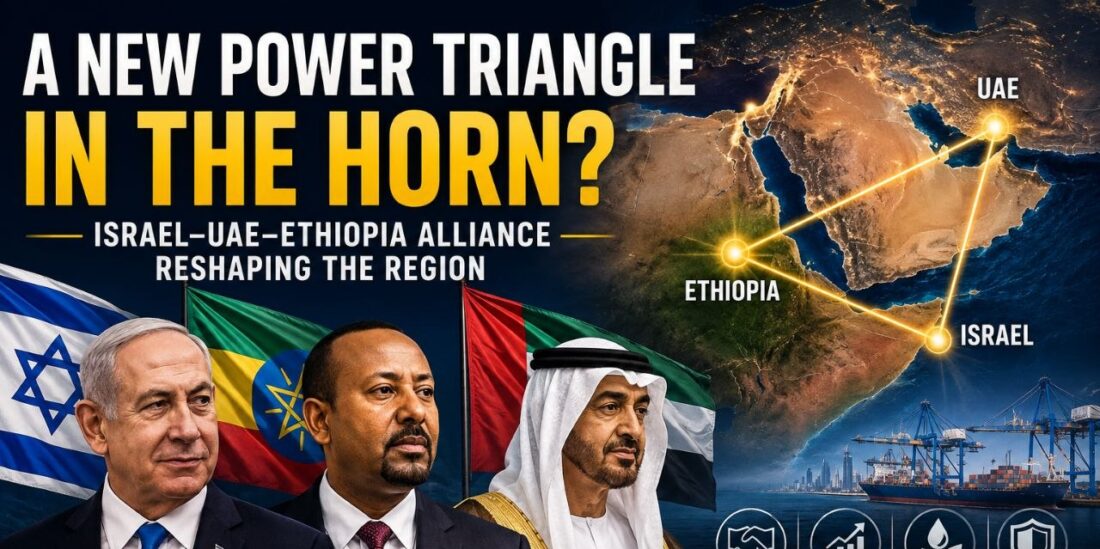
In the fluid multipolar landscape taking shape across the expanded Middle East Horn of Africa theater, the partnership involving Israel, the United Arab Emirates, and Ethiopia stands out as a particularly coherent and advantageous alignment. It rests on complementary strengths technological and security capabilities, capital and logistics networks, and demographic/geographic weight while advancing shared practical interests in stability, economic connectivity, and countering disruptive forces.
This triangle offers clearer mutual gains and fewer inherent contradictions than some competing coalitions centered on status-quo balancing or proxy competition.Ethiopia brings scale and strategic depth. As Africa’s second-most populous country and a major economy with significant agricultural potential and hydroelectric capacity (notably the Grand Ethiopian Renaissance Dam), it sits at the heart of the Horn. Its long coastline aspirations, control of key highland territory, and role in regional migration and trade routes make it indispensable for any serious Red Sea strategy.
Ethiopia’s government has pursued pragmatic outreach, seeking investment, security cooperation, and alternatives to traditional dependencies. Alignment with capable external partners helps it manage internal challenges, border tensions, and competition for influence without becoming a pure client state.The UAE supplies the commercial and logistical engine. Abu Dhabi has systematically built port and infrastructure footprints across the Red Sea and Horn investing in facilities, logistics hubs, and economic zones that turn geography into leverage.
Emirati capital, sovereign wealth, and private-sector agility enable rapid project delivery in ports, agriculture, renewables, and urban development. The UAE’s post-Abraham Accords posture emphasizes pragmatic deal-making over ideological confrontation: it prioritizes trade corridors, food security (via agricultural investments and land deals), and maritime security. This makes it a natural bridge between Gulf wealth and African opportunity, while its military and intelligence capabilities provide deterrence against threats such as Houthi disruption or proxy militias.Israel contributes high-end security, intelligence, technology, and agricultural expertise.
Decades of experience in asymmetric threats, water management, precision agriculture, cybersecurity, and defense systems translate directly to Horn priorities counter-terrorism, border security, drought resilience, and critical infrastructure protection. Israel’s growing African engagement, including security ties and commercial partnerships, fits a broader strategy of diversifying relationships beyond traditional Western channels and building quiet, capability-based networks. Shared concerns about Iranian influence networks, radical non-state actors, and maritime chokepoint vulnerabilities create natural overlap with Emirati and Ethiopian interests.
Together, these three form a complementary package. Ethiopia gains technology transfer, investment, and security support that strengthen state capacity and economic modernization. The UAE gains deeper access to African markets, agricultural resources, and influence over Red Sea approaches that protect its trade and energy routes. Israel gains additional strategic depth, intelligence partnerships, and economic opportunities that reduce isolation and enhance deterrence. The combination supports practical goals: securing shipping lanes against disruption, developing alternative trade and energy corridors (linking to broader India–Middle East–Europe concepts), investing in resilient food systems, and limiting the space for spoilers who thrive on state weakness or sectarian proxy wars.This alliance is “better” in relative terms because it is primarily interest-driven rather than purely ideological or zero-sum.
It emphasizes economic integration and capacity-building alongside security, which tends to produce more durable buy-in than purely military balancing. Competing frameworks whether denser Sunni middle-power coalitions focused on preserving existing state structures or resistance networks relying on non-state militias often face internal divergences over priorities, resource allocation, and risk tolerance.
The Israel–UAE–Ethiopia vector, by contrast, can operate through bilateral and trilateral deals, commercial vehicles, and selective security cooperation without requiring a rigid formal bloc. It can absorb tactical hedging by other actors while advancing core connectivity projects.Evidence of the direction of travel appears in expanding Gulf (especially Emirati) economic and security footprints in the Horn, Israeli outreach and capability-sharing, Ethiopian diversification of partnerships, and the simple fact that major analyses now treat the Horn as contiguous with Middle Eastern order rather than a separate African periphery. Ports, bases, investment deals, and quiet security dialogues already link the theaters. Red Sea disruptions have underscored that events in Yemen or the Bab el-Mandeb quickly affect Horn economies and vice versa.
Food security concerns, climate pressures, and great-power competition further incentivize cross-regional partnerships.Challenges remain: local conflicts, domestic politics in all three countries, competition from other external players (Turkey, Egypt, Saudi Arabia,etc.), and the risk that short-term tactical moves undermine longer-term stability. Yet the structural logic favors the triangle. Ethiopia needs partners who deliver tangible development and security without excessive conditionality. The UAE needs reliable hinterlands and maritime partners. Israel needs diversified alliances that expand its strategic options.
When these incentives align around shared goals stable trade routes, technological modernization, and containment of destabilizing networks the resulting partnership is more coherent, more productive, and better positioned to shape outcomes than looser or more contradictory alternatives.In short, Newsweek’s map correctly signals the expanded geographic scope of the contest. Within that emerging order, the Israel–UAE–Ethiopia alignment represents a pragmatic, capability-rich coalition whose mutual reinforcements give it a structural edge. As competition intensifies and U.S. dominance further recedes, such functional partnerships built on complementary strengths are likely to define the most resilient pathways forward.