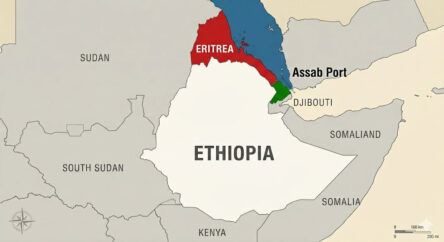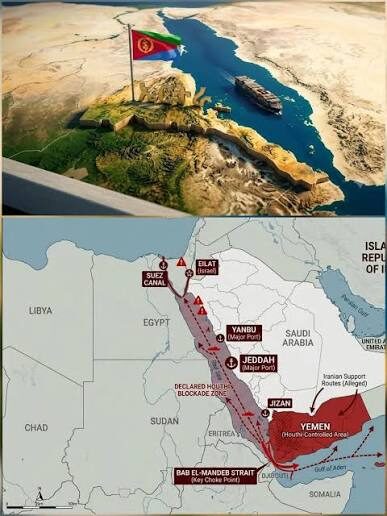
Eritrea says its sovereignty is “not negotiable.” But does defending sovereignty mean Ethiopia must give up its pursuit of secure Red Sea access? That is the real debate and the Eritrean statement deserves a closer look.
Eritrea’s Embassy is correct on one fundamental principle: sovereignty and territorial integrity must be respected. No state should acquire another country’s territory through coercion, military pressure, or unilateral action. But the Embassy’s statement becomes less convincing when it treats Ethiopia’s pursuit of reliable Red Sea access as if it necessarily means a demand for Eritrean sovereignty or territorial ownership.
That is a critical distinction. Ethiopia can recognize Eritrea’s sovereignty while simultaneously arguing that its landlocked status creates legitimate economic and strategic interests that deserve peaceful, negotiated solutions.
The debate, therefore, should not be reduced to “Eritrean sovereignty versus Ethiopian expansionism.” The real question is whether two neighboring states can reconcile Eritrea’s territorial integrity with Ethiopia’s legitimate need for secure, predictable and affordable access to international maritime trade.
BodyFirst, the Embassy presents “sovereign access” as though the phrase automatically means territorial acquisition. That interpretation is not the only possible one. Sovereign access can refer to arrangements in which a state exercises agreed rights through contracts, leases, special economic arrangements, transport corridors, or other bilateral mechanisms without acquiring sovereignty over the host territory. International commerce already operates through numerous arrangements in which landlocked states depend on neighboring coastal countries.
Therefore, rejecting territorial claims is entirely compatible with discussing special or long-term arrangements for Ethiopian maritime access. Ethiopia does not need to own a port to benefit from one. Equally, Eritrea does not need to surrender sovereignty for Ethiopia to obtain predictable access. Presenting these two objectives as mutually exclusive creates a false choice.
Second, Ethiopia’s geography cannot simply be dismissed as an economic inconvenience. Ethiopia is one of Africa’s largest countries by population and economy, yet it has no coastline. Its dependence on external ports directly affects the cost and security of imports and exports, including fuel, food, fertilizer and industrial goods. From Addis Ababa’s perspective, diversification of maritime access is therefore a strategic economic concern, not necessarily evidence of territorial ambition.
That does not create a legal entitlement to Eritrean territory. But neither does Eritrea’s sovereignty eliminate Ethiopia’s legitimate interest in negotiating better access.
Third, the historical argument requires greater balance. Eritrea’s history and its people’s struggle for self-determination deserve recognition, including the 1993 referendum and Eritrea’s subsequent international recognition. However, historical grievances should not be transformed into a permanent framework through which every contemporary Ethiopian discussion about the Red Sea is interpreted as an attempt to reverse Eritrean independence.
The two issues are different. Eritrea’s independence is an established political and legal reality. Ethiopia’s current search for maritime access is a contemporary geopolitical and economic question. One can recognize the first without condemning the second.
Fourth, the Embassy invokes the principle of inherited African borders. That principle is important, but African sovereignty also depends on cooperation across those borders. Landlocked and coastal states are economically interconnected. Roads, railways, pipelines, ports and trade corridors routinely cross national boundaries.
Sovereignty is not strengthened by making cooperation impossible; it is strengthened when sovereign states create agreements that serve their mutual interests.
Finally, Eritrea’s foreign relations should certainly not be reduced to an anti-Ethiopian coalition. However, the same logic should apply to Ethiopia.
If Eritrea’s partnerships with Egypt, Somalia, Saudi Arabia, the UAE or others should not automatically be interpreted through an Ethiopia-centered lens, Ethiopia’s pursuit of Red Sea access should not automatically be interpreted through an Eritrea-centered security lens The region needs less zero-sum thinking, not more.
Eritrea is right that its sovereignty is not negotiable. But sovereignty does not mean that neighboring states are prohibited from presenting legitimate economic and strategic interests. Ethiopia can respect Eritrea’s borders while seeking commercially meaningful, legally negotiated and mutually beneficial access to the Red Sea.
The strongest solution is therefore neither territorial revisionism nor permanent confrontation It is negotiation.
Eritrea does not have to surrender sovereignty. Ethiopia does not have to surrender its maritime aspirations. A carefully structured agreement could protect Eritrean territorial integrity while giving Ethiopia reliable commercial access.
The Horn of Africa has spent decades paying the price of unresolved historical grievances and zero-sum geopolitics. The real test of sovereignty is not whether states refuse every difficult negotiation. It is whether sovereign states can negotiate without threatening each other.
Eritrea’s sovereignty should be respected. Ethiopia’s legitimate economic interests should also be acknowledged. The future of the Horn should be built not on assumptions of inevitable conflict, but on practical agreements that turn geography from a source of confrontation into an opportunity for cooperation.