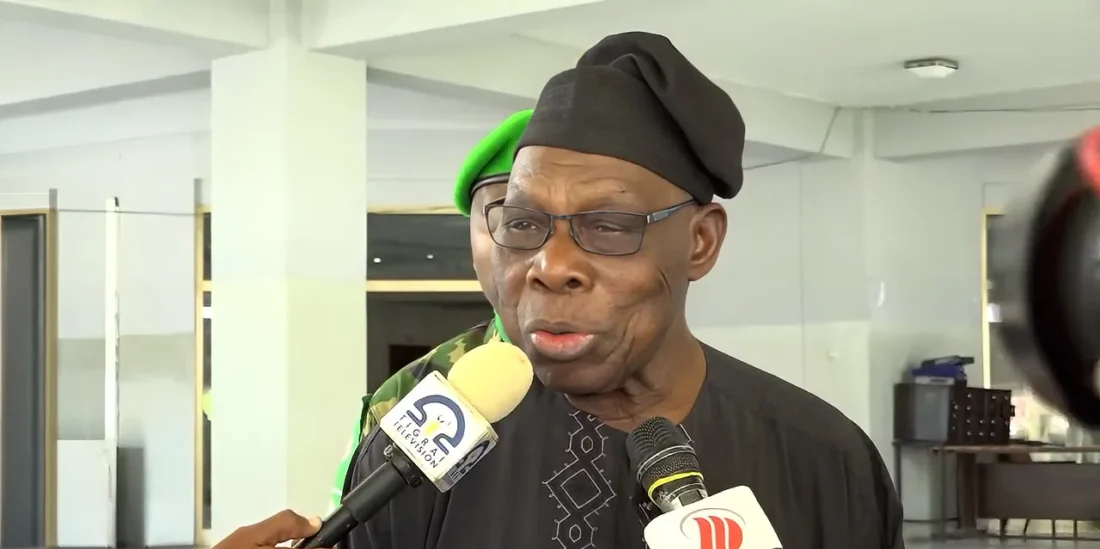
Olusegun Obasanjo is once again being drawn into Ethiopia’s Tigray question. The TPLF’s latest proposal for his mediation comes at a particularly sensitive moment, when political tensions are rising, armed structures remain intact and developments inside Sudan are creating new regional security concerns.
On the surface, a call for mediation sounds constructive. Ethiopia should always prefer dialogue to another catastrophic war. But the TPLF’s proposal cannot be examined in isolation. It must be assessed against the party’s continuing militarization, its internal power struggles and the reported involvement of TPLF-linked forces in Sudan’s civil war.
Obasanjo matters because he was central to the African Union process that produced the Pretoria Agreement in November 2022. Pretoria was not merely a ceasefire. Its objective was to end the armed confrontation and create a transition from military confrontation toward constitutional and political processes.
This is why the current TPLF proposal presents a difficult question. Is the party seeking mediation to strengthen Pretoria, or seeking a new process that can protect political and military structures that Pretoria was supposed to transform?
The TPLF’s central problem is its continued reliance on military power as a political instrument.
A lasting peace cannot emerge when a political organization retains deep influence over large armed formations and when internal political disagreements generate competing military structures.
This over-militarization creates a dangerous political environment. Political disputes become security disputes. Civilian institutions become vulnerable to armed pressure. Leaders have an incentive to maintain military structures as insurance against political defeat.
The TPLF cannot simultaneously present itself as a normal political actor while maintaining politics organized around military leverage.
The danger becomes greater when TPLF-linked military networks extend beyond Ethiopia.
Sudan’s civil war has increasingly become entangled with the wider geopolitics of the Horn. Eastern Sudan, particularly areas bordering Ethiopia, has become strategically important because of the movement of armed groups, military alliances and competing regional interests. Army 70, a large Tigrayan force that remained in Sudan after the northern Ethiopian war, has been reported as becoming involved alongside Sudanese Armed Forces-aligned formations in the conflict against the Rapid Support Forces. This development is strategically significant.
It means that armed personnel associated with Ethiopia’s unresolved political crisis have become connected to another devastating civil war. The consequences are serious First, involvement in Sudan can preserve military networks that should be undergoing demobilization and political transition Second, it internationalizes Ethiopia’s internal security problems. Sudan can become strategic depth for Ethiopian armed actors, allowing domestic political disputes to intersect with foreign military calculations Third, it risks creating a regional proxy environment.
This brings us back to Obasanjo Mediation itself is not the problem. The problem is the purpose of mediation.
If Obasanjo’s engagement is intended to reduce tensions, restore communication and push the parties toward genuine implementation of Pretoria, it could be useful But mediation must not reward unilateralism and militarization.
The TPLF should not be permitted to create political pressure through armed structures, deepen instability and then seek international mediation that effectively upgrades its bargaining position without requiring corresponding commitments.
Any renewed process should instead focus on implementation. The TPLF must clearly separate party politics from armed structures.
Armed formations must not become parallel political institutions. Questions surrounding forces and networks operating beyond Ethiopia’s borders must also receive serious attention The stakes extend beyond Tigray. A renewed crisis would directly affect Sudan and Eritrea and could draw external actors deeper into northern Ethiopian politics.
Sudan’s war has created a new security vacuum. Eritrea’s relationship with the Sudanese Armed Forces has expanded the strategic significance of the Ethiopia-Sudan-Eritrea triangle.
In this environment, the involvement of TPLF-linked forces in Sudan is not a minor development. It represents the regionalization of an unresolved Ethiopian political conflict.
For Ethiopia, this demands vigilance.
The AU and Ethiopian authorities should insist that any facilitation process include verifiable commitments, timelines and accountability mechanisms, rather than open-ended negotiations over previously agreed obligations clearly.
Obasanjo’s return may provide an important opportunity for de-escalation. But mediation should not become a rescue mechanism for a militarized political strategy.
The TPLF’s latest proposal must be assessed against the broader reality: continued armed influence in Tigrayan politics, internal factional competition and the reported extension of TPLF-linked military networks into Sudan’s civil war.
The central question is simple Will mediation help complete the transition from armed politics to civilian politics?
If the answer is yes, Obasanjo’s intervention could strengthen peace. If mediation instead legitimizes parallel armed structures, rewards instability or allows external military networks to remain part of Ethiopian political bargaining, it could deepen the crisis Ethiopia needs dialogue But dialogue must strengthen Pretoria, constitutional order and demilitarization.
Peace cannot be sustainable when military power remains the foundation of political influence.