

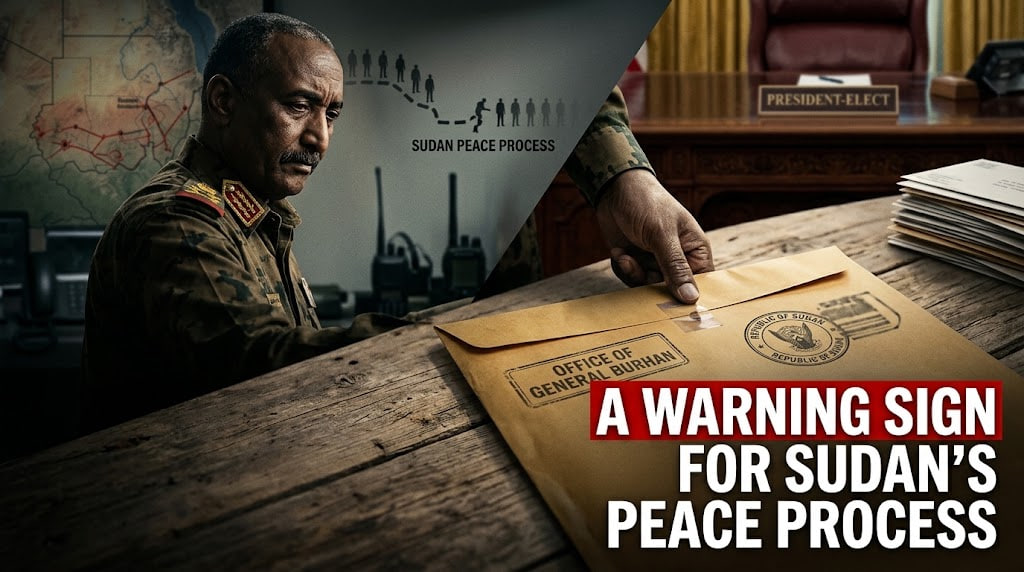
Sudan’s army chief, Abdel Fattah al-Burhan, has appealed directly to Donald Trump, reaffirming his commitment to US-led peace efforts. But the timing matters. A channel already exists between Burhan and Trump’s senior adviser, Massad Boulos, who recently met the Sudanese leader in Egypt. Burhan’s decision to address Trump directly, following the dispute over his UN visa and Washington’s pressure for a ceasefire, raises a difficult question: is Khartoum trying to advance negotiations, or signalling that it no longer trusts the American mediation process as currently structured?
On October 15, Burhan announced that he had written to Trump, pledging Sudan’s commitment to a just and lasting peace that protects the country’s sovereignty, unity, and territorial integrity. The message comes after Washington pressed the Sudanese Armed Forces to accept a proposed 90-day humanitarian ceasefire, with the controversy over Burhan’s UN visa further straining relations. Boulos subsequently met Burhan in Egypt in early October, demonstrating that direct engagement between the US envoy and Sudan’s military leadership remained possible.
Burhan’s letter should not be interpreted simply as another declaration of support for peace. Its timing suggests an effort to change the political level at which Sudan’s objections are heard. Rather than relying exclusively on negotiations conducted through Boulos, Burhan is appealing to the president himself, potentially seeking to reset the relationship after Washington’s coercive approach generated resentment in Khartoum.
The problem is that bypassing an existing negotiating channel can weaken confidence in the mediation process. Boulos remains an important interlocutor, and direct presidential engagement does not automatically mean that Burhan has abandoned him. Nevertheless, the move raises questions about whether the current channel has sufficient credibility to produce an agreement acceptable to both sides.
Khartoum’s central objection concerns the risk that a temporary ceasefire could freeze existing military positions without resolving the mechanisms sustaining the war. Sudanese reporting on the letter says Burhan called for the withdrawal of RSF forces from civilian areas, an end to external weapons supplies, and effective monitoring. The full letter has not been publicly released, so these reported conditions should be treated as attributed accounts rather than independently confirmed text.
The underlying strategic disagreement is clear. Washington wants an immediate humanitarian pause, while the Sudanese Armed Forces argue that a ceasefire without enforceable safeguards could allow the Rapid Support Forces to regroup and rearm. A humanitarian truce can save lives, but its design matters. Without credible monitoring, clear obligations, and consequences for violations, a temporary pause may postpone fighting rather than create a pathway towards peace.
At the same time, Khartoum cannot use concerns about the ceasefire’s design to avoid meaningful negotiations indefinitely. Civilians need humanitarian access now. The challenge is to establish arrangements that protect them without allowing either side to exploit the pause for military advantage.
The dispute over Burhan’s UN visa illustrates the limitations of pressure when it is not accompanied by sufficient political trust. Washington appears to have intended to increase the cost of rejecting its ceasefire proposal. Instead, the episode contributed to a public confrontation over sovereignty and the legitimacy of US pressure.
This does not mean Washington should abandon leverage. The Sudanese conflict involves grave humanitarian consequences, and external actors supplying weapons or financing to the belligerents must also face scrutiny. But pressure is useful only when it helps move the parties towards an enforceable agreement. If it convinces one side that the mediator is attempting to dictate the political outcome, it can harden resistance and encourage leaders to seek alternative channels.
Burhan’s appeal to Trump may therefore be an attempt to separate the president from the approach pursued by his adviser. Whether that interpretation is correct remains uncertain. What is clear is that the US needs a coherent negotiating strategy in which its demands, incentives, and enforcement mechanisms reinforce one another.
Burhan’s letter is an opening for renewed engagement, but it is also a warning about the state of the mediation process. A direct appeal to Trump cannot substitute for a functioning negotiating channel, and a ceasefire cannot deliver lasting peace without credible safeguards and accountability. Washington must address Sudan’s legitimate concerns about implementation while maintaining pressure for humanitarian access. Burhan, in turn, must translate his declared commitment into concrete negotiations rather than allowing disagreements over diplomatic treatment to become another obstacle. The test is not whether Burhan says he supports peace. It is whether Washington and Khartoum can agree on terms that protect civilians, constrain the belligerents, and prevent a ceasefire from becoming merely an interval between rounds of fighting.