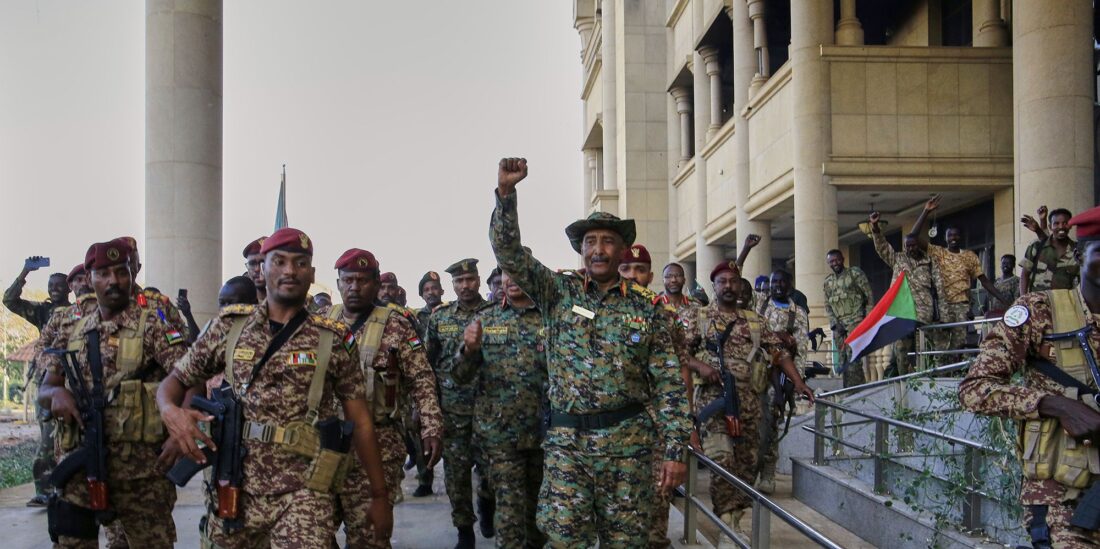
A diplomatic delegation in the Republican Palace. A military leader hailed for his commitment to peace. And a government, suspended from the African Union for five years now being welcomed back to the fold.
The meeting between General Abdel Fattah Al-Burhan and the African Union Peace and Security Council in Khartoum marks more than a routine diplomatic engagement. It is the most visible signal yet that Sudan’s military leadership is attempting to transform battlefield momentum into political legitimacyusing the government’s recent return to the capital as leverage to reset its relationship with the continent.
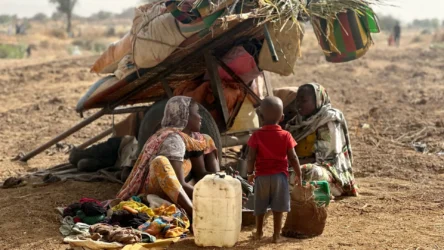
For nearly three years, Sudan has been consumed by a devastating war between the Armed Forces and the Rapid Support Forces (RSF) a conflict that has killed tens of thousands and displaced some 14 million people creating what the UN describes as the world’s worst displacement crisis . Now with army advances on the ground and a newly returned administration in Khartoum the military is gambling that it can parlay military gains into a political settlement on its own terms.
The diplomatic choreography on August 16, 2026, was careful and deliberate . The delegation’s head, Ambassador Mohamed Khalid of Algeria offered praise reaffirmed the AU’s commitment to Sudan’s sovereignty and rejected external interference . But behind the diplomatic language the meeting exposed a more complex reality a military leadership seeking to consolidate its position while the very institutions of the state remain fractured and the war continues to rage.
The official statement from the Sovereignty Council described the meeting as fruitful noting that the AU delegation welcomed the government’s return to carrying out its duties from the capital, Khartoum describing this as a pivotal step toward restoring the functioning of state institutions.
On paper, this represents a significant moment. The government’s return to Khartoum after months of operating from Port Sudan signals a degree of control over the capital and an effort to reassert state authority. The AU’s endorsement of this step suggests a cautious rapprochement with the military leadership, despite Sudan’s suspension from the organization following the 2021 coup On the ground, the reality is different.
The government’s return is less a restoration of civilian authority than a consolidation of military command. Prime Minister Kamil Idris, speaking during the same AU visit, acknowledged that red lines cannot be crossed, including the refusal to place the Sudanese Armed Forces and the paramilitary RSF on an equal footing . This is not the language of neutral peacemaking. It is the language of a military administration that sees total victory as the only acceptable outcome.
The AU delegation’s stated positions, while seemingly supportive, also carry implicit pressure. The Council called for strengthening the inclusiveness of the transitional process and working toward achieving national consensus . This is a diplomatic way of saying that military victory alone will not be enough. A genuinely inclusive political settlement one that reflects the aspirations of all Sudanese people will require compromises that General Al-Burhan has so far been unwilling to consider.
The Kampala summit that exposed the crisis in Somalia was not mentioned in the Khartoum communiqué, but its shadow looms over the proceedings . In Somalia the US decision to end logistical funding for the African Union mission has triggered an uncoordinated retreat with Ethiopian troops pulling back from towns like Burhakaba and the UN selling off its own equipment .
For Sudan the lesson is clear international commitment is not infinite.
The AU delegation’s insistence on a comprehensive political settlement is partly driven by the recognition that Sudan’s war cannot be sustained indefinitely by external actors and that without a political resolution the country risks the same fragmentation now unfolding in Somalia.
The AU’s rejection of parallel entities or governments is a direct reference to the RSF’s efforts to establish civilian administrations in areas under its control . The delegation’s firm position on this point is significant it undermines the RSF’s claims to legitimacy and reinforces the AU’s commitment to Sudan’s territorial integrity .
However, the AU’s stated concerns about the continuation of the war and the resulting heavy loss of life, destruction of infrastructure and worsening humanitarian crisis are not abstractions . The conflict has created catastrophic conditions, with over 21 million people facing acute hunger . Every day of fighting deepens the humanitarian catastrophe and makes a political settlement more difficult to achieve.
The military’s gamble is clear use battlefield momentum to force the RSF to the negotiating table on terms favorable to the Armed Forces. Prime Minister Idris’s announcement that Sudanese-Sudanese dialogue will begin soon is part of this strategy . The dialogue will be owned by all the people of Sudan, but the military’s red lines suggest that ownership will be tightly controlled.
The government’s peace initiative, presented to the UN Security Council in December 2025, calls for the RSF to withdraw from areas under its control and enter integration and demobilization procedures. This is not a negotiation. It is a surrender demand. The AU delegation’s call for dialogue and national reconciliationis thus at odds with the military’s insistence on preconditions that the RSF is unlikely to accept .
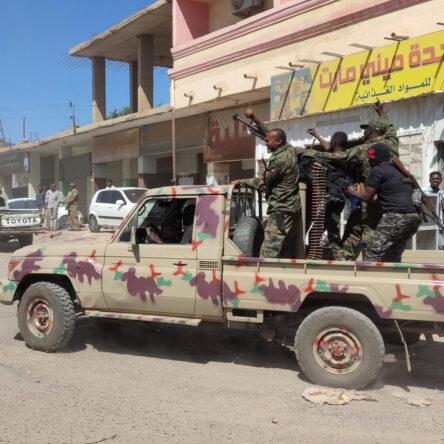
Meanwhile, the war continues unabated. The Sudanese army is advancing in the Kordofan region and has pledged to head toward Darfur until the entire country is liberated. The RSF, which controls vast swaths of territory in Darfur and elsewhere, shows no sign of capitulating. The military’s gambit may be designed to pressure Washington and other international actors to designate the RSF a terrorist organization a move that would further isolate the paramilitary force .
For the African Union, the Khartoum meeting represents a dilemma as much as an opportunity. Sudan has been suspended from the organization since the 2021 coup, and the AU’s Peace and Security Council has been largely sidelined from the peace process, with competing initiatives from the Intergovernmental Authority on Development (IGAD), Saudi Arabia, the United States and others .
The AU’s mission to Khartoum is an attempt to reassert its centrality in the Sudan peace process a role that Ambassador Khalid explicitly reaffirmed . The delegation’s emphasis on the pivotal role of the African Union and its commendation of the Quintet’s efforts are part of this repositioning .
But the AU’s leverage is limited. It lacks the financial resources to fund a peacekeeping mission or reconstruction effort. Its calls for dialogue and reconciliation are easily dismissed by a military leadership that believes it can win on the battlefield. And its members are divided with some favoring engagement with the military and others demanding more robust pressure .
The reopening of the African Union Liaison Office in Khartoum, which the delegation welcomed is a small step toward re-engagement . But it is also a signal that the AU is willing to work with the military leadership, even as the war continues and civilian political forces remain marginalized.
The immediate future of the peace process will depend on whether the military’s military gambit succeeds or fails. If the army continues to advance and the RSF is pushed back, Al-Burhan may feel empowered to dictate terms and sideline the AU’s calls for inclusivity.
If the war grinds into a stalemate, the military may be forced to make compromises that it has so far resisted.
The medium term outlook is more precarious. With the war entering its fourth year and no end in sight, the humanitarian crisis will only deepen. The AU’s calls for a comprehensive political settlement will remain aspirational as long as both sides believe they can win. And the risk of fragmentation, with parallel governments and foreign interference will continue to grow.
The AU delegation’s message was clear The only path to achieving lasting peace is through dialogue and national reconciliation. But the military leadership’s actions suggest it has chosen a different path one that leads through the battlefield, not the negotiating table. The AU’s dilemma is whether to continue engaging a military administration that rejects its core principles or to risk irrelevance by demanding accountability that no one is willing to enforce.
The AU flag now flies over a meeting room in Khartoum, but the war continues in Kordofan and Darfur. The government is back in the capital, but the state remains fractured. And the soldiers who have fought for three years are still fighting.
The crisis in Sudan is no longer just about a military coup or a political transition. It is about whether a military leadership that believes it can win on the battlefield can be persuaded to accept the compromises necessary for peace. The AU’s mission to Khartoum produced communiqués, but no ceasefire.
What is certain is that the meeting on August 16 is not the end of the story. It is the beginning of a new chapter one in which Sudan’s military leadership faces the limits of its military gambitand the African Union confronts the limits of its diplomatic leverage.