

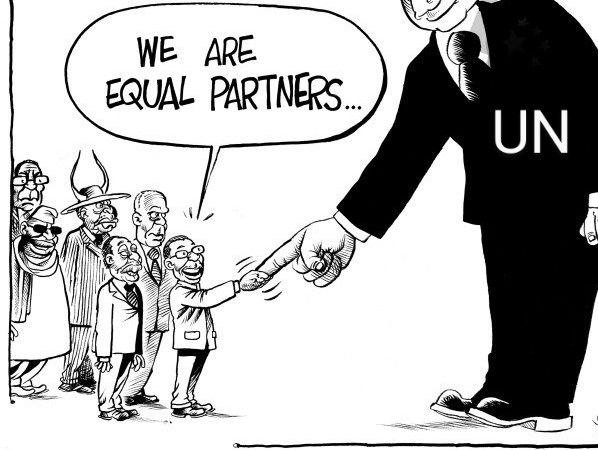
Last week, the UN General Assembly met under a world on edge: war in Europe, conflict in the Middle East, U.S.–China rivalry, and crises mounting across Africa. Leaders lined up to deliver speeches. Russia warned of a “global order unravelling.” Israel’s prime minister vowed never to accept a Palestinian state. And in a moment that drew both laughter and frustration, the U.S. president complained about a broken escalator and a malfunctioning teleprompter mocking the institution’s very credibility.
Amid the noise, African leaders once again took the podium to demand what has eluded them for more than 80 years: equality.
But why demand equality from a stage that has never treated Africa as an equal?
The Familiar Chorus
This year’s UNGA carried the theme: “Better together: 80 years and more for peace, development and human rights.” On the surface, the debate followed familiar lines. Russia framed the West as destabilizing. Israel doubled down on Palestine. India emphasized multipolarity.
And Africa? Africa pressed its long-standing demands:
- Reform of the Security Council to reflect demographic and geopolitical realities.
- Debt cancellation and fairer trade rules to end cycles of dependency.
- Climate justice, as the continent most vulnerable yet least responsible for emissions.
- A stronger voice in shaping global governance.
South Africa, speaking on behalf of many, put it bluntly: while the UN preaches equality, African nations remain denied meaningful influence in its most powerful bodies.
Against this backdrop came the U.S. president’s quip about escalators and teleprompters. He lamented that the UN delivers “empty words” instead of real solutions. For Africa, the irony cut deep: this has been its reality at the UN since the beginning.
A Broken Machine
The imagery of broken escalators and faltering machinery was almost too perfect. For many Africans, the UN itself is a broken machine, an institution that promised protection, peace, and fairness but too often delivers paralysis.
African leaders reminded the Assembly of their grievances:
- Selective enforcement of international law, where rules are applied to weaker states but bent or ignored by the powerful.
- Repeated interventions, sanctions, and coups imposed disproportionately on African soil.
- Unfair economic rules, where debt and trade structures suffocate growth while aid is offered as a substitute for justice.
Meanwhile, the global wealth gap is widening. The powerful still write the rules; the weak still live under them.
Why Show Up?
So why do African leaders keep returning to this flawed platform? Why continue asking for reforms that never arrive?
The answer is both pragmatic and sobering: because walking away could mean stepping into something worse.
Without the UN, there is no global floor, only the law of the jungle. In that world, the strong take what they want, and the weak are left with nothing. However imperfect, the UN at least provides a stage where the voiceless can still speak, where the marginalized can still demand to be heard.
For Africa, a continent silenced for centuries by colonialism, that stage, however broken, still matters.
The Illusion and the Hope
In truth, the UN has never delivered equality for Africa. It has offered recognition, platforms, and promises, but rarely power. Yet African leaders continue to show up not out of naïveté, but out of necessity.
As one diplomat put it: “It is better to have a flawed table than no table at all.”
The UN, in the words of the U.S. president, does have “tremendous potential.” But until it lives up to that potential, Africa’s presence in New York will remain both a protest and a plea a reminder that equality is not a gift to be granted by the powerful, but a right that must be claimed.
Eighty years on, the illusion of equality persists. The question now is whether Africa’s demand will remain a ritual, or finally force the world to confront the imbalance at the UN’s core.