
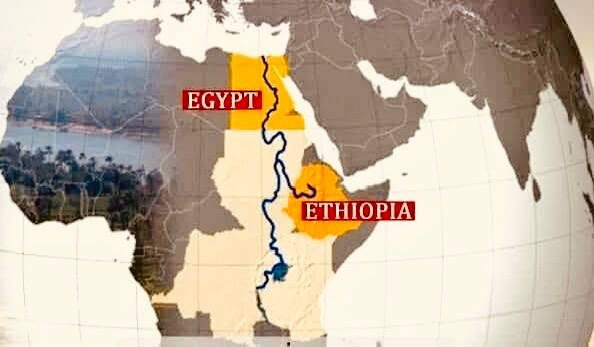

For millennia, the Blue Nile has cascaded from the Ethiopian Highlands, carrying more than 80 percent of the Nile River’s silt and volume downstream through Sudan and into Egypt. Today, that natural bounty totals roughly 84 billion cubic meters of water annually the lifeblood of two downstream nations. Yet under colonial-era treaties from 1929 and 1959, Ethiopia, which contributes the overwhelming share of the flow, received no allocation or compensation. The Grand Ethiopian Renaissance Dam (GERD) has already shifted the power balance. Now imagine a bolder step: what if Addis Ababa began charging Sudan and Egypt for the water that crosses its borders?
This is no longer pure speculation. Upstream nations worldwide are increasingly asserting sovereign rights over resources that flow outward. Ethiopia could frame the demand not as a blockade but as fair compensation for watershed maintenance, reforestation, and the opportunity cost of forgoing its own full agricultural and hydropower development. The question is no longer whether such a claim could arise, but what precedents support it—and what it would actually cost the recipients.
Real-World Precedents: Downstream Pays Upstream Trans-boundary rivers rarely flow for free when economics and sovereignty collide. Two clear examples illustrate how receiving nations already compensate upstream providers. In Southern Africa, the Lesotho Highlands Water Project delivers billions of cubic meters from Lesotho’s mountains to South Africa’s industrial heartland. Under a 1986 treaty, South Africa pays Lesotho royalties—currently around $200–300 million annually for the water transferred. The payments, which represent up to 15 percent of Lesotho’s government revenue, cover not just construction but ongoing resource value. Johannesburg and Pretoria receive reliable, high-quality water; Lesotho gains revenue and hydropower. It is a textbook case of downstream payment for upstream flow.
In Southeast Asia, Singapore has long purchased raw water from Malaysia’s Johor state. Under 1961–1962 agreements still in force, Singapore pays a nominal 3 Malaysian sen (roughly 0.7 U.S. cents) per 1,000 gallons of raw water drawn from Malaysian rivers. In return, it supplies treated water back to Johor at a higher rate. Though the price is modest, the principle is unambiguous: the downstream city-state compensates the upstream supplier for the resource itself, not merely infrastructure. Malaysia retains sovereignty and revenue; Singapore secures its supply.These arrangements prove that water markets can function across borders when parties recognize mutual dependence. Ethiopia could cite them to argue that the Nile is no different: the Ethiopian Highlands act as a natural reservoir, filtering and delivering 84 billion cubic meters downstream each year at no charge.
How Much Does It Cost to Receive 84 Billion m³ of Nile Water for Free? The economic subsidy is staggering. One way to quantify it is through the replacement cost of obtaining equivalent freshwater elsewhere. Large-scale seawater desalination, the most viable alternative for arid nations, currently costs between $0.50 and $1.50 per cubic meter for major plants, depending on energy prices and scale. At a conservative $0.80 per cubic meter, providing 84 billion cubic meters via desalination would require roughly $67 billion annually more than the entire annual defense budgets of many mid-sized economies and a sum that would dwarf Egypt’s current agricultural output.
A more direct valuation uses the economic productivity of irrigation water itself. Recent studies by the International Water Management Institute (IWMI) across the Nile Basin estimate the marginal value of irrigation water at $0.03–0.37 per cubic meter, depending on the crop. Vegetables and perennials command the higher end; staple grains the lower. Applying a midpoint of roughly $0.10 per cubic meter yields an annual direct economic value of about $8.4 billion. This figure captures only on-farm returns; it excludes the broader multiplier effects food processing, exports, employment for millions, and urban water supply—that support Egypt’s agriculture sector (approximately 11–14 percent of GDP) and Sudan’s economy. In short, the “free” Nile water underpins tens of billions in annual output and food security for more than 150 million people.
These numbers explain why downstream governments have historically treated the flow as an inviolable right. Yet they also reveal the leverage upstream nations now possess. A modest Ethiopian levy even 1–2 U.S. cents per cubic meter would generate $840 million to $1.68 billion yearly for Addis Ababa while remaining far below the downstream replacement cost or productivity value.
Geopolitical and Practical Realities-Such a demand would undoubtedly trigger fierce negotiations. Egypt and Sudan could counter with claims of historic rights, investment in downstream infrastructure, or threats of reduced trade and investment. International law under
the 1997 UN Watercourses Convention emphasizes “equitable and reasonable utilization,” a flexible standard that increasingly favors upstream development. The GERD negotiations have already shown that power has shifted; a payment demand would simply monetize that shift. Critics might warn of conflict, but precedents suggest otherwise. The Lesotho–South Africa and Malaysia–Singapore deals demonstrate that clear financial agreements can stabilize relations rather than inflame them. Water, after all, is becoming the new oil scarce, essential, and increasingly priced. Ethiopia has invested billions in the GERD and watershed protection. Asking downstream beneficiaries to share that burden is not radical; it is rational resource economics.
In the end, the Nile’s future may hinge less on who controls the tap than on who pays for the water that flows from it. If Ethiopia formalizes a payment mechanism, it could pioneer a new model of transboundary water diplomacy—one in which every drop carries a price tag that reflects its true value to those who receive it. The river that once united three nations in uneasy silence might yet bind them in pragmatic partnership. Whether that partnership arrives through cooperation or confrontation will depend on how seriously the downstream states weigh the hidden cost of water they have long taken for granted.