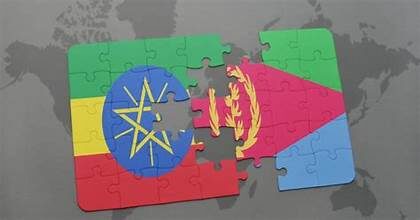
Each week, the drums of war seem a little louder between Ethiopia and Eritrea.
In the latest round, Addis Ababa accused Asmara of territorial violations and backing armed groups.
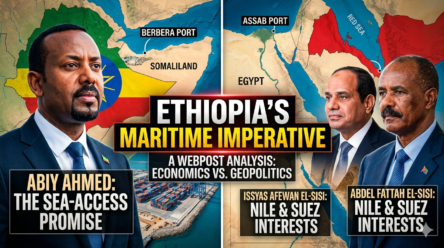
A week ago, it was Isaias in Cairo, a five-day working visit with President Abdel Fattah el-Sisi that showcased tighter Eritrea–Egypt coordination.
That’s the temperature these days.
But the pattern is older and it keeps circling back to one constant: Isaias Afwerki.
This phase did not begin over the old argument at Assab.
It began when Ethiopia signed an MOU with Somaliland for sea-access in January of 2024.
Mogadishu rejected the deal as a violation of its sovereignty.
In the weeks that followed, Eritrea aligned with Somalia and Egypt as an axis of resistance against Addis Ababa and declared military and diplomatic support to Somalia
Not over its border with Ethiopia, not over Assab. Over a deal with Somaliland.
Turkey later helped cool Ethiopia–Somalia tensions, but the geometry remained, and Eritrea doubled down against Ethiopia.
So the question writes itself:
why does Asmara mobilize when Ethiopia moves to formalize access elsewhere, away from Eritrea?
Isais’s recent reactions echoes a long-standing habit.
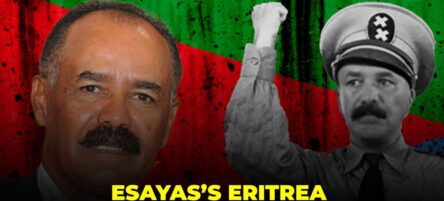
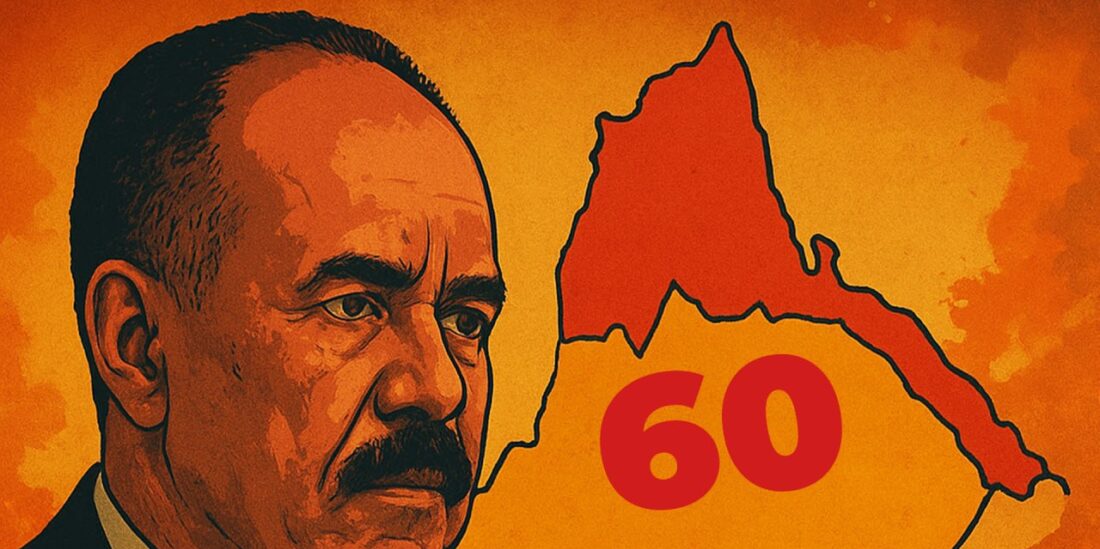
For nearly 60 years, his relationship with Ethiopia has been defined by confrontation and war across radically different governments in Addis Ababa.
He started his journey in the 1960s as a fighter against the imperial state that had absorbed Eritrea. His war continued through the 1974 Marxist revolution that overthrew the monarchy and abolished the empire. Through the Derg years, Isaias fought alongside the TPLF until the regime collapsed in 1991 and Eritrea became independent in 1993.
There was a short peace from 1993 to 1998.
But old habits die hard.
In 1998 Isais ignites a two years bloody boarder war with his former comrades, the TPLF, over border demarcation issue.
What makes the pattern unmistakable is what happens under leaders who, on paper, should have been easiest to work with. The TPLF led EPRDF government that midwifed Eritrea’s independence; The successor that kept state-to-state recognition intact; And later Abiy Ahmed, who not only accepted Eritrea’s sovereignty but signed a peace declaration in 2018 and reopened the skies.
Even in those seasons, confrontation returns.
The 2018 thaw lasts roughly two years before Eritrean forces fight inside Ethiopia during the Tigray war. But when the Pretoria agreement ended that conflict and relations soured again.
Across monarchs, Marxist revolutionaries, Ethnic federalists, and reformers in Addis, the rhythm from Asmara’s leader is strikingly consistent.
Ethiopia’s leaders and ideologies may change; but Isais’s war against Ethiopia will not.
In the last 6 decades, Isais has only been at peace with Ethiopia for only 6 years.
So what has 6 decades of fighting brought Eritreans?
Inside Eritrea, the picture is bleak.
Power is centralized.
National service is effectively indefinite.
Young people leave in large numbers.
Rights groups continue to report arrests, abuses, and discrimination
More importantly, the economy is small and stagnant.
As of 2024, Eritrea’s GDP is roughly $2.9 billion. Gross National Income per capita is about $650.
Ethiopia, by comparison, sits near $174 billion in GDP, with a Gross National Income per capita around $1,020.
For ordinary Eritreans, the “peace dividend” never arrived.
And Isais’s entire political career is built on mobilization against a failed Ethiopia.
A stable and prosperous Ethiopia weakens that narrative.
A tense, war torn Ethiopia sustains it.
Set the present against that logic.
Isaias Afwerki’s system depends on permanent mobilization, three decades of indefinite national service, a wartime economy, and politics without elections.
A sustained confrontation with Ethiopia helps explain all of it.
It justifies the economic hardships, security controls, and the absence of normal political life.
That’s why today’s lineup matters. Ethiopia seeks predictable sea access.
Eritrea aligns with Egypt and raises pressure on Addis Ababa.
The issue is not only ports, it’s narrative.
A stable, growing Ethiopia weakens the case for permanent emergency in Asmara.
A tense, militarized Ethiopia keeps it alive.
In the end, dividing people with shared history and culture along colonial borders for short-term political gain is as shortsighted as it is corrosive.
It hollows out economies, fuels flight, and locks the Horn into cycles of crisis that solve none of its real problems.