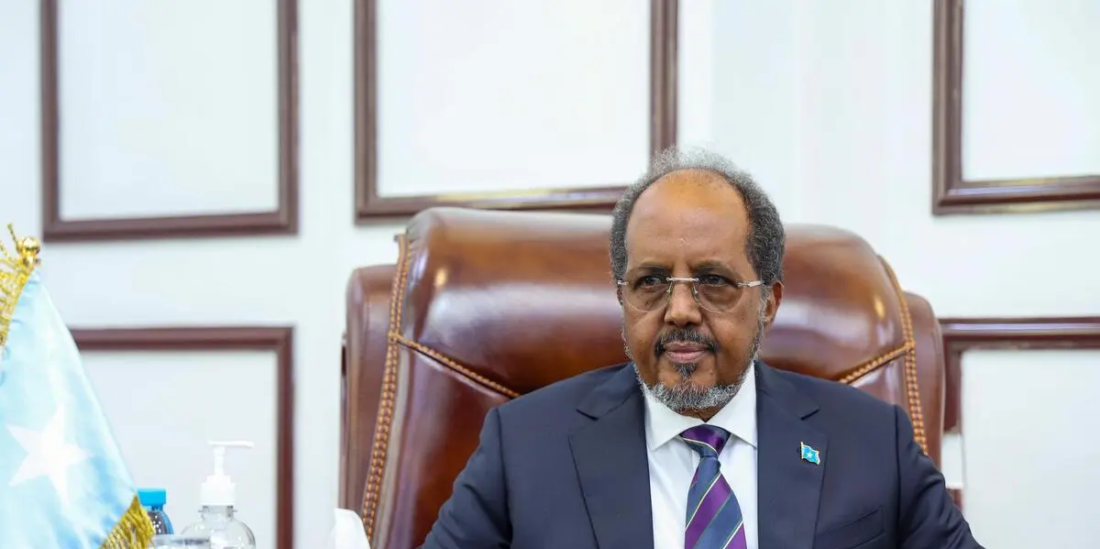
In early July 2026, President Hassan Sheikh Mohamud’s government announced yet another “new phase” in the fight against Al-Shabaab, the fourth such rhetorical reset since he declared “total war” in August 2022. The pattern is now familiar: bold promises, initial gains, and eventual reversal. But the real reason for this endless cycle has little to do with battlefield bravery or Al-Shabaab’s resilience. It lies in Villa Somalia itself a political center at war with its own federal member states and contested even over who is president. Somalia’s counterinsurgency cannot succeed when the state waging it is fractured from within.
For years, Somalia’s fight against Al-Shabaab has been framed as a military struggle. Today, that view is incomplete. Repeated offensives have shown that clearing territory is possible, but holding and governing it is not. The latest “final offensive” arrives at a moment when Somalia faces not only a powerful insurgency but a constitutional crisis that has paralyzed its political center. This internal rupture may be the single greatest obstacle to defeating Al-Shabaab. Regardless of tactical gains on the ground, Somalia’s geopolitical and security future remains clouded by its inability to unify its own house.
Mohamud’s offensive began with genuine promise. Clan militias in Hirshabelle and Galmudug, the Ma’awisley, had already begun turning against Al-Shabaab’s taxation and forced conscription. Backed by Turkish-trained units, U.S. and Turkish airpower, and international support, the Somali National Army recaptured significant territory in central Somalia.
Yet the pattern repeated: the government could clear but not hold. Coordination with clan militias broke down, recruits deserted, and gains evaporated. By early 2026, Al-Shabaab had launched its Shabelle Offensive, retaking much of Hiraan and Middle Shabelle, and pushing close to Mogadishu. The insurgency now controls roughly 30 percent of territory, rings the capital with checkpoints, and maintains a managed conflict that neither side can decisively win.
The core issue is no longer just Al-Shabaab’s adaptability. It is Somalia’s political class, which can no longer present a unified front. In March 2024, parliament extended presidential and parliamentary terms, pushing Mohamud’s mandate to May 2027. The opposition rejected this, and when the original term ended in May 2026, they declared him illegitimate.
The Somali Salvation Forum, uniting former presidents, prime ministers, and key federal member states like Puntland and Jubaland, now forms the strongest opposition coalition in years. Puntland and Jubaland have suspended relations with Mogadishu and built independent security ties with
Ethiopia and Kenya. This fragmentation has created parallel security architectures precisely when coordinated action against Al-Shabaab is most needed.
Counterinsurgency doctrine demands “clear, hold, build.” Somalia has repeatedly demonstrated the ability to clear territory but lacks the political cohesion to hold and govern it. Treating federal member states as subordinates rather than essential partners has undermined every major offensive.
The AUSSOM transition has further complicated the situation, with thinning international support and a government too distracted by its succession crisis to manage security handovers effectively. The constitutional dispute and the insurgency are not parallel stories, they are causally linked. Political paralysis deepens the legitimacy gap that Al-Shabaab exploits.
Al-Shabaab is not on the verge of capturing Mogadishu, nor is the Somali National Army defeated. But the war has settled into a structural equilibrium sustained by Mogadishu’s self-inflicted divisions.
Breaking this cycle requires three things: a genuine, internationally guaranteed resolution of the succession dispute that brings Puntland and Jubaland back as partners; an honest approach to electoral reform that does not entrench incumbency during active conflict; and a sustained hold-and-build strategy that treats regional administrations as the foundation of any successful campaign, not rivals to be managed or bypassed.
Absent these steps, the July 2026 “new phase” will likely follow the same arc as its predecessors: initial momentum followed by stall and reversal. Somalia has the military capacity to hurt Al-Shabaab. What it lacks is the political unity to convert those tactical successes into lasting governance and stability.
The latest offensive may generate headlines, but Somalia’s tragedy runs deeper. It is not that the state lacks soldiers willing to fight, it is that the political center has not yet found a way to survive its own internal contest for power long enough to finish what its soldiers keep starting. Until Villa Somalia resolves its internal war, victory over Al-Shabaab will remain elusive.