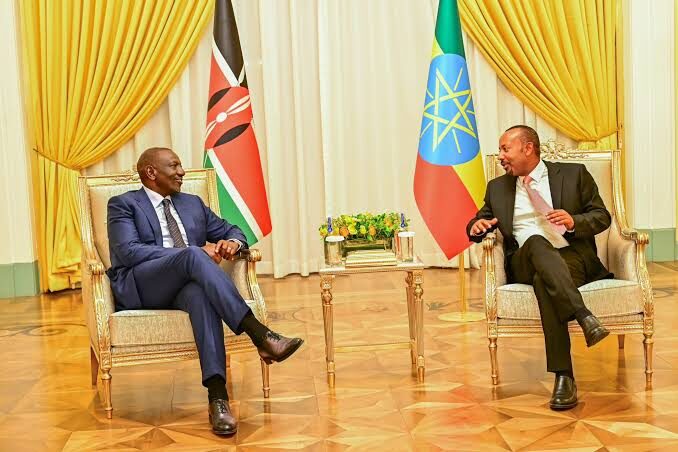
In a region defined by conflict and external interference, two leaders met not just as neighbors, but as architects of a new order. Their promise: to build stability from within and reclaim the Horn of Africa’s future from foreign powers. On December 23, 2025, Kenyan President William Ruto arrived in Addis Ababa for a working visit hosted by Ethiopian Prime Minister Abiy Ahmed.
Framed by both as a meeting of “historical brothers,” the session sought to accelerate economic integration and present a united front on regional security. Coming just days after a new cross-border trade deal, this meeting signals a deliberate and strategic alignment between East Africa’s two most influential powers at a time of profound regional uncertainty.
This analysis unpacks the visit’s agenda: the drive for economic sovereignty, the shared security challenges, and the potential emergence of a powerful new bloc capable of defining the Horn’s future.
The Brotherhood Narrative Personal Diplomacy as Political Strategy
The visit was steeped in a rhetoric of fraternity and shared destiny, a calculated move to transcend historical complexities and bureaucratic inertia.
Prime Minister Abiy’s description of the talks as “deep, historical, and brotherly” and the recent signing of a simplified cross-border trade agreement are pillars of a deliberate strategy. This narrative of kinship serves a dual purpose: it mobilizes domestic support by appealing to shared culture and history, and it projects a unified image to the outside world.
In a region where alliances are often transactional and fragile, the conscious cultivation of personal chemistry between Abiy and Ruto; both positioning themselves as next-generation, reformist leaders aim to create a durable partnership resistant to external spoilers.
From Border Markets to Continental Corridors
At its core, the alliance is driven by a pressing economic logic, with both nations seeking to unlock growth hampered by geography and bureaucracy. The newly simplified trade agreement targets the vital informal sector, which constitutes up to 40% of cross-border commerce.
By formalizing and easing the flow of goods like livestock and grains, it directly benefits border communities and builds grassroots support for integration. The larger, strategic vision, however, is anchored in mega-projects like the Lamu Port-South Sudan-Ethiopia Transport (LAPSSET) Corridor.
For landlocked Ethiopia, this represents a critical alternative gateway to the sea beyond Djibouti. For Kenya, it secures a guaranteed flow of cargo and positions the country as the undisputed commercial hub for the interior.
The Security Consensus A United Front in a Fractured Region
Faced with common threats, Addis Ababa and Nairobi are aligning their security policies to promote “African-led solutions.” The Horn of Africa is besieged by interconnected crises: the Al-Shabaab insurgency in Somalia, civil war in Sudan, and internal ethnic conflicts.
Both Ethiopia and Kenya have borne the brunt of these instabilities, contributing troops to peacekeeping missions and facing direct security spillovers. Their unified call for regional dialogue and stability is a direct challenge to the piecemeal, often competing interventions of foreign powers like the UAE, Turkey, and Gulf states.
By presenting a joint front, they aim to steer mediation efforts particularly regarding tensions between Ethiopia and Somalia over the Somaliland deal—and bolster their own leverage against transnational terror groups.
The Geopolitical Calculus Balancing Acts and Strategic Autonomy
This burgeoning partnership is also a deft maneuver in the global arena, where both nations navigate a multipolar world. Ethiopia and Kenya are nodes of interest for all major powers: China funds infrastructure, the U.S. maintains security partnerships, and Gulf States invest strategically.
The Abiy-Ruto axis is not about rejecting these relationships but about managing them from a position of greater strength and cohesion. By deepening ties with each other, they reduce their individual vulnerability to pressure and create a combined market more attractive to investors.
Furthermore, as Ethiopia chairs the African Union and Kenya advocates for institutional reform within it, their collaboration amplifies their voice in setting the continent’s agenda, championing a vision of sovereignty and integration led from within Africa.
Ruto’s visit was more than a diplomatic meeting; it was the blueprint for a potential new axis of power in the Horn of Africa. By intertwining economic futures and security strategies, Ethiopia and Kenya are attempting to build a pole of stability that can withstand both internal fractures and external manipulation. The success of this project hinges on translating brotherly rhetoric into concrete results, tangible trade growth, seamless infrastructure, and effective joint crisis management. If they succeed, they could redefine the region’s trajectory. If they fail, the Horn’s fragile order may succumb to the very forces of division they seek to overcome.