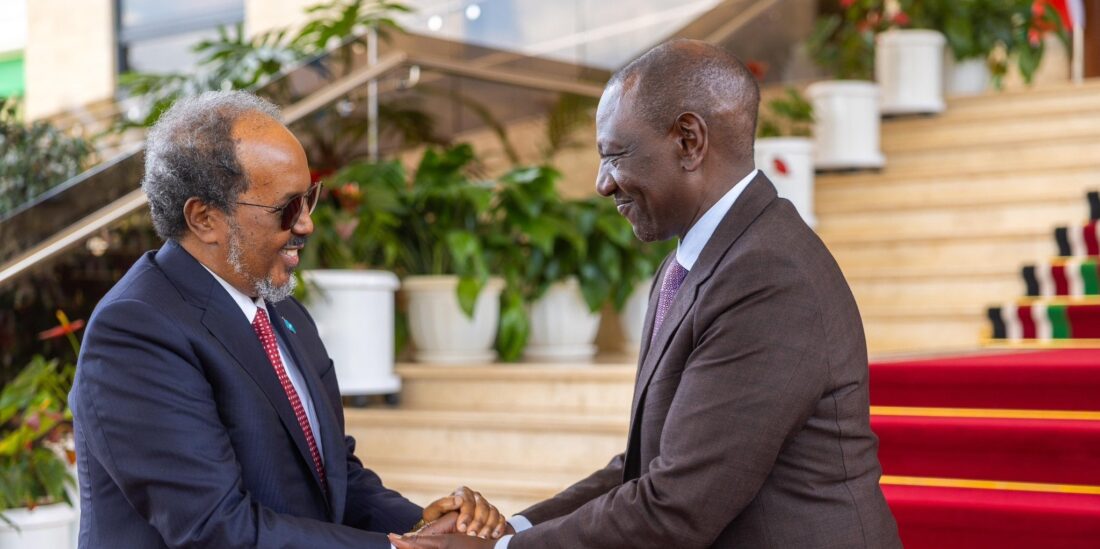
The guns in Mogadishu have not fallen silent, but the diplomatic scramble has shifted westward.Somali President Hassan Sheikh Mohamud has made an unannounced visit to Kenya, holding talks with President William Ruto in Narok. While the official readout emphasized trade, bilateral relations and regional integration the timing of this trip speaks volumes about the acute pressures bearing down on the Somali government.
Constitutional crises, internal rebellion and the looming expiration of critical international funding have created a perfect storm. As AUSSOM troop-contributing countries voice concerns over financial constraints and political uncertainty, President Hassan Sheikh’s sudden journey to Nairobi suggests a leader racing to reassure his neighbors and secure the lifelines necessary for his state’s survival.
On the surface, the meeting on June 22 appeared to be standard diplomatic fare. According to Villa Somalia, the two leaders discussed strengthening bilateral relations and the importance of continued cooperation for peace and development in the Horn of Africa.
However, the context could not be more dire. President Ruto had just returned from the G7 summit in France, where he likely encountered international concern over Somalia’s political trajectory. Kenyan media reports suggest that East African leaders have been pushing for a “genuine political settlement” in Somalia to prevent disruptions to support for the African Union Support and Stabilization Mission in Somalia (AUSSOM).
The subtext of the Narok talks is likely dominated by two issues. The first is the financial viability of AUSSOM. With troop-contributing countries facing “growing financial constraints,” there is a real risk that the mission’s ability to sustain operations against Al-Shabaab could be compromised. The second is the internal political violence in Mogadishu, which Ruto himself has expressed “worries” about, citing uncertainty over the status of federal institutions.
The Somali President is facing mounting political and security pressures. The constitutional amendment extending his term has not only fractured the political opposition into a military confrontation but has also alarmed international partners who fund his security apparatus.
The trip to Kenya appears to be an attempt to reassure a key regional stakeholder. Kenya is a major trading partner and a vital backer of AMISOM/AUSSOM. By appearing alongside Ruto and discussing “economic growth” and “regional integration,” President Hassan Sheikh seems to be trying to project an image of normalcy and control.
However, this charm offensive is undercut by the realities on the ground. As one former prime minister has alleged, government forces are using heavy weapons and drones in civilian areas and there are accusations of war crimes. The “lasting consequences” warned by the US Embassy are not abstract they relate directly to whether countries like Kenya will continue to bankroll a government perceived as using its military apparatus against political rivals.
President Hassan Sheikh’s visit to Nairobi is a recognition that his legitimacy is not solely determined in Mogadishu. It is also adjudicated in the regional capitals and Western chanceries that keep the Somali state financially afloat.
The Kenyan media reports that leaders are pushing for a political settlement. This is a diplomatic euphemism for what the US Embassy previously spelled out the actions of the current administration are jeopardizing security and unity. The Narok meeting may have reinforced the language of partnership, but the fundamental question remains.
Can President Hassan Sheikh reconcile his political survival with the demands of international partners who see the ongoing conflict as a threat to the entire region? The answer to that question will determine whether Somalia’s future is decided in a conference room in Narok, or in the bombed-out streets of Howlwadaag.