

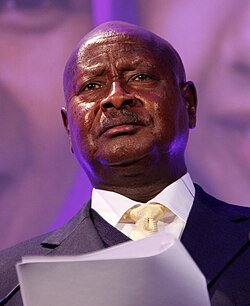
Museveni’s dramatic declaration revives colonial-era wounds and tests the limits of regional unity.
A fiery speech in Mbale City has sent ripples of tension across East Africa after Ugandan President Yoweri Museveni declared that Uganda is entitled to access the Indian Ocean and warned that denying this right could lead to conflict.
The remarks, delivered before thousands of supporters, have triggered a diplomatic scramble from Nairobi to Dodoma, reigniting debates about colonial borders, regional economic imbalances, and the fragile cohesion of the East African Community (EAC).
Colonial Legacies and Old Wounds
Museveni’s argument rests on a historical grievance: that Uganda’s landlocked fate is the product of arbitrary colonial boundaries drawn by British and German administrators during the Scramble for Africa.
Uganda, carved without access to the ocean in the late 19th century, has since been economically tethered to its coastal neighbors—particularly Kenya. Today, an estimated 80% of Ugandan trade depends on the port of Mombasa.
“The colonial boundaries were drawn for administrative convenience, not economic logic,” says Dr. Sarah Nalwoga, a historian at Makerere University. “Museveni is tapping into a genuine grievance shared by many African nations boxed in by borders drawn in European capitals.”
Ugandan officials have long argued that this geography functions as an “economic straitjacket,” with bureaucratic delays and port congestion in Mombasa costing the country billions annually.
Regional Tensions Exposed
The timing of Museveni’s claim adds pressure to an already fragile geopolitical landscape. The East African Community, an ambitious bloc seeking economic and political integration has recently struggled with internal disagreements, security concerns, and unequal development.
Kenya responded cautiously. Foreign Affairs Cabinet Secretary Musalia Mudavadi reaffirmed Kenya’s commitment to “facilitating port access under international law,” even as diplomats quietly worked to contain rising tensions.
Public reaction in Kenya, however, was far less diplomatic: social media users mocked Museveni as an “Ocean Bandit,” while several former officials demanded an immediate retraction and apology.
Museveni’s demand for regional talks on sea access highlights a long-standing imbalance within the EAC: coastal states Kenya and Tanzania hold natural logistical advantages over landlocked Uganda, Rwanda, Burundi, and South Sudan. Addressing this disparity may require deeper integration than member states have so far been willing to pursue.
Economic Pressures Mount
Beneath Uganda’s assertive rhetoric is a stark economic reality. The country’s $50-billion economy remains deeply vulnerable to external chokepoints.
Uganda pays roughly 20% in port-related fees and has faced frequent disruptions due to political tensions, customs disputes, and delays on the Northern Corridor through Kenya. The stalled Standard Gauge Railway extension, which was meant to slash transport time and cost, has only amplified frustration.
“The economic argument is undeniable,” says regional trade analyst Michael Otieno. “When access to your nearest port relies on another country’s stability and goodwill, every delay becomes an existential threat.”
Uganda has made attempts to diversify its options, including shifting parts of its oil export strategy toward Tanzania’s port of Dar es Salaam via the $3.5-billion East African Crude Oil Pipeline. But these alternatives have yet to replicate the efficiency or reliability of the Mombasa route.
Diplomacy or Escalation?
While Museveni’s warning invoked the possibility of conflict, analysts say outright war remains improbable. Uganda’s military, though experienced, is overstretched from operations in Somalia and the Democratic Republic of Congo and would face formidable opposition from both Kenya and Tanzania.
Instead, many observers interpret the speech as strategic provocation.
“It’s diplomatic shock therapy,” one regional diplomat said privately. “He’s forcing an issue that the EAC has avoided for decades.”
The best-case scenario would see the crisis push the EAC toward long-discussed reforms: guaranteed port access frameworks, revived regional infrastructure projects, and genuine progress on the long-promised East African Federation.
The worst-case scenario could deepen rifts, spark trade retaliation, and invite external powers to exploit regional divisions.
A Watershed Moment for East Africa
Museveni’s unexpected claim to the Indian Ocean has done more than stir controversy, it has reignited fundamental debates about colonial borders, regional equity, and the future of East African integration.
His message is clear: landlocked nations cannot afford to be constrained by inherited geography, and the EAC must confront this reality or risk fracturing.
Whether this becomes a catalyst for unity or a trigger for division now rests with the region’s leaders.