

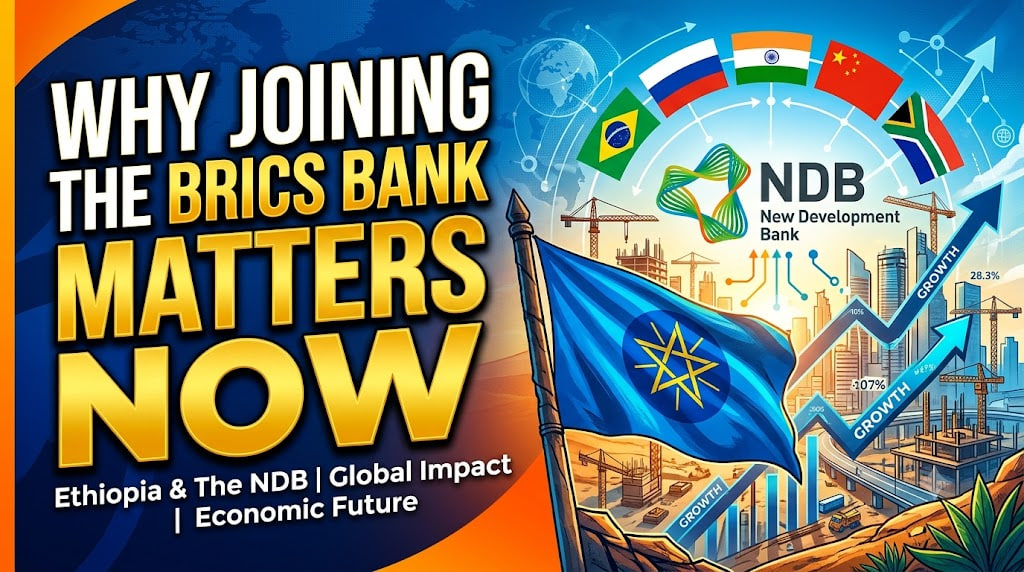
Ethiopia is taking a major step toward reshaping its development strategy by joining the BRICS New Development Bank. With a phased $294.5 million investment, Addis Ababa aims to unlock new infrastructure financing, diversify funding sources beyond traditional lenders, and strengthen its role in the emerging Global South economic order.
Ethiopia is on the verge of a significant financial milestone. The country plans to acquire 2,945 shares in the BRICS New Development Bank (NDB), with each share valued at $100,000, for a total investment of approximately $294.5 million. According to reports, Ethiopia will pay 20% ($58.9 million) upfront, with the remaining 80% spread over 14 installments across 13.5 years. This move, pending parliamentary approval, positions Ethiopia as a member of this multilateral development bank and brings substantial economic, infrastructural, and strategic advantages.
The NDB, established in 2015 by the original BRICS nations focuses on funding infrastructure and sustainable development projects in emerging markets and developing countries (EMDCs). For Ethiopia, membership opens doors to a new pool of capital that is often more flexible and less conditional than traditional sources like the World Bank or IMF.
Ethiopia faces a persistent infrastructure financing gap. The NDB can help bridge this by supporting large-scale projects in transport, energy, water and sanitation, digital infrastructure, and agriculture. As a member, Ethiopia gains a seat on the NDB board (without veto powers for any single country) and can directly influence project prioritization. This is particularly valuable for a nation pursuing ambitious goals like becoming a middle-income country through industrialization and the African Continental Free Trade Area (AfCFTA) integration.
Unlike some Western-led institutions, the NDB emphasizes demand-driven, nationally owned projects with fewer policy conditionalities. This allows Ethiopia to align loans more closely with its Homegrown Economic Reform Agenda, focusing on sectors like renewable energy, industrial parks, and urban development without external dictates on governance or economic policy.
One of the clearest benefits is diversification away from over-reliance on traditional donors and dollar-denominated debt. The NDB has pioneered local-currency lending in member countries, reducing exchange rate risks. For Ethiopia, which has faced foreign currency shortages and debt servicing pressures, this could stabilize macroeconomic conditions and ease balance-of-payments strains.
Membership also broadens Ethiopia’s access to global capital markets through the NDB’s strong credit rating and ability to mobilize resources. As Ethiopia’s economy grows—driven by manufacturing, agriculture modernization, and services—NDB financing can support export-oriented industries and job creation, addressing unemployment and poverty reduction.
Ethiopia has prioritized mega-projects such as the Grand Ethiopian Renaissance Dam (GERD), railway networks, industrial zones, and renewable energy expansion. NDB funding aligns perfectly with these priorities. The bank supports climate-smart and resilient infrastructure in line with the UN Sustainable Development Goals (SDGs) and Paris Agreement.
Potential project areas for Ethiopia include:
Energy: Expanding hydropower, solar, wind, and geothermal capacity. Transport, Agriculture, Digital and Social Infrastructure.
By funding these, the NDB can accelerate Ethiopia’s structural transformation, attract more foreign direct investment (FDI), and create multiplier effects across the economy.Legal and Operational PrivilegesUpon membership, the NDB gains the right to own property in Ethiopia and enjoys tax-exempt and customs-exempt status. This facilitates smoother operations, potentially encouraging the bank to establish a regional presence or office, which could bring expertise, technical assistance, and further investment.
Joining the NDB strengthens Ethiopia’s ties with BRICS+ nations, enhancing its voice in global South forums. As one of Africa’s fastest-growing economies and a key player in the Horn of Africa, Ethiopia’s membership signals credibility and opens avenues for technology transfer, trade partnerships, and South-South cooperation. It complements Ethiopia’s full BRICS partnership status and reduces vulnerability to geopolitical shifts in Western-dominated financial systems.
The installment payment structure makes the $294.5 million commitment manageable, allowing Ethiopia to reap benefits while spreading the fiscal burden. Over time, successful NDB-funded projects can improve the country’s creditworthiness, attract more private investment, and support inclusive growth. Challenges remain such as ensuring efficient project implementation, debt sustainability, and governance but the opportunities outweigh the costs for a developing nation seeking autonomous development paths.
In conclusion, Ethiopia’s investment in the NDB represents a forward-looking strategy. It provides not just capital but also strategic autonomy, infrastructure momentum, and stronger global partnerships. As Ethiopia navigates its development journey amid global uncertainties, NDB membership could prove instrumental in building a more resilient, prosperous, and self-reliant economy for generations to come.